To accompany the online exhibition opening on February 8, Cascades and Glacial Landscapes, New clay sculptures by Jeff Shapiro, Joan Mirviss will moderate a discussion with prominent clay artist Jeff Shapiro and ceramic collectors Halsey and Alice North on Jeff's unique journey: from ceramic training in Japan as a young man, through his decades-long evolution into an independent artist creating highly original works that draw from his varied experiences.
The audience is invited to submit questions they may have for Jeff and the Norths, which may be selected for the Q & A portion of the event.
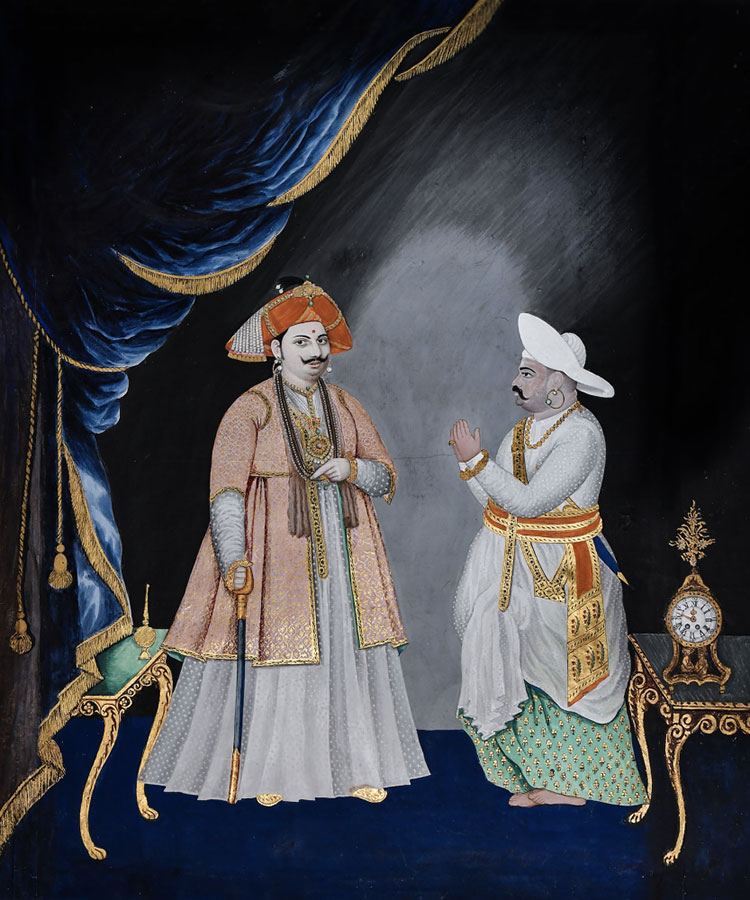
Maharaja Sarabhoji Accompanied by His Minister, Tanjore, Company Style, circa 1790, Opaque water-based pigments with raised gold on board, 23 1/2 x 17 1/4 in. (60 x 44 cm.), Kapoor Galleries
Provenance: Given as a gift to Lady Henrietta Clive (1758-1830) in 1800 by the Maharaja Sarabhoji (r. 1798-1832). Sophus Andreas Bergsøe (1838-1896), Aalborg circa 1880. Thence by descent.
It seems incongruous to include an elaborate European ormolu clock in an Indian Tanjore Company Style painting of Maharaja Sarabhoji Accompanied by His Minister, circa 1790. The maharaja, depicted as a heavily bejeweled figure with an elaborate turban and side-whiskers, stands formally facing outward with the index finger of his left hand pointing downward towards his ceremonial sword, and a minister with pressed palms faces the maharaja awaiting instructions. They are framed on one side by a curtain with gold fringe and tassels and are flanked by two European-style gilt-legged tables. The clock is placed upon one of the tables. The European accoutrements of the room are inspired by European portraiture, and this portrait is painted in a style that developed in the mid-eighteenth century, which catered to the tastes of the British colonials. The raised gold is typical of Tanjore painting.
Maharaja Serfoji II of Tanjore (also known as ‘Sarabhoji,’ r. 1798-1832), the last ruler of the Maratha Bhonsle Dynasty of Tanjore, was installed by the British as the titular head of Thanjavur. He was the adopted son of Maharaja Thulajah. As a young man, he was entrusted to the care of a Danish missionary, Reverend Christian Freidrich Schwartz, who sent him to Madras for his formal education. He enjoyed an excellent relationship with the British after he acknowledged their administration of Tanjore and was then granted sovereignty over the lands surrounding the Fort of Thanjavur as well as a pension (see Archer, Rowell, and Skelton, Treasures from India: The Clive Collection at Powis Castle, London, 1987, p.124; and John Chu, Game of Thrones in an ‘Asiatic World’: Henrietta Clive and Anna Tonelli in British India, National Trust Historic Houses & Collections Annual, 2018, p. 40.).
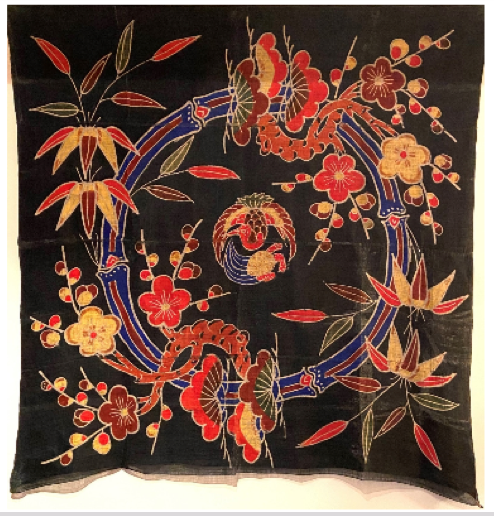
Wrapping cloth (Uchikui) Hemp, stencil and resist dyed, Okinawa, early Showa period, 20th century, David M. Kahn Collection
LIVE ZOOM WEBINAR: COLLECTING MINGEI: THREE PERSPECTIVES
Sunday, February 7, 5 P.M. EST
Japanese folk art and crafts both fall into the collecting category Mingei. This overarching term covers everything from preindustrial crafts to handmade everyday tools and vessels. Discussing their approach on collecting will be Kyoko Utsumi Mimura, Waseda University arts faculty member and former Director of the Mingeikan in Tokyo; Ty Heineken, Joint Director, Studio Japan, in Kingston, New Jersey, and author with his wife, Kiyoko, of Tansu: Traditional Japanese Cabinetry, published by John Weatherhill in 1981, the first cultural overview on the subject in a foreign language; and David M. Kahn, Executive Director of the Adirondack Experience in upstate New York and a JASA board member.
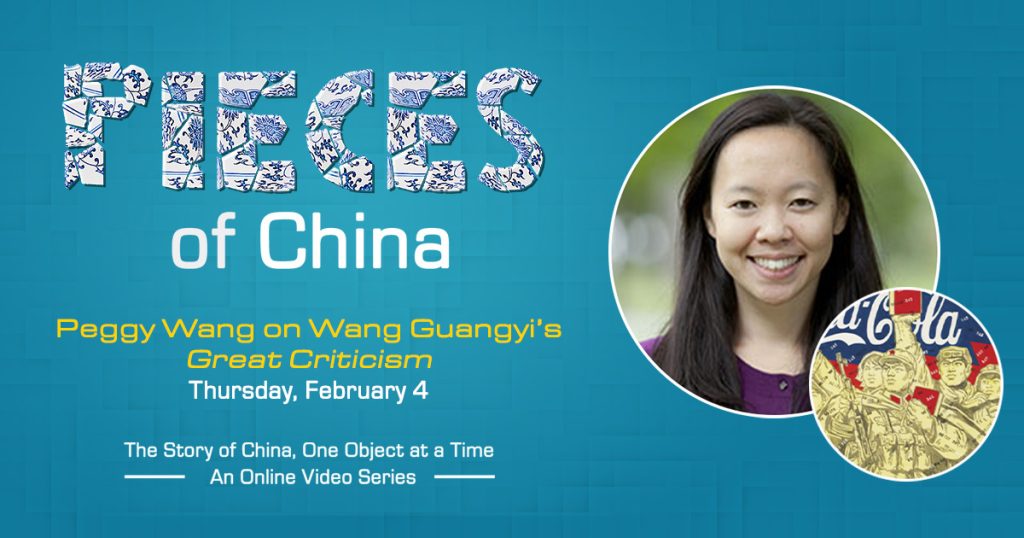
Wang Guangyi’s Great Criticism series, which juxtaposes revolutionary images with the Coca Cola and other western commercial logos, has become an iconic representation of China’s contemporary art movement. The series has been described again and again as a form of subtle political protest. But what did Wang really mean? Do we oversimplify Chinese art? Peggy Wang, author of the new published The Future History of Contemporary Chinese Art, examines China’s most famous “political pop” and challenges the way the art world views Chinese art.
Pieces of China is an online series that tells the story of China, one object at a time. Each live-streamed 15-minute episode features experts, thought leaders, and friends, who will share objects, places, and ideas—personal or culturally significant—that combine to build a unique picture of modern China.
Peggy Wang is associate professor of art history and Asian studies at Bowdoin College. Her research explores how meanings and histories are constructed in light of cultural globalization. Her new book, The Future History of Contemporary Chinese Art, which focuses on methods of interpretation and narratives of agency, speaks to Wang’s inquiries into what it means for histories of contemporary art—and Art History more generally—to be inclusive.
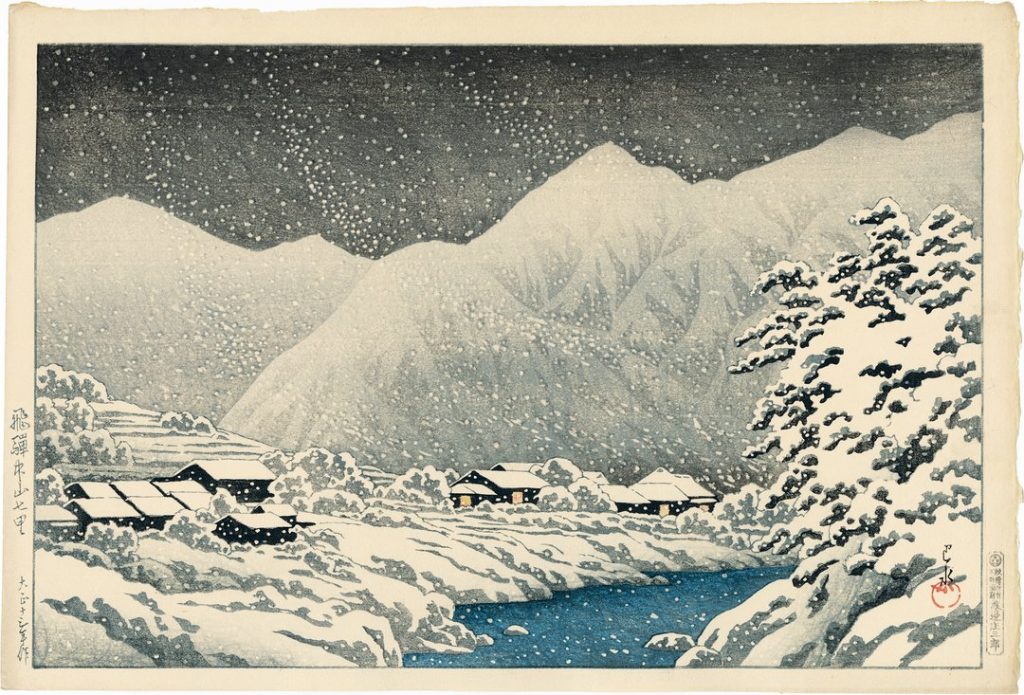
Kawase Hasui (1883-1957) In the Snow, Nakayama Hichiri Road, Hida, dated 1924
KAWASE HASUI: MASTER OF SNOW
Kawase Hasui (1883-1957) is one of the 20th century's most celebrated Japanese landscape shin hanga artists. His genius was in capturing a specific place during a specific season and time of day, creating surprisingly personal scenes that also have universal appeal. The refined techniques of the printers and carvers of the late Taisho and early Showa periods also are the finest of the century. We celebrate the recent storms with a select group of Hasui snow prints, which are some of his most appreciated and sought-after works. Stay tuned: more Hasui works to come!
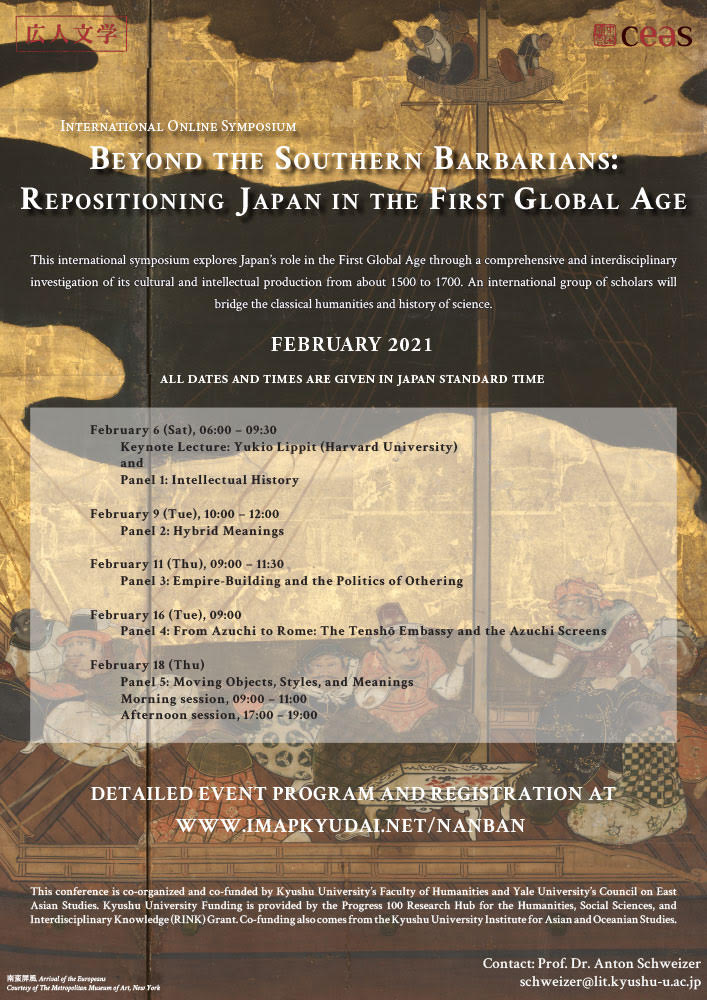
This international symposium explores Japan’s role in the “First Global Age” through a comprehensive and interdisciplinary investigation of its cultural, material, and intellectual production from about 1500 to 1700. The thematic focus lies on transcultural exchange and its related processes, such as shifting taxonomies and iconographies; translation, interpretation, and appropriation; re-evaluation and re-interpretation; and the construction of social biographies of moving objects.
A key goal is to advance the discussion beyond prevalent yet limiting models such as, for instance, a narrowly conceived, bilateral exchange between Iberia and Japan. Instead, this symposium aims to complicate and deepen our understanding of the complex amalgam of actors and trajectories of exchange by exploring the pre-existing cultural, political, and economic spaces of an “East Asian Mediterranean;” transfer routes via South and South-East Asia as well as the Americas; diasporas and hybrid communities; continuities, ruptures, and innovations in the conceptualization of self and other; and processes of mapping, labeling, and appropriation.
Researchers from top institutions around the world and from a wide disciplinary range will convene to bridge the classical humanities (history, art history, literature, religious studies, intellectual history) and history of science (astronomy, cartography). The aim is to find a balance between established and emerging scholars as well as between the academic cultures of Japan, Europe, and the Americas.
This symposium is co-organized and co-funded by Kyushu University’s Faculty of Humanities and Yale University’s Council of East Asian Studies.
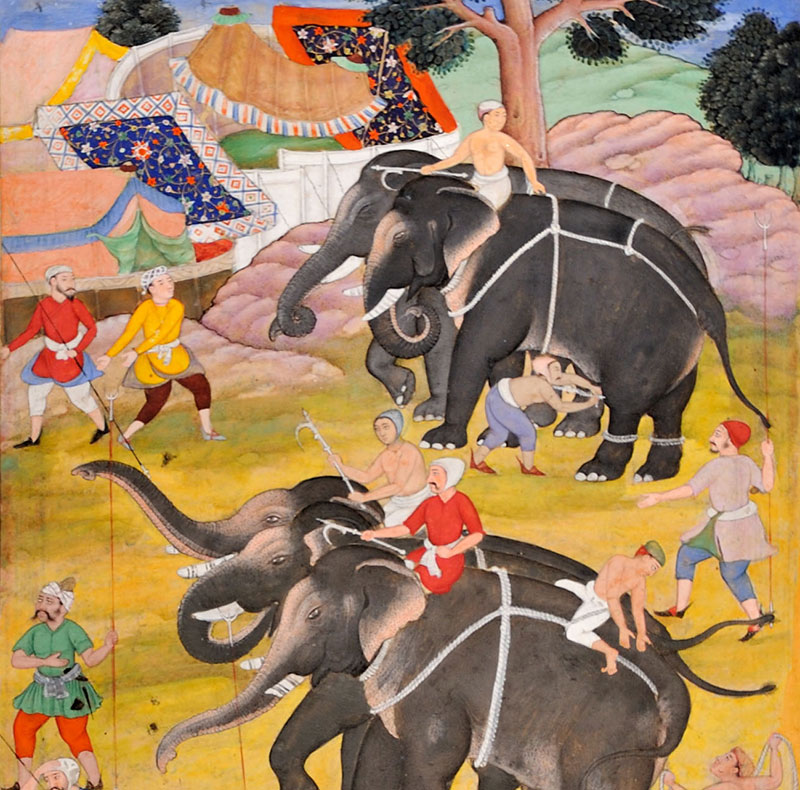
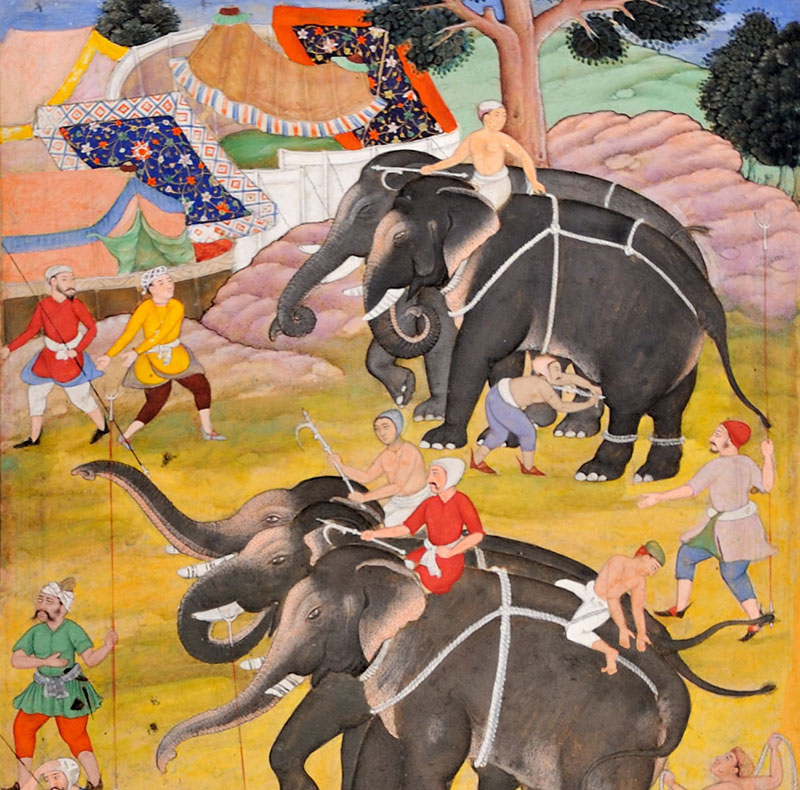
A party of hunters returning to camp, Leaf from the British Library-Chester Beatty Library Akbarnama, Mughal India, 1603-04 9 by 5 in., 22.9 by 12.7 cm., painting; Image courtesy Oliver Forge & Brendan Lynch Ltd.
New York: Continuing its lively series of virtual panel discussions, Asia Week New York is delighted to present Tales in Connoisseurship: Appreciating Indian Painting with an all-star panel of specialists including Brendan Lynch, co-director of London-based Oliver Forge & Brendan Lynch Ltd., Marika Sardar, PhD, Curator, The Aga Khan Museum in Toronto, and collector Gursharan Sidhu, PhD. These renowned experts will reveal their personal journeys of connoisseurship within the rich and wonderful world of Indian paintings. The presentation will be held on Thursday, January 28 at 5:00 p.m. (EST), 2:00 p.m. (PST). To reserve, visit: https://zoom.us/webinar/register/WN_ksNoWmVSRzagAi5UYrouCg
Says moderator Anu Ghosh-Mazumdar, Senior Vice President & Head of the Indian & Southeast Asian Art Department at Sotheby’s: “Any collecting category requires three lynchpins to thrive and survive – the collector, the curator and the dealer. We are excited to host this panel which brings together these three key elements, showcasing the synergy of interest, curiosity, discipline, scholarship and commerce in forging connoisseurship.”
About the Experts: Anu Ghosh-Mazumdar has been with Sotheby’s since 2003 and was appointed Head of the Sotheby’s Indian & Southeast Asian Art department in 2011. A specialist for both Classical as well as Modern Indian art, she plays a key role in securing major consignments for Sotheby’s sales of Indian, Himalayan & Southeast Asian Art and Modern and Contemporary South Asian Art held in Asia, Europe and the United States. Landmark sales of Indian and Himalayan art for which she recently provided her expertise include: Indian paintings from the Estate of Dr. Claus Virch (2015 & 2016), The Richard R. and Magdalena Ernst Collection of Himalayan Art (2018), and most recently an historic collection of Mughal and Ottoman textiles from the Estate of H. Peter Stern, co-founder of the Storm King Art Center (2020). Ms. Ghosh-Mazumdar has lectured widely on the South Asian art market at both private and public international forums.
Brendan Lynch is a London-based dealer in Indian and Islamic Art. He spent twenty years at Sotheby’s, working in London and New York, and left in 1997 as Director of the Islamic and Indian Art Department. In 1998 he set up, with former colleague Oliver Forge, an art consultancy dealing and acting as agents in Indian and Islamic Art and Art of the Ancient World. The company has exhibited Indian Court Paintings annually at Asia Week New York since 2009.
Gursharan S. Sidhu holds degrees from the Indian Institute of Technology (IIT Madras) and Stanford University. After a long career in academia and the technology sector at Apple Inc. and Microsoft, he now focuses on his lifelong passion for the arts of India. Currently, Sidhu is a member of the Board of Trustees of the Seattle Art Museum, as well as on the Acquisitions Committee of the Asian Art Museum of San Francisco and the Board of Trustees of the Museum for Art and Photography (MAP), in Bengaluru. He served as co-chairman of the Board of the Smithsonian Institution’s Freer and Sackler Galleries in Washington DC. He and his wife collect traditional and vernacular paintings from India and art from Mexico.
Marika Sardar is Curator at the Aga Khan Museum in Toronto. She previously worked at the Museum of Islamic Art in Doha, the San Diego Museum of Art, and the Metropolitan Museum of Art. Her major exhibitions include: Interwoven Globe (2013), focusing on the worldwide textile trade from the 16th-18th century; Sultans of Deccan India, 1500-1750 (2015), examining the artistic traditions of the Muslim sultanates of central India; and Epic Tales from Ancient India (2016), looking at narrative traditions and the illustration of texts from South Asia. Ms. Sardar, along with John Seyller and Audrey Truschke, has recently published the Mughal-era Persian-language manuscript of the Ramayana in the collection of the Museum of Islamic Art.
About Asia Week New York The collaboration of top-tier international Asian art galleries, the six major auction houses, Bonhams, Christie’s, Doyle, Heritage Auctions, iGavel, and Sotheby’s, and numerous museums and Asian cultural institutions, Asia Week New York is a week-long celebration filled with a non-stop schedule of simultaneous gallery open houses, Asian art auctions as well as numerous museum exhibitions, lectures, and special events. Participants from Great Britain, India, Italy, Japan, and the United States unveil an extraordinary array of museum-quality treasures from China, India, the Himalayas, Southeast Asia, Tibet, Nepal, Japan, and Korea.
Asia Week New York Association, Inc. is a 501(c)(6) non-profit trade membership organization registered with the state of New York. For more information visit www.AsiaWeekNewYork.com @asiaweekny #asiaweekny
About Songtsam, Presenting Sponsor Founded by Baima Duoji, in 2000, the Songtsam Group is the only collection of luxury Tibetan-style retreats found across the Tibetan Plateau that offers guests sophisticated elegance, refined design, modern amenities, and unobtrusive service in places of natural beauty and cultural interest. With his long-standing and strong interest in Chinese, Himalayan, and Southeast Asian art, Mr. Baima started collecting art long before he established his first hotel, Songtsam Lodge Shangri-La, which is located next to the famous Songzanlin Monastery in Shangri-La. Many of the properties across the Tibetan plateau are decorated with Mr. Baima’s personal collection, with each hotel acting as a private art museum. For more information, visit www.songtsam.com.
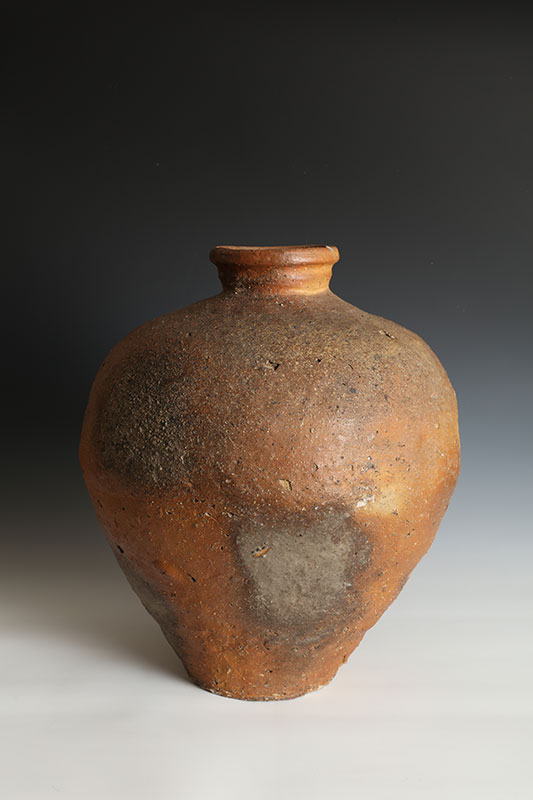
Shigaraki Jar, Stoneware with natural ash glaze, Muromachi period (1333-1573), 15th-16th century H 18½ x W 16¼ x D 16 in.
Thomsen Gallery will present select works of Japanese art from the 6th century to the present, including folding screens and hanging scroll paintings, gold lacquer boxes, signed bamboo ikebana baskets, tea ceramics, and contemporary porcelain sculptures by Sueharu Fukami.
A highlight among the screens is Autumn Flowers by the Kyoto School, a six-panel screen painted in ink and mineral colors on paper with gold leaf from the 19th century. Additional folding screens date from the Edo period and the Showa era also focus on seasonal motifs.
The gold-lacquer boxes included in the show are writing boxes, tea caddies, and document boxes dating from the Taisho through Heisei eras. Standing out is a tea caddy with the bold design of stretched dried abalone, an auspicious betrothal symbol in Japan, by the ninth-generation lacquer artist Nishimura Hikobei of Kyoto.
Among the bamboo ikebana baskets are works by the famous first generation basket makers Tanabe Chikuunsai I and Maeda Chikubosai I, as well as works by later artists, such as Tanaka Kosai. Early ceramics from the 6th through the 16th centuries are contrasted by iconographic porcelain sculptures by the contemporary ceramic artist Sueharu Fukami.
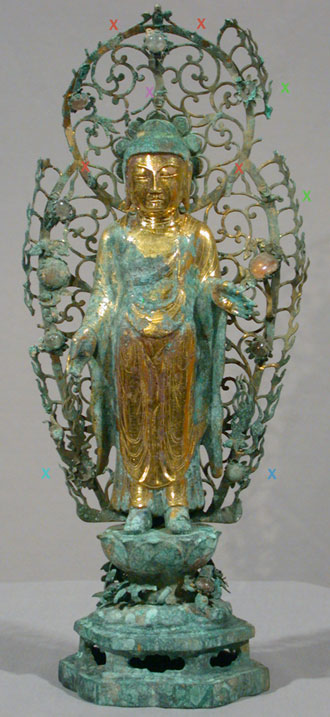
Korean gilt copper “medicine” Buddha, late 7th-early 8th century
We are pleased to share the third installment of additional material related to our recent webinar on art conservation which featured scholarly contributions from two leading Asian Art conservators, Leslie Gat, (Art Conservation Group) and John Twilley (Art Conservation Scientist), along with AWNY members Mary Ann Rogers (Kaikodo LLC), and Thomas Murray (Thomas Murray Asian and Tribal Art).
Part three begins with a summary from John Twilley, followed by answers to questions posed by attendees during and after the event.
“Scientific analysis applied to artworks serves several purposes, chiefly to guide conservation treatment and to inform art history on the physical aspects of the making of art. Cleaning and corrosion removal are operations that frequently entail irreversible changes to an artwork and therefore often require testing to determine their feasibility and impact on the object. As in medicine, the first priority of conservation should be to do no harm. Historically, many attempts to clean and “restore” artworks have been marred by misunderstandings about their materials and original appearance, or by the prioritization, in the imaginations of collectors, of certain characteristics over others that were essential to the artist’s original work. The example of the cleaning and recarving of Greek and Roman sculptures that occurred in the 18th and 19th centuries, during which polychrome decoration was often lost, provides a cautionary tale for how we should approach Asian art. The Victorian preference for white marble surfaces as aesthetically desirable, coupled with an antihistorical denigration of the role of color in the ancient world, allowed much to be lost forever.
Chinese sculptures in wood and stone are widely appreciated to have been decorated with polychrome. What is less often understood is that they were subject to multiple devotional redecorations during their existence in worship and that common practice was to cover the earlier layers rather than remove them. Unfortunately, Chinese sculptures with damaged polychrome decoration have sometimes been stripped of paint remnants in a quest to elevate sculptural form and uniformity. When they have not been removed, scientific study of these successive paint layers allows us to understand the chronology of costume styles preserved there and to date them.
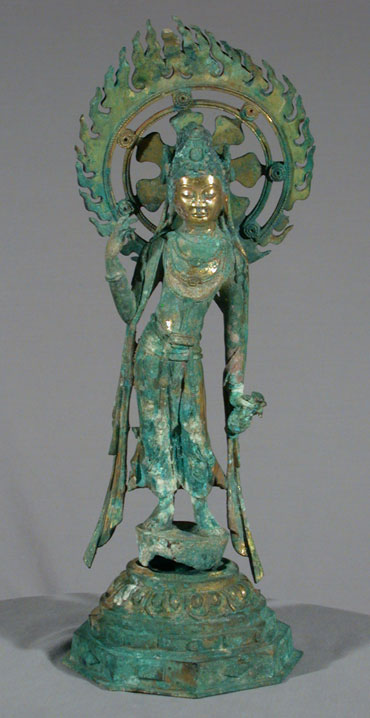
Even less recognized are metal sculptures that were decorated with painted polychromy augmenting gilt bronze. Two sculptures dating to the 8th century CE illustrate the essential role of scientific testing in recognizing the presence of polychrome and preventing its destruction. Testing of a corrosion-covered, late Sui or early Tang bronze Avalokiteshvara revealed painted linework and shading over gold that have become inextricably bound with corrosion products from the bronze and incrusting minerals acquired from the environment. Testing of a Korean gilt copper “medicine” Buddha, which radiocarbon dating confirmed to be of the late 7th to early 8th century, reveals decoration with opaque aquamarine glass and rock crystal “jewels,” the latter of which derived their color from painted settings, contrasting with painted flowers. The peculiar yellow hair of this Buddha, which convention dictates should be blue or black, represents the first discovery of the iron phosphate mineral vivianite in Asian polychrome decoration. Rare encounters with this pigment in Dutch painting of the 17th century, including in the work of Rembrandt’s first pupil, Gerrit Dou, inform this discovery and explain the contradictory color. Vivianite, known as blue ochre, is unstable. It transforms to the yellow color seen today in the Buddha’s hair by an irreversible oxidation of the iron. Recognizing this same formerly blue pigment in the painted centers of gold-petalled flowers garlanding the Buddha’s base allows us to visualize the original color scheme. It included orange-backed rock crystal flowers alternating with blue painted flowers around the base, and turquoise glass flowers alternating with orange-painted rock crystals in the mandorla.
Today, these decorations are permeated by corrosion products and mineral deposits that variously contrast with, or blend in among the original colors of the work. Survival has been selective, with discolored successors of some of the artist’s original colors, altered by the environment, alongside intact neighbors. While part of the corrosion might be removable, the majority of these transformations are irreversible. Scientific examination allows the original appearance to be appreciated for what remains and predicts that some aspects of the original appearance cannot be recovered through any form of treatment. It shows that the stripping of corrosion, once conceived as the appropriate means of revealing a gilded surface, instead would have misrepresented these two works. A successful treatment of that kind would expose them in a way that their makers never intended them to be seen and skew modern understanding of the art of the period. Such cases pose a challenge to all concerned but they also present opportunities—to collectors, in their stewardship of the art, to foster scholarship and high standards of care; to the conservator, to exercise restraint and to consider the potential for new discoveries; and to the scientist, to not merely record what remains but to interpret its origins and reconstruct the artist’s methodology.”
Details of this work may be found in the following publication: John Twilley, Polychrome Decorations on Far Eastern Gilt Bronze Sculpture of the Eighth Century, In Scientific Research on the Sculptural Arts of Asia, Proceedings of the Third Forbes Symposium at the Freer Gallery of Art, J.A. Douglas, P. Jett, and J. Winter, eds., Freer Gallery of Art, Washington, 2007, pp.174-187
Bronze Avalokitesvara with painted details, late Sui-early Tang dynasty (8th century)
Some questions and answers about metal conservation:
1. Can the corrosion be removed to allow the original gilding to show? If not, why not?
For these two cases, we now know that the original decoration was not a uniform layer of gilding. It involved paints applied atop the gilding to contrast with it. The corrosion now permeates the paint. Removing the corrosion would result in removing the paint to give a stripped-down gold surface that was never intended to exist alone. From a practical standpoint, corrosion has undercut some of the gilding so that the gilding now adheres to the corrosion on top better than it does to the original surface below, from which it may easily be lost. As the photo detail of the face of the Avalokiteshvara showed, removing the external corrosion leads to in an uneven result with dull, copper-colored areas alongside bright gilding and remnants of the paint.
2. I collect early (Momoyama Period) steel Japanese tsuba (sword guards). Often, these objects present with varying degrees of rust. Should ALL of this rust be removed?
Rust that is orange in color is not necessarily active, though it may be. Iron rust is often exacerbated by chloride salts that cause even more trouble for iron than they do for bronze. In severe cases, droplets or weeping trails of orange liquid may develop because the iron chlorides have such high affinity for moisture in the air. This can cause the problem to migrate, damaging new areas. Because the chloride is never consumed, it goes on stimulating further corrosion. The chlorides responsible for this need to be removed as thoroughly as possible because suppressing this kind of corrosion by maintaining a sufficiently dry environment is almost impossible, even in a museum case. A good solution usually involves a combination of removal of accessible chlorides, treatment by a corrosion inhibitor, and housing in a dehumidified enclosure. The latter implies a continuing need for maintenance.
3. How is “proper condition” of conserved objects determined, exactly? Who decides?
The decision needs to be based on a dialog between the art historian/archeologist/historian, the conservator, and owner, but a dialog that is informed as fully as possible about the ramifications of treatment that may impact materials associated with the item of primary interest. For example, an understanding is taking hold in paleontology that “preparing” skeletons often results in the erasure of vast amounts of information in the form of fossil remnants of soft tissue, feathers, hair, etc. that were not formerly recognized to have survived. X-ray tomography systems are now coming on-line that are capable of discerning things as minor as an insect fossil inside a block of stone. So paleontology is looking toward a future in which physical divestment of fossils will be greatly reduced or reserved for duplicate specimens. In archaeological artifacts, we routinely see equivalent cases of the preservation of cloth, leather, pigments, lacquer coatings, and other associated goods in the form of corrosion pseudomorphs (early-stage fossils, if you will) that can expand an understanding of the artifact if they are not discarded in a quest to uncover something. If we are to avoid our irreversible actions being regretted by those who come after, as we regret the recarving of Greek and Roman sculpture in the 18th century, we need to minimize the impact of our imperfect understanding.
This post is part three of a three-part essay about our Webinar, Tales in Conservation. To read part one Click here. To read part twoClick here.
Watch an excerpt from the Tales in Conservation webinar:
A party of hunters returning to camp (detail), Leaf from the British Library-Chester Beatty Library Akbarnama, Mughal India, 1603-04, 9 by 5 in., 22.9 by 12.7 cm., painting; 12 ¼ by 8 ½ in., 31 by 21.5 cm. folio, Image courtesy of Oliver Forge & Brendan Lynch Ltd.
Asia Week New York is pleased to host a panel discussion, Tales in Connoisseurship: Appreciating Indian Painting, on Thursday, January 28 at 5pm EST.
What is the most important ingredient in appreciating art? Join our renowned panel of experts: Brendan Lynch, co-director, Oliver Forge & Brendan Lynch Ltd., London; Marika Sardar PhD, Curator, The Aga Khan Museum and Gursharan Sidhu, PhD as they reveal their personal journeys of connoisseurship in the rich and wonderful world of Indian Paintings. The conversation will be moderated by Anu Ghosh-Mazumdar, Head of Department, Indian & Southeast Asian Art, Sotheby’s.