Unmissable Exhibitions at the Art Institute of Chicago

AIC_HiroshigeAsakusa-Rice

Utagawa Hiroshige 歌川 広重 (1797-1858), Asakusa Rice Fields and Torinomachi Festival (Asakusa tanbo Torinomachi mode), from the series One Hundred Famous Views of Edo (Meisho Edo hyakkei), 1857, color woodblock print; oban 14 1/4 × 9 1/2 in., (36 × 24.1 cm)

Mark your diaries for One Hundred Famous Views of Edo at the Art Institute of Chicago, featuring a selection of Hiroshige’s most celebrated prints that capture the poetic beauty of everyday life in Edo (modern Tokyo) and reveal why his vision continues to inspire artists worldwide. While planning your visit, don’t miss The Dawn of Modernity: Japanese Prints, 1850–1900, closing soon—a striking exploration of Japan’s rapid 19th-century transformation, with dynamic prints depicting steam trains, bustling streets, and Western-inspired architecture as the nation embraced modernization.

One Hundred Famous Views of Edo
October 15, 2025 – January 5, 2026

Ukiyo-e, meaning “pictures of the floating world,” was a genre of woodblock print popular from the 17th through 19th century that depicted scenes of everyday life across Japan. Hiroshige’s designs are among the most widely circulated of any premodern print artist, and because of his prints’ popularity, editions ran into the thousands.

His most well-known series, One Hundred Famous Views of Edo, was completed just before his death. Hiroshige had lived his entire life in Edo (present-day Tokyo), and the series offers a great variety of scenes from many locations in and around his home city. Mount Fuji features prominently, as do the waterways and canals that cut through Edo at the time.

The series’ extreme commercial success resulted in Hiroshige creating more than the 100 views of its title over a period of two-plus years. Both during and after his lifetime, many editions of the series were produced as well, with clear differences apparent among them. For example, the earliest deluxe edition usually has multicolored title cartouches, many of which are on view in this exhibition.

This selection of about 35 prints from Hiroshige’s renowned series showcases his captivating style and demonstrates why artists within and outside Japan from the 19th century through today have been inspired by his work.

To learn more, click here.

AIC_Ochiai
Ochiai Yoshiiku, Picture of Men and Women from Many Countries (Bankoku danjo jinbutsu zue),1861, color woodblock print; oban triptych, 36.6 × 72.5 cm (14 7/16 × 28 9/16 in.), Gift of Emily Crane Chadbourne

The Dawn of Modernity: Japanese Prints, 1850–1900
Closing Monday, October 13, 2025

After almost 250 years of near-total isolation, Japan opened to international trade in 1859, following the arrival of Commodore Matthew Perry and his steam-powered fleet in 1853. Foreign ideas and technologies quickly poured in, transforming cities like Yokohama into hubs of global exchange. Japanese printmakers documented these watershed events—often in panoramic triptychs influenced by photography and Western illustrations—depicting steam trains, modern architecture, and bustling streets while promoting the image of a modern nation in ascent. With the fall of the shogunate in 1868 and the start of the Meiji era, Japan embraced rapid modernization under the ideals of “civilization and enlightenment.” The prints in this gallery reflect Japan’s attempts to define itself between Eastern and Western influences and to become Asia’s modern empire.

To learn more, click here.

• • •

The Art and Legacy of Suemura Shobun Closes Soon at TAI Modern

TAIModern_SuemuraInstall

Installation view, SUEMURA SHOBUN

SUEMURA SHOBUN
Closing Saturday, October 4, 2025
1601 Paseo de Peralta, Santa Fe, NM

Don’t miss this rare chance to experience a retrospective of Suemura Shobun (1917–2000) at TAI Modern before it closes! A true son of Osaka, Shobun’s finest works are on display, spanning his prolific career from 1941 to 1996. For the first time, pieces from across his entire career are shown together in the gallery—a once-in-a-lifetime opportunity!

Suemura Shobun was born in 1917 as Suemura Bunzo in Osaka. After graduating from Imamiya Junior High School, he was apprenticed for five years to Yamamoto Shoen (also known as Chikuryusai I), a respected bamboo artist well known for his karamono-style flower baskets. Suemura became independent in 1941, taking the artist’s name “Shobun”: “Sho” meaning flute, as an homage to Yamamoto Shoen, and “Bun” from his given name. However, he had been independent for less than a year when he was drafted and assigned to work in a factory for the war effort. Suemura would not return to working with bamboo until almost a decade later.

In 1951, Suemura had his work accepted into Nitten, the annual exhibition mounted by Japan’s most prestigious fine arts organization, for the first time and would go on to be shown thirty-six more times. He won several awards at the Kansai Exhibition and the Osaka Craft Arts Association Exhibition. In 1962, he was admitted to the Japan Modern Craft Arts Exhibition and later became a full member after winning ten times consecutively. He later exhibited his work as part of a modern craft arts exhibition, sponsored by the Minister of Foreign Affairs, which traveled to major cities in the U.S., Europe, the South Pacific, South Africa, and Australia. The City of Osaka gave him an award of appreciation in 1973. He then became a trustee, judge, and honorary member of the Japan New Craft Arts Association. He has held over forty-five private exhibitions of his art. Suemura passed away at the age of eighty-six in 2000.

The works that Suemura became best known for are made from whole culms of black bamboo. According to the artist, “I like working with black bamboo from Kyushu, which has traditionally been used for making fishing poles. When I use this bamboo, the nodes express distinct patterns and rhythm – I find that visual effect so beautiful.” Suemura used this bamboo to create dynamic compositions that swoop, roll, curve, and coil. Haze, a major exhibition piece from 1962, is a stunning example of Suemura’s original style and creative prowess. However, you will see pieces made from susutake, madake, and hobichiku bamboo in a range of styles as well.

To learn more and view their online catalog, click here.

• • •

Yale University Art Gallery’s Upcoming Alan L. Gans Lecture: Four Scholars, Four Paintings

Yale_Oct2025Lecture

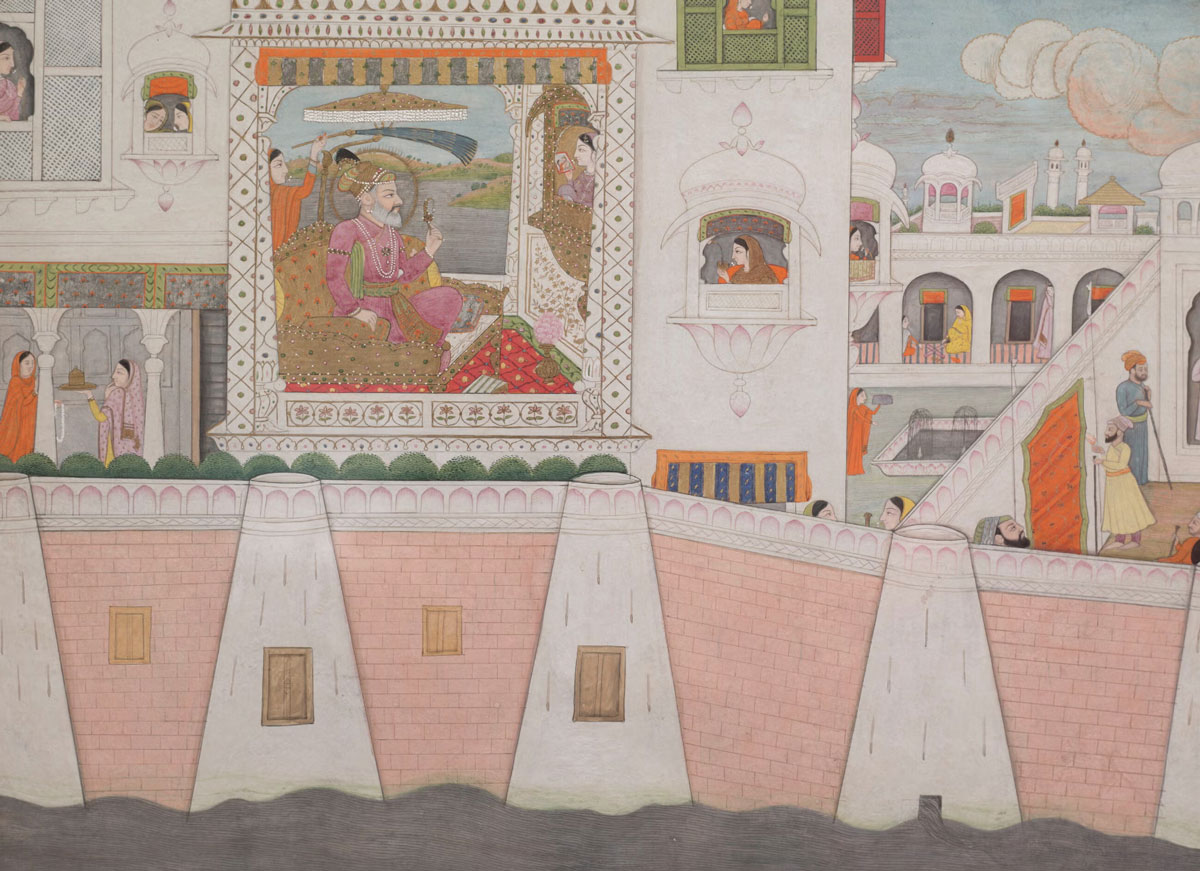
Palace Scene with Emperor Shah Jahan (1592–1666), India, Punjab Hills, Pahari, Independent Rajput States, early 18th century. Opaque watercolor and gold on paper. Yale University Art Gallery, Gift of Lindsay Harper Makepeace in honor of LeRoy McKim Makepeace, B.A. 1937

Alan L. Gans Lecture: Four Scholars, Four Paintings
Thursday, October 9, 2025, 5:30 – 6:30pm
Free and open to all

The Department of Asian Art of the Yale University Art Gallery and the South Asian Studies Council of Yale University is pleased to present the Alan L. Gans Lectures, with short presentations on four South Asian (Indian) paintings in the Gallery’s collection.

Specialists Dipti Khera, Associate Professor of Art History, Institute of Fine Arts, New York University; Mrinalini Rajagopalan, Associate Professor of History of Art and Architecture, University of Pittsburgh; John Seyller, Professor of Art History, University of Vermont; and Emma Natalya Stein, Ph.D. 2017, Assistant Curator of South and Southeast Asian Art, National Museum of Asian Art, Smithsonian Institution, discuss their favorites and explore the many fascinating historical and cultural stories that informed the creation of these works—in different regions of the subcontinent, at different points of time, and under the patronage of diverse rulers.

Denise Patry Leidy, the Ruth and Bruce Dayton Curator of Asian Art at the Gallery, and Kasturi Gupta, Director of Programs and Institutional Partnerships, South Asian Studies Council and Council on Southeast Asian Studies, MacMillan Center for International and Area Studies at Yale, introduce the speakers and moderate a question-and-answer session following the presentations.

In addition to this lecture, be sure to mark your calendars for their upcoming Gallery Talks and Events running through November, presented in conjunction with their current exhibition Nusantara: Six Centuries of Indonesian Textiles.

They look forward to welcoming you soon!

To learn more, click here.

• • •

HK Art and Antiques’ Spanning a Lifetime: Early and Late Works by Cho Yong-Ik Closes Soon

HKArtInstall

Installation view, Spanning a Lifetime: Early and Late Works by Cho Yong-Ik

Spanning a Lifetime: Early and Late Works by Cho Yong-Ik
Closing Friday, October 3, 2025
49 East 78th St, Ste 4B, NYC (by appointment)

These are the final days to experience Spanning a Lifetime: Early and Late Works by Cho Yong-Ik at HK Art and Antiques. This solo exhibition of the late Cho Yong-Ik (1934–2023), a pioneering master of Korean abstract art and a foundational figure of the Dansaekhwa movement, offers a rare opportunity for U.S. audiences to engage with his profound artistic legacy. Cho’s work has been celebrated internationally, featured in the 1967 and 1969 Paris Biennales and the 1967 São Paulo Biennale, and is held in major collections worldwide.

Born in Bukcheong, Korea, he studied painting at Seoul National University under the esteemed art historian and painter Kim Byung-ki, whose emphasis on artistic independence became a lifelong guiding principle. Emerging in the wake of the Korean War, Cho sought to redefine Korean identity through abstraction. His artistic vision was deeply informed by his passion for ancient Korean ceramics and artifacts, which he avidly collected. This reverence for tradition merged with his desire to reshape Korea’s cultural reality, resulting in a practice that bridged history and innovation. While many Dansaekhwa artists adhered strictly to muted palettes, Cho introduced subtle yet intentional use of color within the monochrome framework. His surfaces, often layered with delicately applied acrylics, echoed the translucent glazes of Joseon ceramics, imbuing his work with both material sensitivity and emotional depth. His process—meditative, tactile, and rhythmically executed—reflected a philosophical inquiry into repetition, impermanence, and the act of making.

Don’t miss this rare chance to experience a lifetime of innovation before the exhibition closes!

To learn more, click here.

• • •

Exploring the Art of Manga with Japanese Art Society of America

JASA_ArtofMangaZoom1200

From top left to bottom right: ©Rumiko Takahashi/Shogakukan; ©PAPIER/Jirō Taniguchi, Masayuki Qusumi, FUSOSHA; “Hinemosu notari nikki”; ©Tetsuya Chiba/Big Comic (Shogakukan); ©Mari Yamazaki, Tori Miki/Shinchosha; ©Fujio Akatsuka; ©Hirohiko Araki & LUCKY LAND COMMUNICATIONS/Shueisha; ©Kazumi Yamashita/KODANSHA LTD.; ©Gengoroh Tagame/Futabasha Publishers Ltd.; ©Fumi Yoshinaga/HAKUSENSHA, Inc.; ©Eiichiro Oda/Shueisha

Exploring the Art of Manga
Monday, October 6, 2025, 5pm
Live Zoom Webinar

Join the Japanese Art Society of America for an exploration of manga as a dynamic art form, spotlighting two major exhibitions curated by Dr. Nicole Coolidge Rousmaniere.

Dr. Nicole Coolidge Rousmaniere, Research Director of the Sainsbury Institute for the Study of Japanese Art and Culture at the University of East Anglia, Norwich, England, will speak on manga, a Japanese visual narrative art form that has evolved over the past century into a global phenomenon. Once referring primarily to comics and graphic novels, manga now encompasses digital media, fine art, fashion and other cultural expressions, achieving immense international reach. In Japan, manga is read across all generations and is a thriving industry, with 2023 domestic revenues reaching approximately ¥694 billion ($4.7 billion US dollars).

Over the last two decades, exhibitions of manga in Japan have typically highlighted the work of a single publisher or artist. In contrast, the British Museum’s 2019 exhibition presented original drawings (genga) by 50 artists within a historical framework. From September 25, 2025, to January 25, 2026, the Fine Arts Museums of San Francisco will stage The Art of Manga, an ambitious exhibition of drawings by ten leading contemporary artists.

Please note: Due to copyright restrictions, they ask that the slides shown during this lecture not be “screen grabbed” and disseminated through social media. For a link to Dr. Rousmaniere’s new publication, The Art of Manga, published to coincide with the exhibition, click here. It contains many of the images to which Dr. Rousmaniere will refer during the webinar.

Please contact Cheryl Gall, Membership Coordinator, at [email protected] or 978-600-8128 with any questions.

To register on Zoom, click here.

• • •

Celebrate Mid-Autumn Festival at China Institute in America

ChinaInst_MidAutumnFestival

2025 Mid-Autumn Festival
Sunday, October 5, 2025, 2-5pm
Tickets: $15 (General Admission); Free (CI Students and Members)

Join China Institute for an unforgettable afternoon of hands-on fun, vibrant performances, and cultural discovery as they celebrate the Mid-Autumn Festival — one of China’s most cherished holidays centered around family, gratitude, and togetherness.

Perfect for kids and grown-ups alike, this festive event is packed with engaging activities and exciting experiences that bring Chinese traditions to life!

Highlights include:

  • A lively Uyghur dance performance to kick off the celebration
  • A captivating shadow puppet show of The Legend of White Snake
  • Make your own snow skin mooncakes to take home and share for the festival
  • Craft adorable rice dough sculptures like bunnies and ducks
  • Enjoy drop-in arts & crafts, sugar painting, and more
  • Explore their new exhibition Metamorphosis: Chinese Imagination and Transformation through a family-friendly guided tour with creative art activities

To learn more and view the full schedule of activities, click here.

• • •

Take a Journey Through Ceramics with Joan B Mirviss LTD

MivissZoomSept

Yashichida Oribe Monumental Sculpture by Suzuki Gorō

Zoom Talk: The Transpacific Connection: Ceramic Influences between Japan and the United States
Tuesday, September 30, 2025 at 5pm ET
Online

Join Joan B Mirviss LTD for an insightful Zoom talk on September 30, as they bring together a dynamic panel of renowned senior ceramic artists and educators whose artistic careers have been shaped by time spent in both Japan and the United States, two countries with very distinct approaches to ceramic art. Rooted in centuries of tradition, Japanese ceramics have long emphasized both technical mastery and functional forms. The United States, on the other hand, has become a hub for experimentation free from the strictures of convention.

During the talk, the panelists will reflect on the role that each of these environments have played in fostering their remarkable artistic careers.

Panelists include:
JUN KANEKO, artist
SUZUKI GORŌ, artist
RICHARD BRESNAHAN, artist and educator
REE KANEKO, arts administrator, consultant, and curator

Moderated by JOAN MIRVISS

To register, click here.

• • •

Korean Cultural Center New York Opens Nam June Paik: The Communicator

KCCNY_NamJuinPaik

Nam June Paik, Rehabilitation of Genghis Khan, 1993

Nam June Paik: The Communicator
September 26 – November 22, 2025

The year 2025 marks the 80th anniversary of Korea’s liberation. In commemoration, the Korean Cultural Center New York, in collaboration with the Nam June Paik Art Center and the Hyundai Motor Chung Mong-Koo Foundation, presents Nam June Paik: The Communicator.

Nam June Paik (1932–2006), the founder of video art, was a pioneering artist who freely crossed the boundaries between art and technology. Yet he was more than a mere media experimenter. Through technology, he sought to open new possibilities for connection—between individuals, across cultures, and through shared sensibilities. Above all, he was “a communicator,” an artist of exchange and resonance.

For Paik, art was not an object of contemplation but a site of participation, encounter, and communion. Traversing tradition and modernity, East and West, analog and digital, he realized through art the very spirit of cultural connectivity that underpins today’s K-Culture.

His iconic works, such as TV Cello and robot sculptures, fused electronic media with traditional forms, creating a wholly new visual language. By transforming television sets into instruments or human-like figures, Paik playfully dismantled the boundaries between machine and human, art and everyday life, performance and play. His robots, built from stacked televisions, symbolized his belief that technology could extend human existence and inspire new ways of imagining the world. These works continue to ask us: What is communication?

“It is the duty of the artist to think about the future.
I am an artist, but I have no interest in conventional art.
My interest lies in the entire world.
For me, every day is a matter of communication.”

– Nam June Paik

Communication was his lifelong pursuit and the essence of art. His works sought the liberation of the senses through technology, envisioning art freed from boundaries and limitations.

In this light, his artistic philosophy resonates deeply with the idea of “liberation” today. If liberation is not only about recovering national sovereignty but also about freeing humanity from the confines of time, space, ideology, and thought, then Paik’s art becomes its living, contemporary embodiment.

This exhibition also highlights his enduring commitment to younger generations and to intergenerational dialogue in art. On the first floor, Paik’s Rehabilitation of Genghis Khan (1993) is presented alongside The Car Toward the Future (2025) by emerging media artist Areum Kim, a work that carries forward Paik’s vision of technology intertwined with humanity, love, and coexistence. This juxtaposition demonstrates how his artistic spirit continues to thrive today—through evolving technologies and new creative voices—while opening pathways toward the future.

To learn more, click here.

• • •

Catch KOGEI + Market at Onishi Gallery Before it Closes

Onishi_KogeiMarketInstall

Installation view, KOGEI + Market

KOGEI + Market
Closing Tuesday, September 30, 2025
16 East 79th Street

These are the final days to experience KOGEI + Market at Onishi Gallery, a thought-provoking exhibition exploring the evolving relationship between Japanese craft traditions and Western fine art.

KOGEI + Market juxtaposes historical and contemporary works to illuminate this dynamic dialogue. Visitors will encounter Western masterpieces such as Fleurs by Balthus (1963), Edouard Vuillard’s Nu de dos (c. 1891), and Piet Mondrian’s early painting Farm Buildings in Het Gooi, Veiled by Trees (c. 1898–1902). These works are displayed alongside recent KOGEI pieces in lacquer and metal by Hagino Noriko, Oshiyama Motoko, Onihira Keiji, and Murose Kazumi—a Living National Treasure recognized for his exceptional skill and lifetime achievement in the art of lacquering.

This exhibition is part of an ongoing series at Onishi Gallery that supports the mission of KOGEI USA, a not-for-profit dedicated to elevating the global reputation of Japanese craft through exhibitions and cultural events at major institutions across the United States and Europe.

KOGEI + Market offers a rare opportunity to engage with the rich legacy and contemporary vitality of Japanese craft, while reflecting on its place within the broader narrative of global art history.

Don’t miss your chance to see it before it closes!

To learn more,  click here.

• • •

Celebrate Korean Patchwork Traditions with Charles B. Wang Center

CharlesBWang_PatchworkOpening

Installation view, Through the Light: Contemporary Jogakbo by Wonju Seo

Opening Reception: Through the Light: Contemporary Jogakbo by Wonju Seo
Friday, September 26, 2025, 5-7pm (kindly RSVP)
Charles B. Wang Center Skylight Gallery

Charles B. Wang Center is pleased to celebrate their newest exhibition, Through the Light, with an opening reception on September 26! Melding tradition with innovation, this vibrant exhibit showcases the contemporary jogakbo (Korean wrapping cloth) art of Wonju Seo. Rooted in centuries-old Korean textile practices, Seo’s translucent compositions transform humble fabric into luminous abstractions. Her works echo the geometry of modernist paintings while inviting viewers to experience light as a living element—passing through seams, shifting with space, and casting ephemeral shadows. With a minimalist sensibility and a reverence for craftsmanship, Seo translates the once utilitarian Korean craft of jogakbo into a contemporary language of transparency, balance, and spiritual reflection.

To register for free, click here.

To learn more about the exhibition, click here.

Workshop: The Art of Jogakbo: Korean Patchwork Traditions
Saturday, September 27, 2025, 1-3pm
Charles B. Wang Center East Hall

Tickets: $20 (General); $15 (Students/Seniors 65+) (advanced registration required)

Discover the beauty and tradition of jogakbo—Korean wrapping patchwork—by creating your own textile wall hanging in their upcoming program. This hands-on workshop welcomes participants of all skill levels and invites you to explore both hand-stitching techniques and machine sewing (bring your own sewing machine if you wish).

Guided by a teaching artist, you’ll learn how to piece together fabrics into stunning, eye-catching designs inspired by this timeless art.

Fee includes all materials, limited to 20 people per session.

To purchase tickets, click here.

• • •