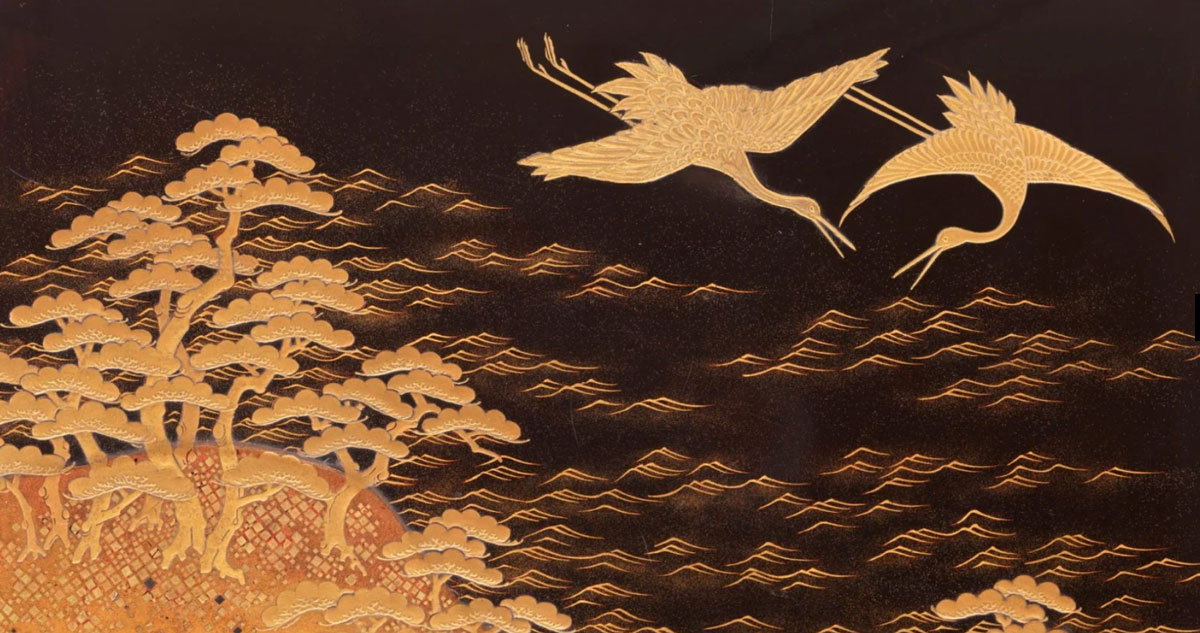
Document Box (Ryoshibako) with Cranes and Landscape (detail); Japan, 18th to 19th century; lacquer and gold on wood; National Museum of Asian Art, Smithsonian Institution, Gift of the Jacqueline Avant Estate, S2024.3.22
Explore the artistry of Asian decorative arts at the National Museum of Asian Art this month! Opening November 21, Adorned in Gold: Japanese Lacquer from the Jacqueline Avant Collection celebrates the dazzling maki-e technique and the beauty of Edo-period lacquerware. Also on view, Woven and Cast: Chinese Textiles and Japanese Metalwork brings together exquisite Chinese textiles and contemporary Japanese metalwork, revealing unexpected connections in craftsmanship, texture, and design. Learn more below.
Adorned in Gold: Japanese Lacquer from the Jacqueline Avant Collection
November 21, 2026 – January 2, 2028
East Building | Gallery 25
Gold powder falls gently onto wet lacquer, shimmering. There, it transforms into plants, birds, and even scenes from stories. This Japanese art form is called maki-e (literally, “sprinkled picture”). Artists have used this method since the tenth century to turn everyday objects into luxuries.
Adorned in Gold explores how maki-e intertwined with Japanese fashion, literature, and identity during the Edo period (1603–1868). Behold dazzling designs on hairpins, combs, decorative boxes, and even a litter used to carry a princess. Meanwhile, discover the complex techniques artists used to make different shapes, textures, and finishes.
This exhibition draws from the collection of the late philanthropist Jacqueline Avant. An icon of the African American community, she personally identified with maki-e’s gold on black aesthetic. Her lifelong passion for Japanese lacquerware shows how art can bridge time and culture.
To learn more, click here.

Composite image details—National Museum of Asian Art, Smithsonian Institution, Freer Collection, Gift of Shirley Z. Johnson: F2015.7; F2022.1.4.1–2; F2022.1.12; F2022.1.13.1–2; F2022.1.14.1–2; F2022.1.16.1–2; and F2022.1.21. National Museum of Asian Art Collection, Bequest of Shirley Z. Johnson: Hasuda Shūgorō / S2022.8.5, © Hasuda Sachiyo; Hosoya Michiru / S2022.8.17, © Hosoya Michiru; Mitsumoto Takeshi / S2022.8.26 and S2022.8.27.1, © Mitsumoto Takeshi; Tanaka Terukazu / S2022.8.30, © Tanaka Terukazu; Ōnuma Chihiro / S2022.8.35, © Ōnuma Chihiro; Ōsumi Yukie / S2022.8.40, © Ōsumi Yukie; Iede Takahiro / S2022.8.45, © Iede Takahiro; and Hannya Taiju / S2022.8.55, © Hannya Taiju
Woven and Cast: Chinese Textiles and Japanese Metalwork from the Shirley Z. Johnson Collection
November 7, 2026 – November 28, 2027
East Building | Gallery 22
Woven and Cast brings together artworks across two sets of media, cultures, and time periods: Chinese textiles of the Ming and Qing dynasties and contemporary Japanese metalwork. You may ask, why pair these very different types of art? The moment you encounter shimmering threads and metals side by side, you’ll understand.
Each stunning pairing begs close looking. Discover how various materials shine, from silk and peacock feathers to gold and silver. Explore shared motifs and decode the symbols, techniques, and craftsmanship that make up these works. You’ll even encounter surprising connections between media, such as gold-wrapped thread and woven metal. To support your exploration, approachable summaries introduce key terms and explain the techniques of weaving, embroidery, hammering, and casting. Meanwhile, videos bring the metalwork process to the gallery alongside close-up looks at the textiles with art conservators.
These distinct traditions complement each other with unexpected visual connections. Together, they create an effect more spectacular than either form does alone. Donor Shirley Z. Johnson recognized this when she built these collections. Follow her unique vision to understand the allure of radiant surfaces and metallic sheens worked in different artistic media.
To learn more, click here.