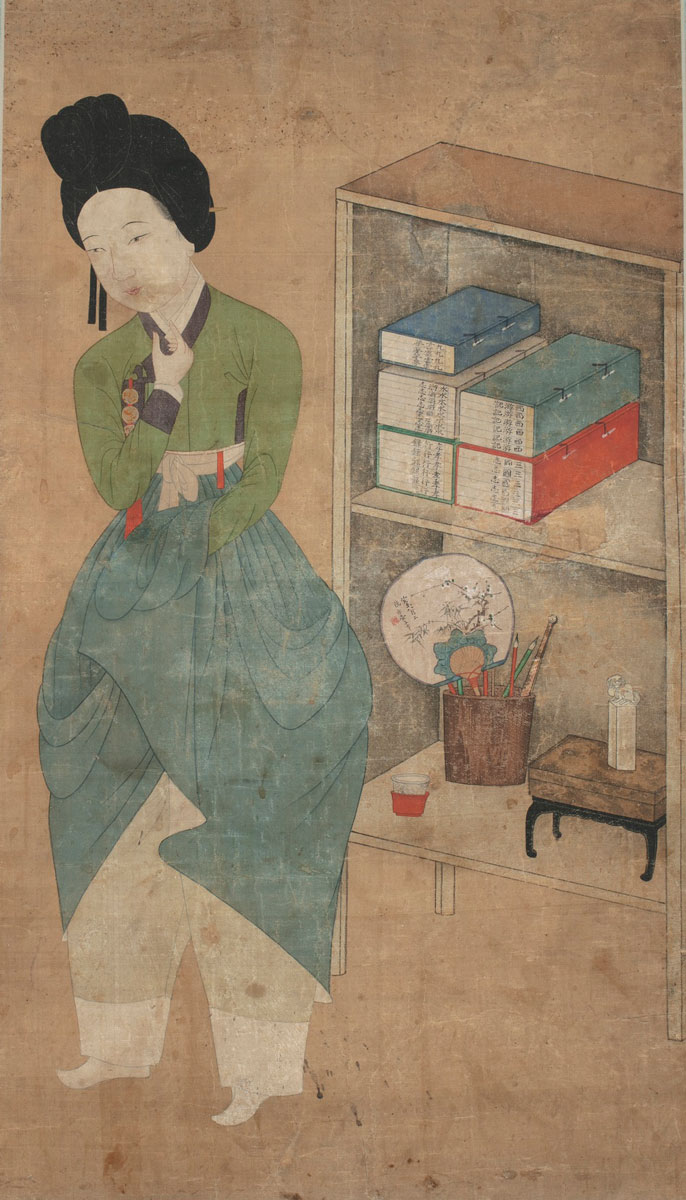
Jang Shiheung (1714‒after 1789), Young Woman by a Bookcase with Fan, Korea, Joseon Dynasty (1392−1897), hanging scroll: ink, color, and gold pigment on silk, 29⅞ x 17⅛ in. (76 x 43.5 cm); From a set of four paintings of virtuous women, signed: Bangho ja and dated 8/1763
Meritorious Men and Virtuous Women: Five Important Eighteenth-Century Korean Paintings
September 28 − October 9, 2026
17 East 76th Street, 3rd Floor
Special Exhibition Hours: Mon–Fri, 11am-5pm or by appointment (closed Oct 3-4)
Sebastian Izzard LLC Asian Art is pleased to present Meritorious Men and Virtuous Women: Five Important Eighteenth-Century Korean Paintings, featuring a small group of rare figure paintings from the late Joseon dynasty. A tradition of commemorative portraits of celebrated scholar-bureaucrats became a part of the court’s artistic production, where painters in the Joseon royal painting bureau were commissioned to paint portraits of elite men. Women were rarely the subject of figurative paintings and portraits, with a few select exceptions. For the most part, upper-class women are not depicted in Joseon dynasty paintings in accordance with period standards of propriety where the domestic lives of respectable women were kept private.
The coincidental acquisition of two fine works, a single portrait of a member of the scholarly elite, and a set of four paintings of virtuous women, have been brought together for the present exhibition. The Portrait of Yi Jeongbo at his 60th Birthday Party and the Four Paintings of Virtuous Women by Jang Shiheung together reflect the societal ideals of the Joseon dynasty. Mothers and wives, young and old, worked together to support the men of the family and raise sons to continue the patrilineal family line so that one day they could become accomplished men, such as Yi Jeongbo. The large scale of the paintings of women contrasts with the privacy of the domestic scenes that are usually shielded from public. However, the plentiful use of colorful pigment and accents of gold speak to the importance of these paintings, which captured the model behavior of upper-class women that served to support the public lives of upper-class men as scholar-officials and patriarchs and uphold Neo-Confucian patrilineal values.
The exhibition will be accompanied by a fully illustrated catalogue.
To learn more, click here.