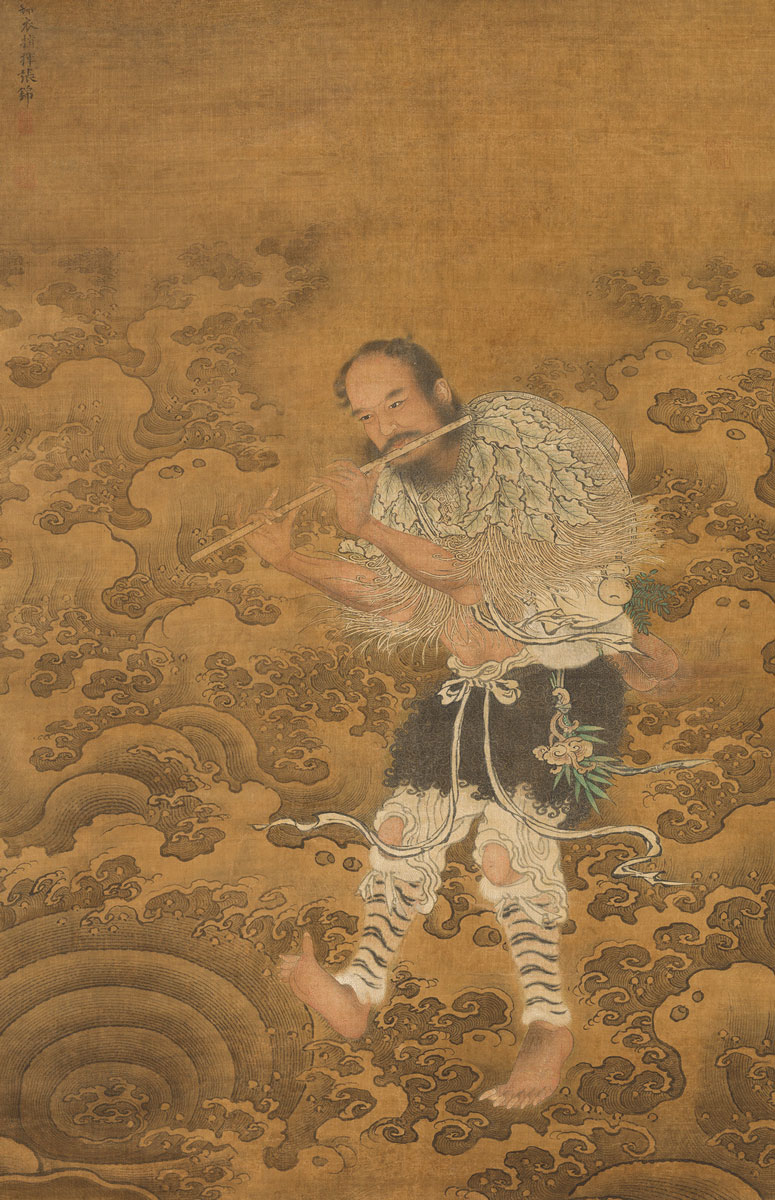
Zhang Jin 張錦 (Chinese, ca. 1450s–1520s), Daoist Immortal Han Xiangzi, late 15th century, hanging scroll, ink and color on silk, Museum Purchase: Gift of the Duke and Duchess of Talleyrand-Perigord, by exchange, 2011.70
Asia Week New York is thrilled to welcome the Cincinnati Art Museum as its newest cultural institution member! Located in scenic Eden Park, the Cincinnati Art Museum features a diverse, encyclopedic art collection of more than 73,000 works spanning 6,000 years. In addition to displaying its own broad collection, the museum presents several national and international traveling exhibitions each year, along with a vibrant array of art programs, activities, and special events. General admission is always free, thanks to the Rosenthal Family Foundation, with additional benefits available to museum members.
Don’t miss Rediscovered Treasures, a captivating new exhibition highlighting artworks from the museum’s renowned East Asian Art collection—many newly identified through recent research that reveals their hidden histories. Visitors can also explore the museum’s extensive collections of South Asian Art, Islamic Art, and Antiquities, each offering a rich glimpse into the artistic traditions and histories of diverse cultures. Free exhibition tours are available every Thursday evening!
Rediscovered Treasures
September 19, 2025 – January 18, 2026
Free Exhibition Tours Every Thursdays, 6:30–7:30pm
Evenings for Educators: Rediscovered Treasures, Thursday, January 15, 2026, 4-7pm
The Thomas R. Schiff Gallery (Gallery 234 & 235)
Rediscovered Treasures features nearly 60 artworks selected from the Cincinnati Art Museum’s East Asian Art collection. Each tells a fascinating story of its rediscovery through scholarship or conservation, fulfilling two key goals of the museum’s mission: interpreting and preserving the cultural objects in our care.
The museum acquired the core of its East Asian collection in the late nineteenth century when Cincinnati became a flourishing cultural center in the Midwest. These early acquisitions were often left unidentified, misidentified, or sometimes not accessioned at all due to a lack of information at the time. However, over the past two decades, new research on these works and others in the East Asian collection has led to many exciting discoveries, providing not only new information about the objects themselves, but also their histories and provenances.
Be sure to join all the related programs!
To learn more, click here.

Celestial Maiden Attended by an Ascetic and a Gana. Rajasthan, India, c. 1000–1099. Stone, 23 1/4 × 13 3/4 × 6 1/2 in. (59.1 × 34.9 × 16.5 cm). Cincinnati Art Museum, Museum Purchase with funds provided by Carl and Alice Bimel, 2001.59
South Asian Art, Islamic Art and Antiquities Collections
The Cincinnati Art Museum’s department of South Asian Art, Islamic Art, and Antiquities is honored to steward distinguished collections that include over five thousand works of art. Tracing a trajectory that begins with neolithic period objects from the ancient Middle East, the collection promotes the arts and cultures of a vast geographic region over centuries. Recently, the collection has expanded to include contemporary works from artists based in greater South Asia and the Middle East, as well as diasporic artists in the US and Europe.
The arts of historic South Asia (often defined as modern India, Pakistan, Bangladesh, and Sri Lanka) are represented through architectural fragments, decorative arts, and paintings. The arts of the Islamic World (defined as countries where Islam was/is widespread, and here concentrates on the Middle East and Central Asia) includes strengths in ceramics, metalwork, and the calligraphic arts.
At the center of the ancient collections are the architectural fragments from Khirbet et-Tannur. As the most significant collection of Nabataean material outside of Jordan, CAM is committed to the research, conservation, and display of these works for visitors and scholars alike. The ancient Mediterranean collection features notable examples of sculpture and ceramic vessels from ancient Egypt, Greece and Rome.
The department generates new scholarship through collection-based research, presented to our audiences through exhibitions, publications, and digital projects.
To learn more, click here.
East Asian Art Collection
The East Asian Department of Cincinnati Art Museum covers the arts of China, Japan, and Korea. The Museum acquired its first East Asian art works in 1881, making it one of the oldest museum collections of East Asian art in the United States.
The Chinese art collection spans nearly five thousand years, from the Neolithic to the present. Major strengths of the current holdings are ancient ritual bronzes of the Shang and Zhou dynasties, Buddhist sculptures from the sixth to the nineteenth centuries, ceramics from the Neolithic period to the Qing dynasties, and paintings from the thirteenth to the twentieth century.
The Japanese art collection of nearly 5,000 works is the largest of the East Asian collection, which includes: ceramics, paintings, prints, metalwork, sculptures, objects in lacquer and ivory, and other forms. The collection is especially rich in the arts of the Edo period. The Korean art collection includes ceramics, metal and lacquer works, paintings, prints, and textiles.
To learn more, click here.