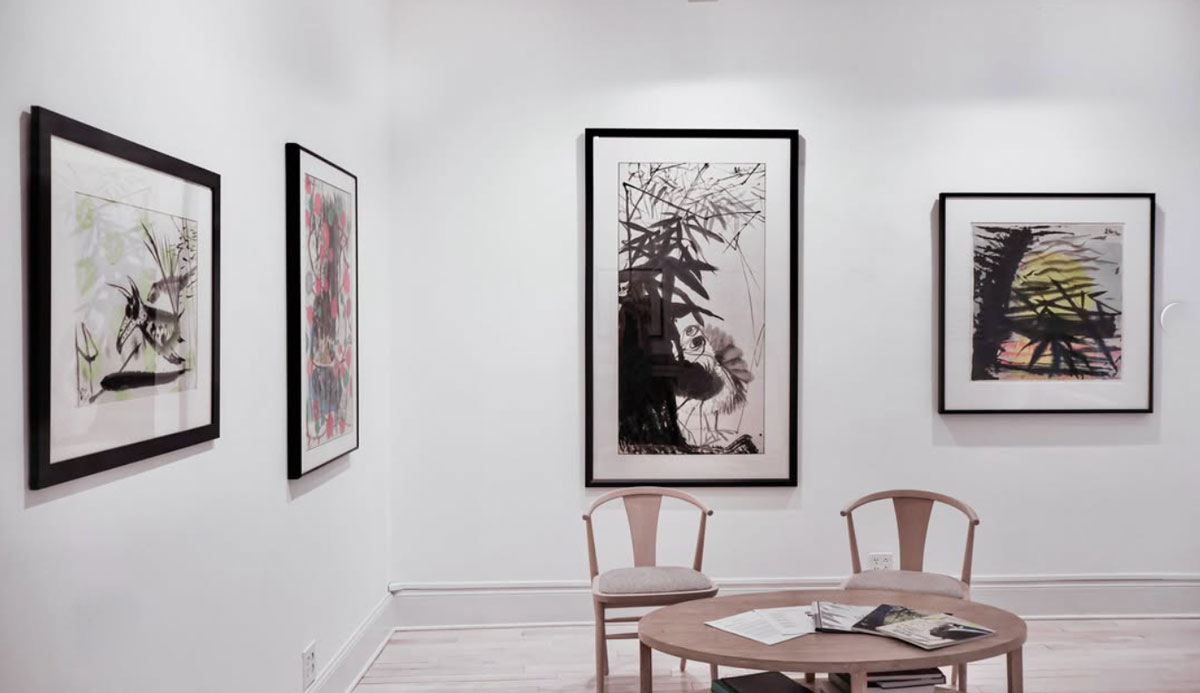
Installation view of The Art of Chao Chung-Hsiang at Alisan Fine Arts
Although our nine-day celebration of captivating exhibitions, exciting auctions, and engaging events has come to a close, the art continues! Many of our member gallery exhibitions remain on view in the weeks ahead, offering wonderful opportunities to experience outstanding works of Asian art. Missed an exhibition during Asia Week? Now is the perfect time to see it—or return for a second look. Make plans to visit before these exhibitions close!
Alisan Fine Arts
The Art of Chao Chung-Hsiang
Through October 17, 2026
and
Fong Chung-Ray and Hung Hsien: A New Horizon
Through November 11, 2026
120 East 65th St, NYC
Tuesday–Saturday, 10am-6pm
Two compelling exhibitions, on view concurrently, explore the evolving language of Chinese art in the modern era. The Art of Chao Chung-Hsiang and Fong Chung-Ray and Hung Hsien: A New Horizon bring together the work of three pioneering artists who reimagined Chinese artistic traditions through modern and contemporary approaches. Chao transformed traditional ink painting through abstraction, geometric forms, vibrant acrylics, and Chinese philosophical symbolism, while Fong and Hung, both members of Taiwan’s influential Fifth Moon Group, developed distinctive artistic languages shaped by their experiences in the United States. Together, the exhibitions offer a fascinating dialogue between tradition, migration, and artistic innovation.
To learn more, click here.

Installation view of Kiyomizu Rokubei: 250 years of ceramic expression from Kyoto at Dai Ichi Arts, Ltd.
Dai Ichi Arts, Ltd.
Kiyomizu Rokubei: 250 years of ceramic expression from Kyoto
Through September 24, 2026
18 East 64th St, NYC
Monday–Friday, 11am-5pm
By appointments only on weekends
Based in Kyoto since the mid-Edo period, the Rokubei lineage has flourished through generations of continual reinvention. Bringing together works by the fifth through eighth generations, the exhibition traces this extraordinary journey—from the fifth and sixth generations’ inventive experiments with glazes, painted decoration, and classical references to the sculptural, architecturally inspired slab-built forms of the seventh and eighth. Together, these works reveal how a centuries-old tradition can continually evolve while retaining its distinctive identity.
To learn more, click here.

Installation view of A Well of Rouge, a Flower of Fortune: Teaching and Learning in Chinese Flower Painting at Fu Qiumeng Fine Art
Fu Qiumeng Fine Art
A Well of Rouge, a Flower of Fortune: Teaching and Learning in Chinese Flower Painting
Through October 31, 2026
65 East 80th St, NYC
Tuesday–Saturday, 10am–6pm
A Well of Rouge, a Flower of Fortune: Teaching and Learning in Chinese Flower Painting traces the transmission of Chinese bird-and-flower painting across generations. At its center are Li Fenggong’s baimiao flower-painting lessons, written instructions, and student studies marked with his vermilion annotations, presented alongside more than ten flower paintings spanning the Ming and Qing dynasties to the modern era. Following the intertwined threads of lessons and artistic lineages, the exhibition reveals how this tradition traveled from teacher to student—and ultimately across the sea to New York.
To learn more, click here.

Installation view of A Well of Rouge, a Flower of Fortune: Teaching and Learning in Chinese Flower Painting at Fu Qiumeng Fine Art
Ippodo Gallery
Kaori Someya: The Light Within
Through October 17, 2026
35 N Moore St, NYC
Tuesday–Saturday, 11am-6pm
Mondays by appt only
Kaori Someya’s luminous paintings employ the thousand-year-old technique of urahaku, in which transparent washi paper is backed with gold and platinum leaf to create an ethereal inner radiance. Working in the traditional medium of Nihonga, she explores the complex experience of women in contemporary Japanese society, portraying female figures in richly patterned kimono with expressions poised between serenity and resignation. Through these evocative works, Someya examines the tension between external societal expectations and the deeply personal desire to preserve one’s beliefs, individuality, and sense of self.
To learn more, click here.

Installation view of Maia Ruth Lee: Double Vision at Tina Kim Gallery
Tina Kim Gallery
Maia Ruth Lee: Double Vision
Through October 24, 2026
525 West 21st Street
Tuesday–Saturday, 10am-6pm
Double Vision presents a new body of paintings from Maia Ruth Lee’s Bondage Baggage series alongside sculptural and video works exploring migration, memory, and identity across multiple histories and temporalities. Taking its title from Homi K. Bhabha’s The Location of Culture, the exhibition considers the migrant’s “double vision”—the experience of inhabiting both the place left behind and the place occupied. Across two gallery spaces, Lee transforms memory into material, with images and sculptures that expand, mirror, and reassemble to reveal identity as an evolving accumulation rather than a fixed point of origin.
To learn more, click here.

Installation view of Patina of Time: The Clay Art of Iguchi Daisuke at Joan B Mirviss LTD
Joan B Mirviss LTD
Patina of Time: The Clay Art of Iguchi Daisuke
Through October 30, 2026
39 East 78th St, Ste 401, NYC
Monday–Friday, 11am-6pm and by appointment
A decade after his highly successful international solo debut at the gallery, Iguchi Daisuke returns with Patina of Time: The Clay Art of Iguchi Daisuke. A native of Tochigi Prefecture in northeastern Japan, the artist carries forward the legacy of two of the region’s most celebrated ceramic masters, Kamoda Shōji (1933–1983) and Wada Morihiro (1944–2008). Building on their pioneering approaches, Iguchi creates vessels in which surface and form are seamlessly integrated. Intricate linear patterns flow across gently curving, occasionally lobed forms, creating a dynamic interplay of texture and shape. His work both extends the region’s distinctive ceramic tradition and expresses a uniquely personal artistic vision.
To learn more, click here.

Installation view of Across the Sea: Onishi Gallery with Homo Faber at Onishi Gallery
Onishi Gallery
Across the Sea: Onishi Gallery with Homo Faber
Through September 30, 2026
16 East 79th St, NYC
Tuesday–Friday, 10am–5pm (otherwise by appointment)
To celebrate its 20th anniversary, the gallery is pleased to present Across the Sea: Onishi Gallery with Homo Faber, bringing together works by ten artists, four of whom are participating in the 2026 edition of Homo Faber on Venice’s Island of San Giorgio Maggiore this month. Meaning “human as maker,” Homo Faber embodies the spirit of creativity and craftsmanship that lies at the heart of artistic practice. The exhibition spans ceramics, metal, lacquer, and other media, highlighting each artist’s distinctive material language and the profound dialogue between maker and material.
To learn more, click here.

Installation view of Kiyoshi Hamada: Gazing Into Stillness – Works 1975–2026 at Seizan Gallery
Seizan Gallery
Kiyoshi Hamada: Gazing Into Stillness – Works 1975–2026
Through November 7, 2026
525 West 26th St, NYC
Tuesday–Saturday, 11am-6pm; Sunday–Monday, by appointment only
This exhibition surveys significant works from 1975 to the present by one of the hidden giants of postwar Japanese art. Active since the early 1960s, Hamada has remained a singular figure, working alongside — though never within — the postwar avant-garde movements and groups that surrounded him such as Gutai and Mono-ha. Tracing the evolution of his techniques and materials, the exhibition follows a question Hamada has pursued for over half a century: not what a painting should depict, but how a painting itself — its support, its materials, and the traces of the hand — comes into being.
To learn more, click here.

Hijo Nam, Moments of Journey 2, 2022, fabric and handmade paper on wood box, 34.5 × 34.5 cm. Courtesy Space 776
Space 776
HIJO NAM: Between Time and Being
Through September 27, 2026
37 Clinton St, NYC
Wednesday–Sunday, 12-6pm
Between Time and Being, a solo exhibition by New York–based Korean artist Hijo Nam, brings together fabric assemblages, lacquer sculpture, painting, and mixed media to explore how time, memory, and relationships shape human existence. For Nam, time is not linear but accumulative, embedded in the materials themselves: fabric bears traces of cutting, layering, and handling, while lacquer and wood retain the marks of repetition, weathering, and use. Rather than conceal these traces, Nam embraces them, transforming material into a record of lived experience and the passage of time.
To learn more, click here.

Untitled Peony Basket, China or Japan, Edo to Meiji period, bamboo and rattan, 20.5 x 14.75 x 6.25 in. Courtesy TAI Modern
TAI Modern
Sencha to Sculpture: The Evolution of Japanese Bamboo Art to the 1960s
Through October 10, 2026
1601 Paseo de Peralta, Santa Fe, NM
Tuesday–Saturday, 10am–5pm
Discover the remarkable evolution of Japanese bamboo art, from elegant tea ceremony utensils to dynamic sculptural forms. Featuring nearly 50 works, the exhibition traces the medium’s origins through the Minminsai lineage, including a signed basket by Kobayashi Minminsai I (d. 1791), before following the innovations of Hayakawa Shokosai I and successive generations of master bamboo artists. The exhibition reveals how bamboo emerged as a powerful medium for sculptural expression and marks the first installment of a planned three-part series exploring the history of Japanese bamboo art.
To learn more, click here.