
“Benkei,” 1870s-1880s, Suzuki Chokichi (Japanese, 1848-1919), Japan, Meiji period (1868-1912), Bronze on wood base with gilding, 61 x 31 x 23 ½ in., Gift of Arthur I. Appleton, G12518; Courtesy Appleton Museum of Art
Our summer roundup continues, and this time, we’re heading beyond New York City to highlight must-see Asian art exhibitions at Asia Week New York’s member museums across the United States. From celebrated masterpieces and historic treasures to innovative contemporary installations, these remarkable presentations offer new insights into the rich artistic traditions and cultures of Asia. Beat the summer heat, immerse yourself in world-class art, and plan a visit to these exceptional museums nationwide. Explore the highlights below!
Appleton Museum of Art
Exposition, Empire and Expression: Japanese Global Art 1870s-1970s
Ongoing
4333 E. Silver Springs Boulevard, Ocala, FL
Exposition, Empire and Expression is a must-see exploration of one of art history’s most dramatic transformations. Beginning with Commodore Matthew Perry’s forced opening of Japan to global trade in the 1850s, the exhibition traces a century of extraordinary artistic evolution from breathtaking bronze masterpieces to innovative kimono designs and bold postwar works revealing a century of artistic reinvention shaped by culture, power, and global exchange.
To learn more, click here.

Torii Kiyotada (Japanese, active c. 1716–51), The Main Gate, New Yoshiwara, c. 1745, hand-colored woodblock print; toku-oban yoko-e, beni-e, 43.4 × 63.9 cm (17 × 25 1/4 in.), Clarence Buckingham Collection, 1939.2152; Courtesy Art Institute of Chicago
Art Institute Chicago
The Floating World Emerges: Japanese Prints from the Clarence Buckingham Collection
Through September 6, 2026
111 South Michigan Avenue
Don’t miss this extraordinary glimpse into one of Japan’s most captivating artistic traditions. Born from the “floating world” philosophy of Edo-period Japan, ukiyo-e celebrated beauty, pleasure, and life’s fleeting moments through vibrant depictions of fashionable women, Kabuki actors, and urban culture. Featuring around 40 remarkable works, many gifted by pioneering collector Clarence Buckingham, this exhibition offers a rare opportunity to experience nearly 200 years of Japanese artistic brilliance.
To learn more, click here.

All the Eternal Love I Have for the Pumpkins, 2016. Yayoi Kusama. Wood, mirror, plastic, acrylic, and LED. Dallas Museum of Art, TWO x TWO for AIDS and Art Fund, 2018.12.A–I. ©YAYOI KUSAMA. Courtesy Ota Fine Arts, Victoria Miro, and David Zwirner; Courtesy Cincinnati Museum of Art
Cincinnati Art Museum
Yayoi Kusama: All the Eternal Love I Have for the Pumpkins
Through October 18, 2026
953 Eden Park Drive
Step inside the infinite world of Yayoi Kusama in Cincinnati! All the Eternal Love I Have for the Pumpkins (2016) transforms her iconic yellow polka-dotted pumpkins into a mesmerizing mirrored universe, inviting visitors to become part of the artwork. Complementing the immersive installation, a rare group of Pumpkin acrylic paintings from 1990 to 2004 traces the evolution of Kusama’s beloved motif across her seven-decade career.
To learn more, click here.

BUSEKI Suishin 武関翠心, Flower Basket (hanakago 花籠), about 1920–40. Split smoked bamboo (susudake); 10⅞ × 18 × 17¾ in. Gift of Diane and Arthur Abbey, New York, 2024.727. Photo © and courtesy of Kagedo Japanese Art; Courtesy Denver Art Museum
Denver Art Museum
Grass Scripts Bamboo Art from the Abbey Collection
Ongoing
100 W 14th Avenue Pkwy
Grass Scripts: Bamboo Art from the Abbey Collection delves into how pioneers of modern bamboo in early 1900s Japan sought recognition for their millennia-long tradition as art rather than as craft. Through modern innovations of form and technique, lyrical titles, and signatures, these masters of bamboo brought their own hands and wrote their own selves into the bamboo work of art. Made possible by the generous gift of Arthur and Diane Abbey, this exhibition offers a rare and rewarding window into one of Japan’s most extraordinary artistic traditions.
To learn more, click here.

Animal Power rotation in Islamic art gallery, Gallery 2550; Courtesy Harvard Art Museums
Harvard Art Museums
Animal Power
Through October 21, 2026
32 Quincy Street
Animals have long held profound meaning across cultures, and this installation across Harvard Art Museums’ Islamic and South Asian art galleries brings their rich symbolism to life. Featuring a magnificent Persian hunting carpet, historic ceramics and metalwork, contemporary glass birds, devotional paintings, textiles, and intricate embroidery, the exhibition reveals the enduring connections between animals, art, faith, and culture.
To learn more, click here.

Kinryūzan Temple in Asakusa, 1856, 7th month. Utagawa Hiroshige, Japanese, 1797–1858; Sakanaya Eikichi, Publisher, Japanese. Edo period (1603–1868). Woodblock print (nishiki-e); ink and color on paper. Minneapolis Institute of Art, Gift of Louis W. Hill, Jr.. P.75.51.381
Minneapolis Institute of Art
Hiroshige’s 100 Views of Edo x Emily Allchurch
Through August 23, 2026
2400 Third Avenue South
What happens when a contemporary artist retraces the footsteps of a 19th-century master? This exhibition pairs Utagawa Hiroshige’s iconic series One Hundred Famous Views of Edo, among the most celebrated achievements in Japanese printmaking, with Tokyo Story, a response by British artist Emily Allchurch. Where Hiroshige captured Edo’s landscapes across all four seasons with breathtaking drama and invention, Allchurch traveled to Tokyo in 2009 to photograph what those same places look like today. Using digital collage, she follows Hiroshige’s compositions, cropping, and colors to create images that feel at once familiar and startlingly new. Past and present, woodblock and pixel in conversation across two centuries.
To learn more, click here.

Yayoi Kusama, Aftermath of Obliteration of Eternity, 2009, wood, metal, glass mirrors, plastic, acrylic paint, and LED, the Museum of Fine Arts, Houston, Museum purchase funded by the Caroline Wiess Law Accessions Endowment Fund. © Yayoi Kusama
Museum of Fine Arts, Houston
Yayoi Kusama Aftermath of Obliteration of Eternity
Through Winter 2027
1001 Bissonnet
Created to mark her 80th birthday, Yayoi Kusama’s Aftermath of Obliteration of Eternity is one of the most quietly breathtaking of her legendary Infinity Rooms. Inspired by the Buddhist Tōrō nagashi lantern ceremony honoring ancestors, Kusama transforms a personal ritual into a universal experience. Step inside and watch a constellation of lights multiply across mirrored surfaces before fading into darkness and beginning again—a meditative experience not to be missed.
To learn more, click here.

Kimura Yoshirō (Japanese, born 1946). Droplet (Vessel with Blue Glaze), 2017. Half-porcelain with glaze, 21 1/4 × 23 in. (54.0 x 58.4 cm). The Nelson-Atkins Museum of Art, Kansas City, MO. Purchase: the Asian Art Acquisition Fund in memory of Laurence Sickman, 2025.28.
The Nelson Atkins Museum of Art
Water Embodied: Flow and Meaning of Water in Japanese Art
Through August 23, 2026
4525 Oak Street, Kansas City, MO
Water has long shaped Japan’s landscape, culture, and imagination. Spanning nearly 500 years of Japanese art, this exhibition explores how water has been represented, revered, and reimagined across generations. Featuring nearly 50 objects, it reveals water’s dual nature as both a boundary and a bridge—connecting people, ideas, and traditions. Catch this captivating journey before it ends!
To learn more, click here.

Yin Yu Tang: A Chinese Home, interior. Photo by Dennis Helmar; Courtesy Peabody Essex Museum
Peabody Essex Museum
Yin Yu Tang: A Chinese Home
Ongoing
161 Essex Street, Salem, MA
Built during China’s Qing Dynasty by a prosperous merchant named Huang, Yin Yu Tang, the “Hall of Plentiful Shelter,” stood for more than 200 years as the beloved home of multiple generations in the Huizhou region. When the last family members left in 1982, the house’s story could have ended there. Instead, it began a remarkable new chapter. In the 1990s, the entire structure, along with its contents, was carefully dismantled and transported to Massachusetts, where a team of curators, preservation architects, and Chinese and American craftspeople spent seven years meticulously rebuilding it on PEM’s campus. Since opening to visitors in 2003, Yin Yu Tang has become one of the museum’s most extraordinary treasures: a living testament to family, memory, and the power of cultural exchange.
To learn more, click here.
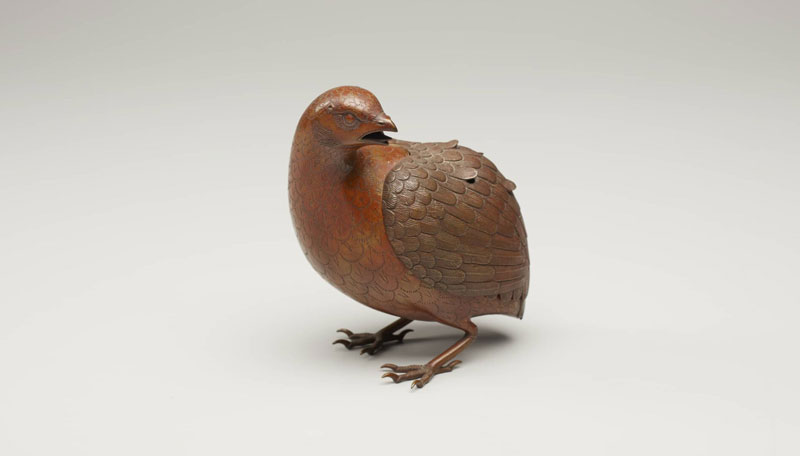
Kōgie Kamejo (Japanese, active 18th/19th century), Incense burner in the shape of a quail, 18th century, Brass with patina and traces of gilding, 4 3/4 in x 2 7/8 in x 5 3/16 in, Gift of Richard Louis Brown in honor of Maribeth Graybill, public domain, 2019.38.1a,b; Courtesy Portland Art Museum
Portland Art Museum
MAKERS: The Culture of Craft
Through May 30, 2027
1219 SW Park Avenue
Makers celebrates the virtuosity of Japanese craftsmanship and the enduring relationship between maker and material. Spanning centuries, the exhibition explores the intersections of art, craft, design, and labor through works ranging from Bizen pottery and lacquerware to bamboo sculpture and metalwork. Featuring many new acquisitions on view for the first time, it highlights the artistry, mastery, and emotional power of beautifully crafted objects while reflecting Portland’s own vibrant maker culture.
To learn more, click here.
Shibata Gitō, Japanese, 1780-1819, Illustration to the Heike Monogatari, ca. 1800, Ink and colors on silk, Image: 33 × 10 3/4 in. (83.8 × 27.3 cm); Overall with knobs: 73 × 17 1/2 in. (185.4 × 44.5 cm), On loan from the Catherine and Thomas Edson Collection, L.2011.10.60; Courtesy San Antonio Museum of Art
San Antonio Museum of Art
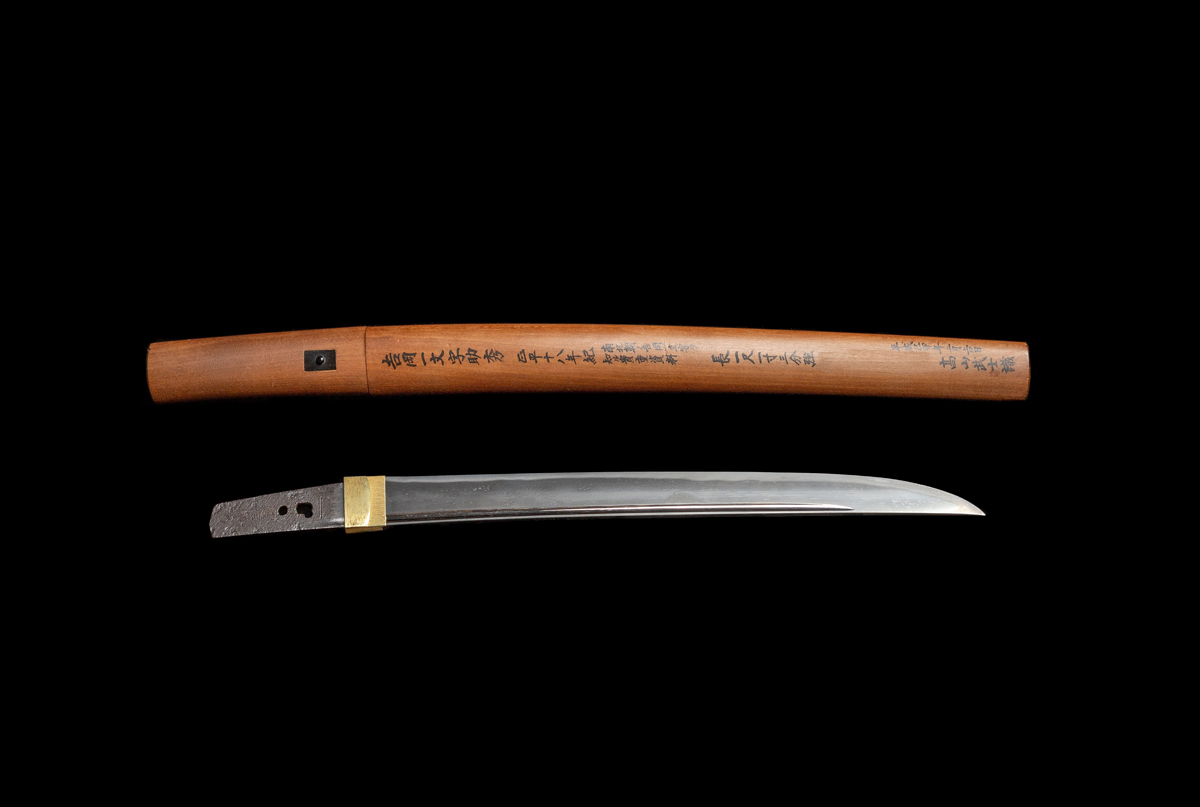
Samurai Spirit: Swords, Accessories, and Paintings
Through January 3, 2027
200 West Jones Avenue
Few objects in Japanese culture carry as much symbolic weight as the samurai sword, a weapon of lethal beauty, forged through the painstaking process of heating and folding steel countless times. The warriors who wielded them inspired centuries of legend, literature, and art, and their blades became revered emblems of honor. This exhibition features two exceptional 14th-century examples, a wakizashi and a katana, acquired through the generous bequest of the late Robert Clemons, offering a rare encounter with craftsmanship that has captivated for more than 600 years.
To learn more, click here.

Vase, 13th-14th century, Porcelaneous stoneware with incised decoration and ash glaze (Seto ware), Japan, Kamakura period (1185–1333), Eugene Fuller Memorial Collection, 53.19. photo: Scott Leen; Courtesy Seattle Art Museum
Seattle Art Museum
Ash-Glazed Ceramics from Korea and Japan
Ongoing
1300 First Avenue
Drawn from the Seattle Art Museum’s exceptional holdings of Japanese and Korean art, this exhibition brings together 34 ceramic masterworks united by a single, extraordinary material: ash glaze. Spanning centuries and cultures, this selection reveals the transformative power of fire, earth, and time—from ancient Korean ritual wares and early Japanese ceramics to refined Seto pottery and monumental storage jars. Together, these works tell a sweeping story of craftsmanship, innovation, and artistic ingenuity across two of Asia’s greatest ceramic traditions.
To learn more, click here.