Final Week to Experience Kiyoshi Hamada at Seizan Gallery

Seizan_HamadaInstall

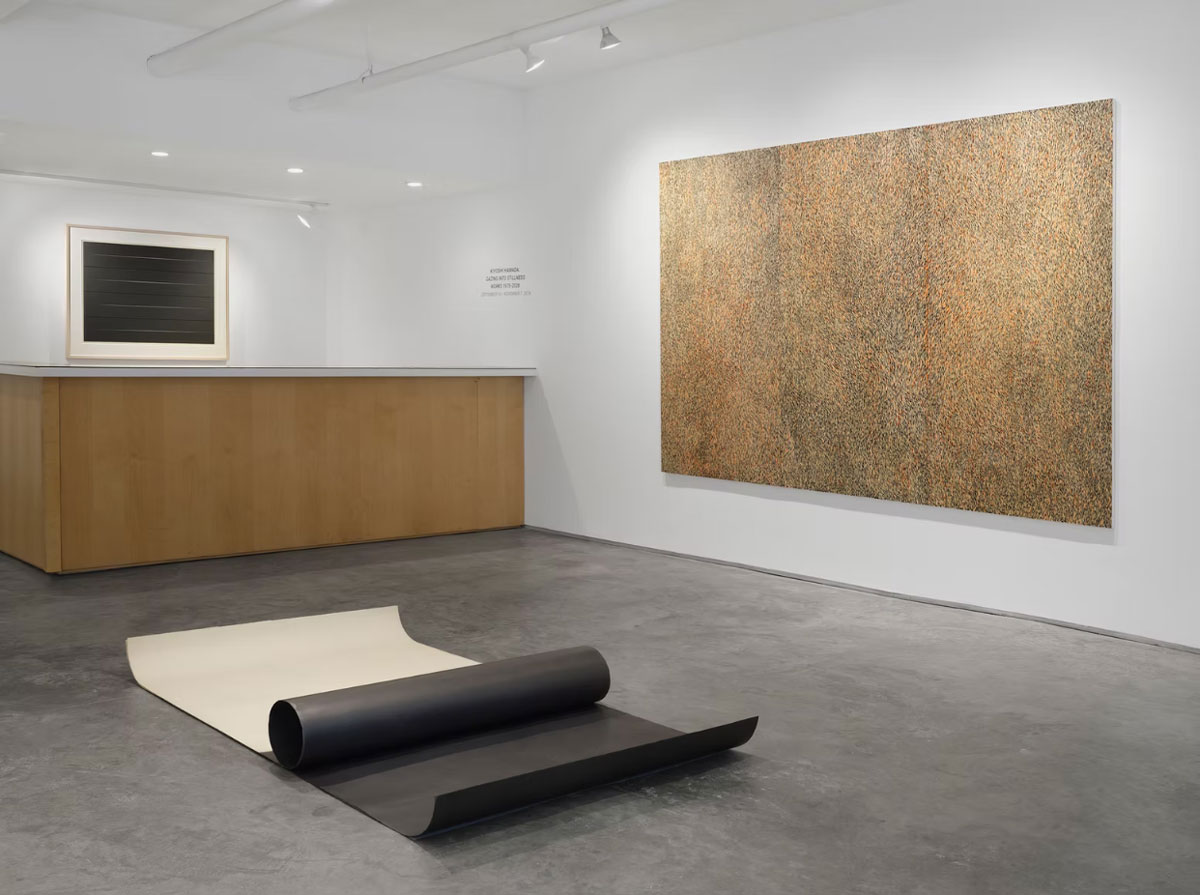
Installation view Kiyoshi Hamada: Gazing Into Stillness – Works 1975–2026 at Seizan Gallery, NYC. Photography by Thomas Barratt.

Kiyoshi Hamada: Gazing Into Stillness – Works 1975–2026
Closing Saturday, November 7, 2026
525 West 26th Street, NYC
Tuesday to Saturday, 11am–6pm

There’s still time to discover this exceptional survey of Kiyoshi Hamada, one of the hidden giants of postwar Japanese art, at Seizan Gallery before it closes on November 7. Spanning nearly five decades, the exhibition traces Hamada’s remarkable artistic journey and his ongoing exploration of painting as a physical process rather than simply a means of representation. Working independently of the postwar avant-garde movements that surrounded him, Hamada has developed a singular visual language through his engagement with materials, texture, repetition, and the traces of the artist’s hand.

From his early, minimalist plywood paintings inspired by memories of the Pacific horizon, to densely layered graphite drawings and richly textured canvases carved into with brushes and gouges, the exhibition reveals an artist continually pushing the boundaries of abstraction. The presentation culminates in two large-scale ink paintings created especially for this occasion, offering a compelling reflection on a practice shaped by more than fifty years of experimentation, patience, and sustained inquiry.

Be sure to visit the gallery before November 7 to experience this remarkable tribute to Hamada’s enduring artistic vision.

To learn more, click here.

• • •

Final Days of Fong Chung-Ray and Hung Hsien: A New Horizon at Alisan Fine Arts

Alisan_NewHorizonInstall

Installation view of Fong Chung-Ray and Hung Hsien: A New Horizon at Alisan Fine Arts, NYC

Fong Chung-Ray and Hung Hsien: A New Horizon
Closing Thursday, November 5, 2026
120 East 65th St, NYC

These are the last days to view A New Horizon, featuring artists Fong Chung-Ray and Hung Hsien before it closes at Alisan Fine Arts on November 5. Both artists immigrated to Taiwan as teenagers and later settled in the US, where they reside today; Fong in California, and Hung in Texas. Fong and Hung were part of the Fifth Moon Group, a prominent Taiwan art collective that promulgated a move towards modernism while retaining a clear Chinese identity. The focus of this exhibition, however, is the evolution of each artist’s work during their subsequent time spent in the US. Both were influenced by their new surroundings, and as their styles matured, they introduced elements of their cultural tradition in different ways, each creating their own unique contemporary artistic language.

Make sure to catch it before it closes!

To learn more, click here.

• • •

Ippodo Gallery Opens Leaves of Words: Satoshi Nemoto, Tsuneo Nakazawa, Shinya Yamamura

Ippodo_Leaves

Leaves of Words: Satoshi Nemoto, Tsuneo Nakazawa, Shinya Yamamura
October 30 – December 5, 2026
Opening Reception with Artists Satoshi Nemoto and Tsuneo Nakazawa: October 30, 6-8pm (kindly RSVP)
Artist Talk with Satoshi Nemoto and Tsuneo Nakazawa: October 31, 1-2pm (kindly RSVP)

35 N Moore Street, NYC

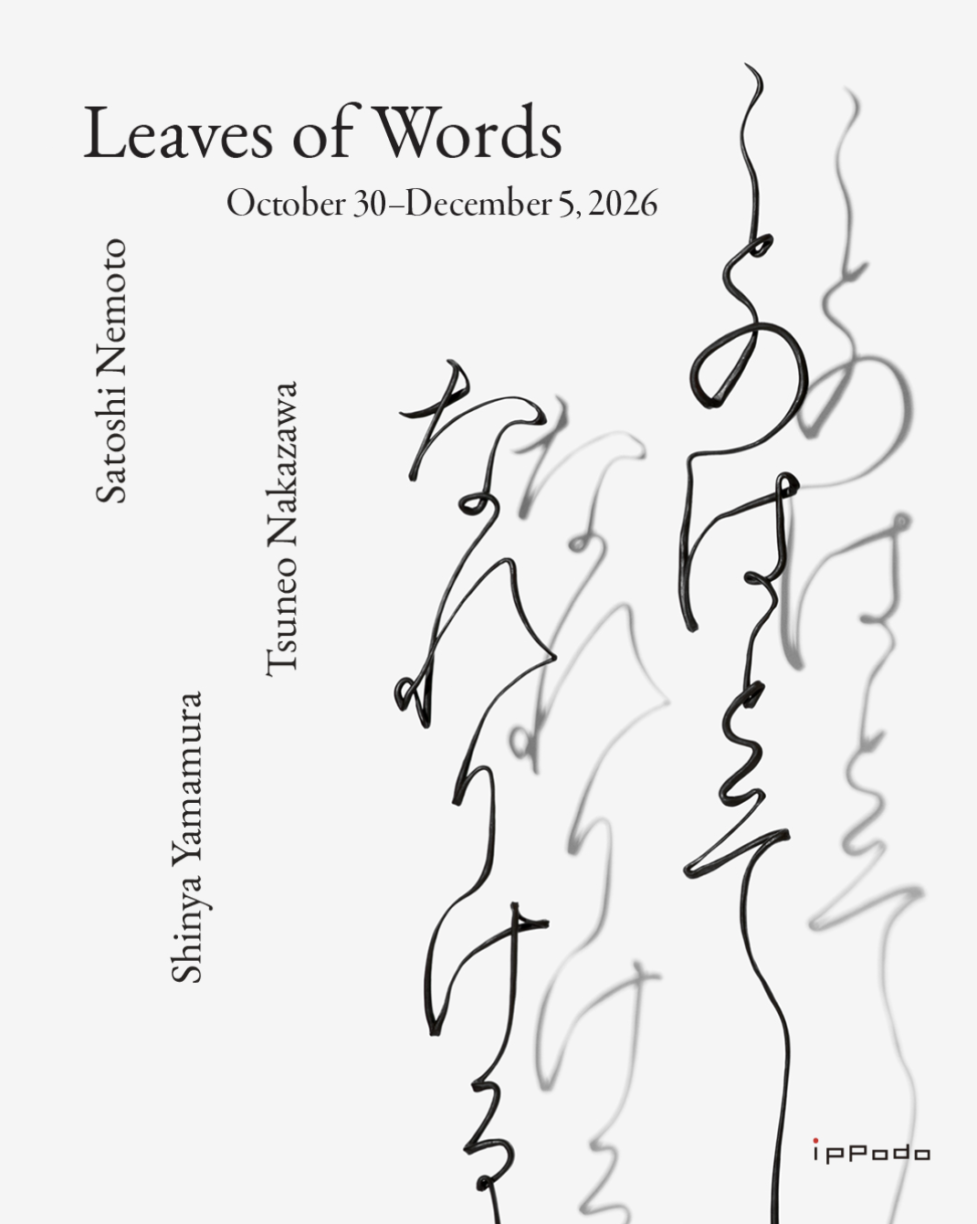
Ippodo Gallery is pleased to present Leaves of Words: Satoshi Nemoto, Tsuneo Nakazawa, Shinya Yamamura, opening October 30 through December 5, 2026.  The exhibition follows a single script across three materials and three hands: the brush of calligrapher Satoshi Nemoto, the forged iron of Tsuneo Nakazawa, and the mother-of-pearl inlay of lacquer master Shinya Yamamura.

“Japanese poetry takes the human heart as its seed and grows into myriad leaves of words.” Preface to the Kokin Wakashū, the earliest kana anthology written by the author Ki no Tsurayuki c. 905.

Kana emerged in the ninth century, when Japanese writers began abbreviating Chinese characters into a phonetic script of their own. In the Heian court, it flourished as the language of poetry and love letters—supple, cursive, and written in a single continuous breath; as much drawing as writing. A thousand years later, kana remains the writing of ordinary Japanese life while retaining its artistic origins. The exhibition features Nemoto’s original works of calligraphy written in Japanese kana, the strokes of each character overlayed and flowing. Nakazawa sculpts kana—from works written by Japan’s historical figures—in iron with inochige (“life brush”): a calligraphy term referring to the continuity of the line. Each work is fluid and unbroken in metal. Yamamura meticulously integrates the script into his tea caddies and incense boxes using traditional mother-of-pearl inlay.

The flowing nature of kana script evokes a visual language before any linguistic meaning. Each stroke inherently possesses rhythm, a breath in the spaces intentionally left between. When realized in raden lacquer and forged iron, the rhythm is given physical form. Set in lacquer by Yamamura, kana script catches the light in shifting color. Hammered into iron by Nakazawa, each mark becomes weighted and casts a shadow. Together the three artists trace one script from brush to iron to lacquer, and one idea from the ninth century to the present.

The exhibition is accompanied by an essay on Nemoto’s calligraphy by Sadako Ohki, Ph.D., the Former Japan Foundation Associate Curator of Japanese Art, Department of Asian Art, Yale University Art Gallery.

They are delighted to welcome the calligrapher Satoshi Nemoto and metal artist Tsuneo Nakazawa, who are travelling from Japan, with an Opening Reception on October 30 from 6-8pm. The artists will speak about the tradition of Japanese kana and waka poetry, as well as their individual artistic techniques during an Artist Talk on October 31 from 1-2pm.

To RSVP to the reception, click here and to RSVP to the artist talk, click here.

To learn more, click here.

• • •

China Institute Gallery at 60 Featured in The Wall Street Journal

ChinaInst_WSJ

Fantastic Winged Feline, fourth-third century B.C. Courtesy China Institute of America

A milestone celebration for China Institute Gallery, its current exhibition, China Institute Gallery at 60, 1966–2026: Selections from Three Millennia of Chinese Art, has earned a place in the pages of The Wall Street Journal, with a recent review celebrating the Gallery’s enduring contribution to the appreciation and understanding of Chinese art.

Bringing together approximately 85 works on loan from more than 30 institutions and private collectors, the exhibition spans nearly three millennia of Chinese artistic achievement, from the 11th century BCE to the 21st century. Exquisite jades and bronze vessels, paintings and calligraphy, Buddhist sculpture, ceramics, and clay burial figures reveal the extraordinary breadth of Chinese art while reflecting the Gallery’s six-decade commitment to deepening public understanding of Chinese art and culture. In his review, art critic Michael J. Hatch also underscores the vital role smaller institutions play in enriching our understanding of culture across generations.

The exhibition is open seven days a week through January. Plan your visit and experience this celebration of Chinese art for yourself!

To read the article, click here.

• • •

Onishi Gallery Returns to Salon Art + Design with an Intimate Collector’s Interior

Onishi_2.-Osumi-Yukie_Araiso

Osumi Yukie 大角幸枝, Silver Vase “Araiso (Rough Shore)”,  2020, hammered silver with nunomezogan (textile imprint inlay) decoration in lead and gold, 10 ⅝ × 10 × 10 in. (27.1 × 25.3 × 25.3 cm)

Salon Art + Design
Crafted Dialogues: Art and Design in Conversation
Booth C5
November 4–8, 2026
Conversation with Guillaume Coutheillas: Friday, Nov 6 at 12pm
Park Avenue Armory | 643 Park Avenue, NYC

Discover a fresh perspective on contemporary Japanese craft as Onishi Gallery returns to Salon Art + Design, November 4–8 at the historic Park Avenue Armory. Titled Crafted Dialogues: Art and Design in Conversation, this year’s presentation has been reimagined by Guillaume Coutheillas, founder of frenchCALIFORNIA, as an intimate collector’s interior, bringing contemporary Japanese craft into a thoughtful dialogue with works by artists from New York, Italy, and Korea.

The booth embodies the cultural dialogue at the heart of Coutheillas’s practice. Born in Paris, he combines French refinement with an American sense of openness and a cosmopolitan curiosity about objects from across the world. His interiors forge connections across cultures, periods, and disciplines, allowing each piece to retain its identity while contributing to a larger narrative.

OnishiSalon
Installation view of Crafted Dialogues: Art and Design in Conversation at Salon Art + Design, Booth C5

Alongside wall works by sculptor Jeffrey Maron, portraitist Agostino Rocco, and mixed-media artist Ran Hwang, the Onishi Gallery booth will present a wide range of Japanese KOGEI: a distinctive category defined by exceptional craftsmanship, a profound engagement with material, and the reinvention of centuries-old traditions in contemporary form. The featured artists work in lacquer, clay, and metal.

In lacquer, Onihira Keiji addresses contemporary subjects while retaining the classical language of gold powders, shell inlay, and polished surfaces. Noguchi Ken’s sculptural forms, by contrast, evoke the movement and depth of the sea. In ceramic art, Kaneshige Kōsuke’s subtle humor reimagines ancient kiln traditions, Konno Tomoko’s biomorphic forms exploit the tension between attraction and apprehension, and Ōhi Toshio Chōzaemon XI’s work in stoneware evokes the primordial forces of the earth. In metalwork, Rusu Aki wields her blowtorch to create sculptural works in iron shaped by elemental processes of transformation, while Living National Treasure Ōsumi Yukie uses gold and lead overlays to imbue her silver vessels with an extraordinary sense of softness.

Also featured will be a selection of contemporary ceramics from the Setouchi region of western Honshu, Japan’s main island. Okano Genroku creates functional and sculptural works in the Bizen ware tradition, celebrated for its chance effects, rough textures, and visible traces of the maker’s hand. Kuroi Hiroshi combines the thin-walled, elegant heritage of Mushiage ware with extensive use of modern polychrome and iron glazes.

Conceived as a space of encounter and discovery, Crafted Dialogues: Art and Design in Conversation celebrates the connections that emerge when diverse traditions, materials, and perspectives converge, revealing craft’s unique capacity to bridge cultures, histories, and disciplines.

Onishi’s Gallery own exhibition Across the Sea, held in celebration of their twentieth anniversary and bringing together ten of Japan’s most accomplished KOGEI practitioners, will be on view at their Upper East Side premises through December 22.

They look forward to welcoming you soon!

To learn more about the fair, click here.
• • •

Final Days of Patina of Time: The Clay Art of Iguchi Daisuke at Joan B Mirviss LTD

Mirviss_PatinaInstall

Installation view of Patina of Time: The Clay Art of Iguchi Daisuke at Joan B Mirviss LTD, NYC

Patina of Time: The Clay Art of Iguchi Daisuke
Closing Friday, October 30, 2026
39 East 78th Street, Ste 401, NYC

There’s still time to view Patina of Time: The Clay Art of Iguchi Daisuke at Joan B Mirviss LTD before it closes October 30. A native of Tochigi Prefecture in northeastern Japan, Iguchi Daisuke (b. 1975) has inherited the legacy established by two of the region’s most renowned past ceramic masters, Kamoda Shōji (1933–1983) and Wada Morihiro (1944–2008). Following in these artists’ footsteps, Iguchi creates works that unify surface and form. The intricate linear surface patterns that adorn his vessels’ surfaces undulate in perfect harmony with their gently curving, occasionally lobed forms, offering a compelling evolution of the region’s burgeoning aesthetic tradition while exploring themes that are entirely his own.

At the heart of Iguchi’s artistic expression is the theme of time: “Rather than simply creating form, I hope to create works that inspire viewers to reflect on memory and the passage of time.”

Inspired by rusted iron, moss-covered rocks, and ancient pottery unearthed in archeological digs, Iguchi has developed a meticulous and time-consuming process to cultivate a weathered and eroded texture on the surface of his vessel forms. Using clay from rice paddies in Ibaraki Prefecture, Iguchi coil-builds his simple yet elegant curving and lobed forms. After an initial bisque firing, he coats his works in ash and metallic oxides before firing them again at temperatures approaching 1300 degrees Celsius. He then polishes his works with a wire brush to create his characteristically textured clay surfaces.

He juxtaposes this surface with strikingly precise linear patterns that he creates by masking the clay body and applying silver slip before the final firing at a lower temperature. These patterns dance across the surface of his vessels, at times running in parallel with the curves of the form, at times diverging to create dynamism and rhythmic tension. The result are works that feel both dauntingly ancient and imminently contemporary.

Don’t miss this stunning exhibition before it’s gone!

To learn, click here.

• • •

From Spiritual Reflection to Bamboo and Lacquer: See What’s New at Thomsen Gallery

Thomsen_SpiritualityInstall

Installation view of Spirituality in Japanese Art at Thomsen Gallery, NYC

Spirituality in Japanese Art
Closing Saturday, October 31, 2026
8 East 67th St, NYC

With just one week remaining before it closes on October 31, don’t miss the opportunity to experience Spirituality in Japanese Art at Thomsen Gallery!  Presented in collaboration with the Foundation for Spirituality and the Arts (FSA), this evocative exhibition explores the enduring connection between art and the spiritual realm. Spanning the 18th century to the present, it brings together works imbued with contemplation, devotion, and transcendence, juxtaposing historical pieces with those by four contemporary artists to trace the enduring influence of spiritual ideas and their evolving expression in Japanese art.

To learn more, click here.

Bamboo and Lacquer
November 5 – December 23, 2026

As Spirituality in Japanese Art draws to a close, there’s more to discover at Thomsen Gallery this fall. Opening November 5, the gallery’s annual autumn exhibition, Bamboo and Lacquer highlights Japanese gold lacquer works and bamboo baskets from the modern period, spanning the 1910s through the 1950s.

To learn more, click here.

• • •

Final Week at Fu Qiumeng Fine Art: Discover Chinese Flower Painting

FQM_RougeInstall

Installation view of A Well of Rouge, a Flower of Fortune: Teaching and Learning in Chinese Flower Painting at Fu Qiumeng Fine Art, NYC

A Well of Rouge, a Flower of Fortune: Teaching and Learning in Chinese Flower Painting
Closing Saturday, October 31, 2026
65 East 80th St, Ground Fl, NYC

There’s still time to discover the rich traditions of Chinese flower painting at A Well of Rouge, a Flower of Fortune: Teaching and Learning in Chinese Flower Painting, on view at Fu Qiumeng Fine Art for one final week before the exhibition closes October 31.

At the heart of the exhibition is a remarkable group of instructional paintings by Li Fenggong (1907–1994), a twentieth-century Chinese painter and teacher devoted to preserving and transmitting the traditions of ink flower painting. More than 100 of his instructional works survive, offering a rare record of how classical painting techniques were taught and passed on in the modern era. Selections from this group are presented on a rotating basis throughout the exhibition.

Alongside Li’s instructional works, the exhibition brings together flower paintings spanning the Ming and Qing dynasties through the modern period, tracing how traditions of Chinese flower painting have been taught, learned, reinterpreted, and transmitted across generations.

Don’t miss this opportunity to explore the artistry, knowledge, and cultural heritage carried through generations of Chinese flower painting. Be sure to visit before the exhibition closes!

To learn more, click here.

• • •

Dai Ichi Arts Invites You to Discover The Art of Living

DaiIchi_ArtofLivingHero

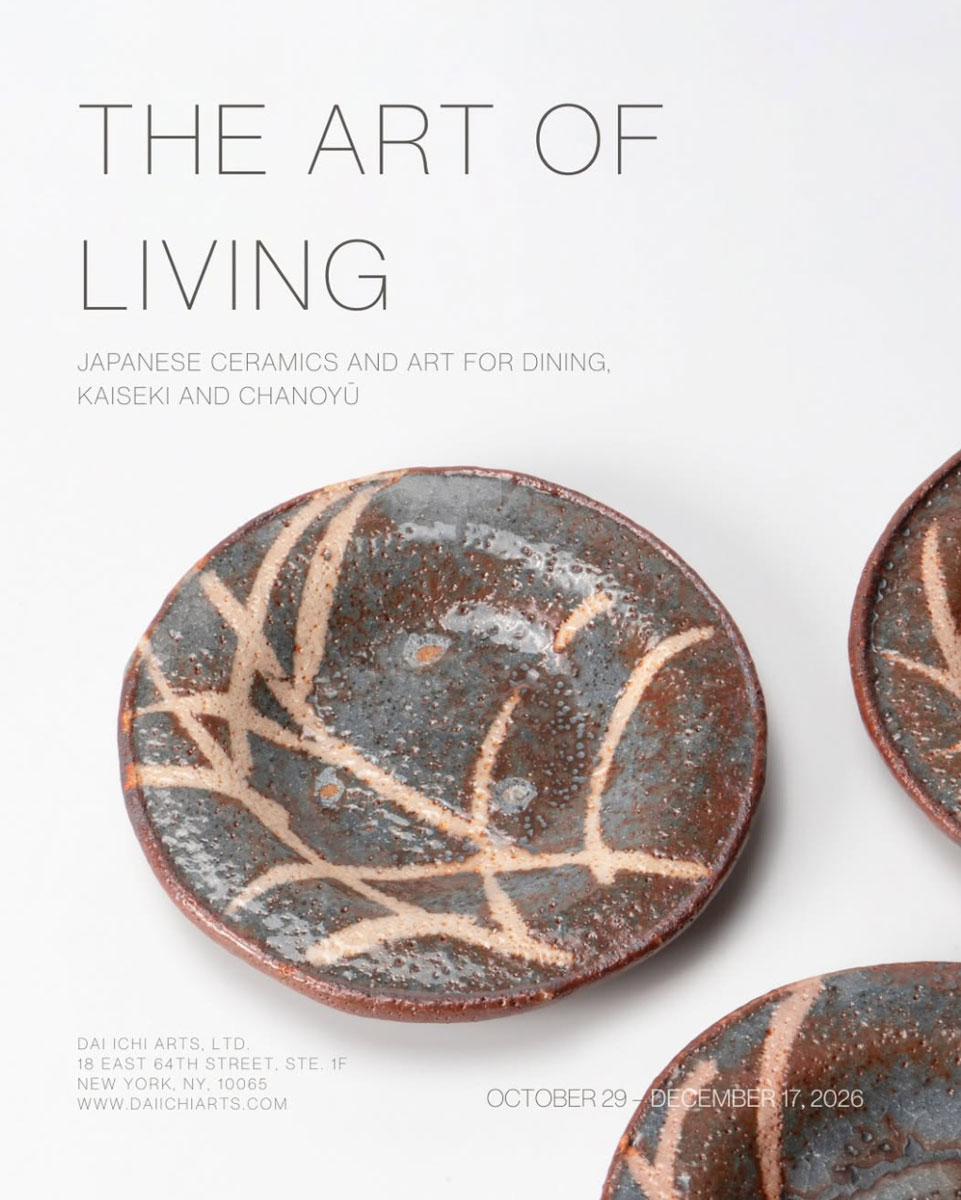
Wakao Toshisada 若尾 利貞 (b. 1933) Nezumi Shino small plates, set of 6, stoneware, 5/8 × 4 3/4 in. (1.5 × 12 cm), with signed wood box, signed artist’s mark at base

The Art of Living
Fine Japanese Ceramics & Art for Dining, Kaiseki, and Chanoyu
October 29 – December 17, 2026

18 East 64th St, Ste 1F, NYC

Dai Ichi Arts, Ltd. is pleased to present The Art of Living, an autumn exhibition of modern and contemporary Japanese ceramics and art for dining, Kaiseki, and Chanoyu by celebrated makers.

The celebrated ceramic artist Kitaōji Rosanjin famously described tableware as “cuisine’s kimono.” Like a kimono, utsuwa (器)—a term meaning vessels, commonly used to refer to tableware—frames and complements what it holds, enhancing the food without competing with it. A vessel’s color, shape, texture, and decoration can make a dish appear more vibrant, delicate, or inviting. And because many Japanese dishes are served in portions small enough to hold, the experience is especially intimate: diners engage with the vessel as well as the food, bringing both close to the body.

This close attention to tableware is especially evident in Sadō: particularly Kaiseki and Chanoyu. In each, vessels are chosen with care for the food, the occasion, the guest, and the season. A meal unfolds through a succession of bowls, plates, trays, sake cups, and containers for sweets or water, each contributing to the rhythm of hospitality. A carefully chosen vessel can express what words cannot: that the host has considered the moment, the season, and the person gathered at the table.

The Japanese table brings together binary qualities: function and beauty, nature and craftsmanship, individuality and harmony, tradition and everyday life. A ceramic vessel carries food, but it can also evoke the season, reveal the maker’s character, bear traces of its own history, and express the intentions of the person who selected it.

Celebrating the art of functional ceramics by celebrated contemporary Japanese artists, our forthcoming exhibition The Art of Living is presented in three parts. The first explores everyday dining through tea cups, platters, bowls, and modern style Japanese tableware. The second turns to kaiseki and the art of the seasonal table. The third enters the tea room, where tea bowls, water jars, and flower vases shape the setting for chanoyu. Together, these three parts reveal how Japanese ceramics bring beauty, meaning, and seasonal tastes to the art of living.

They look forward to welcoming you soon!

To learn more, click here.

• • •

Explore Legendary Futures at the Philadelphia Museum of Art

Philly_LegendaryFutures

Origin of Life, 2011, by Mayank Shyam (Indian, born 1987). © Mayank Shyam

Legendary Futures
Through March 31, 2027

Explore a world where mythology, extraordinary creatures, and imagined futures collide in Legendary Futures, now on view at the Philadelphia Museum of Art through March 31, 2027. Featuring works by Bhajju Shyam, Ram Singh Uruveti, Jangarh Singh Shyam, Mayank Shyam, and Ai Weiwei, the exhibition reimagines stories rooted in Indian and Chinese traditions through contemporary artistic visions, inviting visitors to discover the boundless possibilities of legend and imagination.

Paintings by Bhajju Shyam and Ram Singh Uruveti narrate specific long-shared stories of the Gond communities of India recast through a contemporary lens. Other pieces by Jangarh Singh Shyam, Mayank Shyam, and Ai Weiwei portray marvelous animal life by layering the mythology of India and China onto present-day artistic practices. All this work proves the timelessness of activating the imagination—of the artists and we, the viewers—to envision multiple fantastic futures full of curious, dynamic, and exciting legends.

Be sure to plan your visit today!

To learn more, click here.

• • •