



AUTUMN ASIA WEEK NEW YORK EXHIBITION
Patina of Time: The Clay Art of Iguchi Daisuke
September 10 – October 30, 2026
Special AWNY Autumn Hours from Sept 10-18: Mon–Fri, 11am-6pm & Sat, Sept 12, 11am-5pm
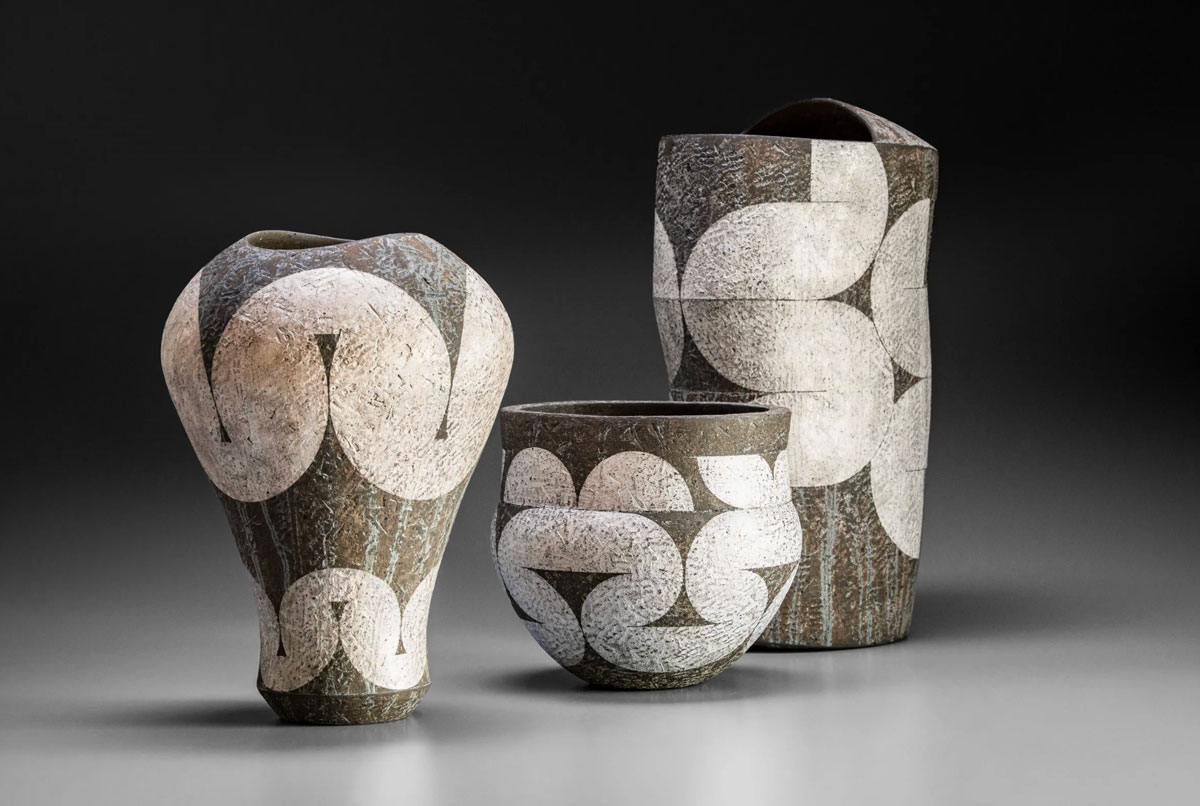
A decade after his highly successful international solo debut at our gallery, we are delighted to present Patina of Time: The Clay Art of Iguchi Daisuke. A native of Tochigi Prefecture in northeastern Japan, Iguchi Daisuke (b. 1975) has inherited the legacy established by two of the region’s most renowned past ceramic masters, Kamoda Shōji (1933–1983) and Wada Morihiro (1944–2008). Following in these artists’ footsteps, Iguchi creates works that unify surface and form. The intricate linear surface patterns that adorn his vessels’ surfaces undulate in perfect harmony with their gently curving, occasionally lobed forms, offering a compelling evolution of the region’s burgeoning aesthetic tradition while exploring themes that are entirely his own.
At the heart of Iguchi’s artistic expression is the theme of time:
“Rather than simply creating form, I hope to create works that inspire viewers to reflect on memory and the passage of time.”
Inspired by rusted iron, moss-covered rocks, and ancient pottery unearthed in archeological digs, Iguchi has developed a meticulous and time-consuming process to cultivate a weathered and eroded texture on the surface of his vessel forms. Using clay from rice paddies in Ibaraki Prefecture, Iguchi coil-builds his simple yet elegant curving and lobed forms. After an initial bisque firing, he coats his works in ash and metallic oxides before firing them again at temperatures approaching 1300 degrees Celsius. He then polishes his works with a wire brush to create his characteristically textured clay surfaces.
He juxtaposes this surface with strikingly precise linear patterns that he creates by masking the clay body and applying silver slip before the final firing at a lower temperature. These patterns dance across the surface of his vessels, at times running in parallel with the curves of the form, at times diverging to create dynamism and rhythmic tension. The result are works that feel both dauntingly ancient and imminently contemporary.
To learn, click here.
UPCOMING EXHIBITION
Exploring the Unseen: The Sculptures of Tanaka Yū
November 5 – December 18, 2026
Tanaka Yū (b.1989), a highly creative, young female artist based in Kyoto, focuses exclusively on clay sculpture. Inspired by the earlier Sodeisha group, she strives to create forms that encapsulate both space and air and question the very nature of functionality — what may really be inside of her clay objects that appear to be vessels wrapped in cloth. The softness, texture, and pliability of cotton cloth colored with traditional dyes for such standard materials are her main point of departure. These trompe l’oeil clay sculptures of Japanese wrapping cloths seemingly enclose hidden vessels or boxes. Although her work appears to be slab-built, Tanaka coil-builds her forms in Shigaraki-blended clay, preferring its superior plasticity. For the surface treatment, Tanaka sponges the surfaces smooth then applies thin layers of clay slip with either a brush or air-brush. Her immediately recognizable work, often in a distinctive turmeric yellow, has already entered the collections of several major museums in the West and has been prominently featured to promote museum exhibitions in recent years.
To learn, click here.
RECORDING OF SEPTEMBER 23, 2026 ZOOM WEBINAR AVAILABLE
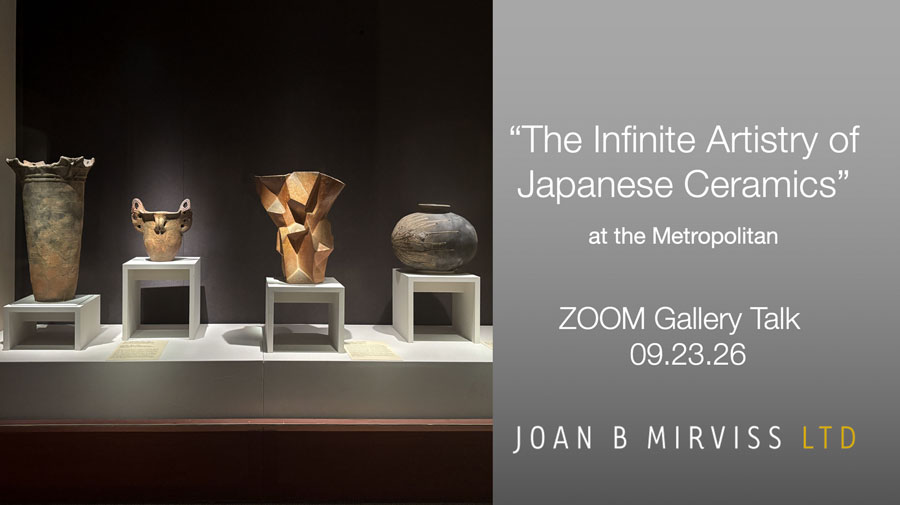
The Infinite Artistry of Japanese Ceramics
Wednesday, September 23, 2026 at 5pm
Zoom
On September 23 at 5pm Eastern, we hosted a lively Zoom webinar on the Metropolitan Museum of Art’s groundbreaking exhibition, “The Infinite Artistry of Japanese Ceramics,” featuring works that span thousands of years of Japanese ceramic tradition. Joan Mirviss moderated a discussion between exhibition curator Monika Bincsik and two artists whose work is featured in the exhibition, Matsuda Yuriko and Kawase Shinobu. The panelists reflected on how the history of Japanese ceramics has shaped contemporary practice and the importance of displaying works from the past and present together as part of a continuous narrative.
Panelists:
Monika Bincsik, Diane and Arthur Abbey Curator for Japanese Decorative Arts, The Metropolitan Museum of Art
Kawase Shinobu, Celadon artist based in Kanagawa Prefecture, Japan
Matsuda Yuriko, Kutani iro-e artist based in Yamanashi Prefecture, Japan
Moderator:
Joan Mirviss, Founder, Joan B Mirviss LTD
To watch the discussion, click here.
Recent Acquisitions
We welcome you to view our recent acquisitions currently on view in the gallery and online.
To learn more, click here.
Videos of Zoom Gallery Talk
Couldn’t make it to one of our gallery talks or want to experience them again? We’re delighted to share that these sessions are now available to watch anytime on our site!
To view them now, click here.
About the Gallery
With more than forty-five years of experience, Joan B. Mirviss is a pillar in the field of Japanese art. As a dealer, scholar, curator, and advisor, she has been the driving force championing the top Japanese clay artists, who she represents exclusively, and whose works she has placed in major museums around the globe. Widely published as a highly respected expert, Mirviss has built many institutional and private collections of Japanese art. JOAN B MIRVISS LTD exhibits modern and contemporary Japanese ceramics, ukiyo-e, and Japanese paintings from its exclusive Madison Avenue location in New York City.


