





Egenolf Gallery Japanese Prints
Kawase Hasui 巴水
(1883-1957)
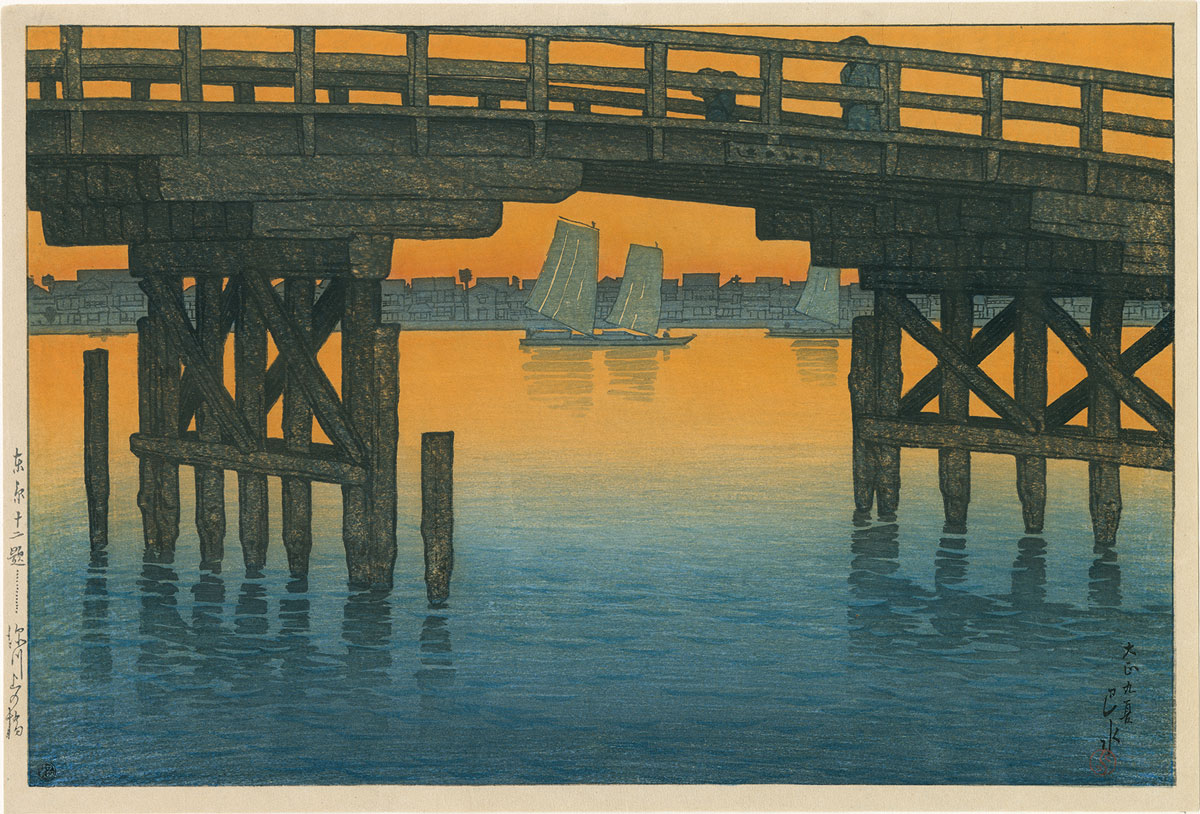
Kamino Bridge, Fukagawa 深川上の橋
Series: Twelve Scenes of Tokyo (東京十二題 Tokyo jûnidai)
Date: 1920, Summer
Water and sky are almost ablaze in the glow of a dazzling orange sunset, our focus on a two-masted wooden boat gliding on the glassy river, framed perfectly beneath the darkened wooden posts and girders that form the Kamino Bridge. Our view seems to be where the Sendai Canal meets the Sumida River. Hasui has outdone himself in capturing a very specific moment at a specific place and time. It could almost be a film still, as the boats are gliding along, the colors of the setting sun are shifting by the second, and the people on the bridge are certainly in motion. This lovely wooden bridge is long gone, and a Tokyo that looks like this is also only a memory. Note also the brilliance of the printing, with the rough textures of the bridge that have the baren marks showing, contrasted with the glassy surfaces of the water and sky. Hasui himself wrote the following about this print in his diary: “The wooden Kami(no) Bridge connects the Fukagawa districts of Saga and Kiyosumi. The setting in this work is a summer evening. The shadows beneath the bridge at twilight contrast the light of the sunset, creating a fine impression. A sailboat moves slowly down the river: this ordinary scene was one that delighted me. Across the river is Nakazu. No incongruous western-style buildings are visible there, and I could not help but think that this area recalled the period when Hokusai designed his Sumidagawa ryôgan ichiran”. From the series “Twelve Scenes of Tokyo”. The sky and water in this print are a much deeper orange than the print depicted in Narazaki and Hotei, which has a more yellow-based color palette. Colors are also deeper here than the Balcer example at the VMFA and the Muller example at the National Museum of Asian Art. This deep orange is probably a variant coloration, but one that this dealer prefers for its intense drama. A rare, pre-earthquake design, especially in this condition and with these colors.
Condition: Excellent impression, color and condition.
Dimensions: ôban (26.5 x 38.4 cm) Publisher: Watanabe
Literature: Hotei #31 Narazaki #31. See Water and Shadow number IV.31 from the Balcer collection, now at the VMFA. See National Museum of Asian Art Seal: Kawase Signature: Hasui
SOLD
SKU: HAC031R
Contact Gallery
Gallery Website

Egenolf Gallery Japanese Prints
Kawase Hasui 巴水
(1883-1957)
Evening Showers at Matsunoshima 松の島の夜雨
Series: Mitsubishi Detached Villa 三菱深川別邸の図 Date: 1920 大正九年
A fabulous, ancient pine tree, its branches supported by wooden supports, spreads on an island in the lake of a classical garden. Atop the dark tones of the print are silver-white strands of falling rain, which fall straight down in the windless night.As Hasui himself notes “This design can be said to the be the best work in the entire set, even though it is reminiscent of the print Karasaki no you {Night rain in Karasaki” from the series Eight views of Omi ca 1834, by Hiroshige} The black shadows from the sky cast a deep indo-blue light that surrounds the rocks under the pines, flickers of light are seen in the windows of the building s on the opposite bank.” The Iwasaki family, owners, of Mitsubishi, commissioned this set of eight woodblock prints of their villa and gardens. to present to their business clients. First and only edition, this work was printed in 1920. This exact print was published in the Folk Museum of Ota City catalog “Hasui Kawase Exhibition Catalog” (2007), page 25, number 11. Provenance: From the personal collection of the late Hasui scholar Hisao Shimizu.
Condition: Excellent impression and condition. Very good color.
Dimensions: oban (25.6 x 38.2 cm) Publisher: Watanabe Shôzaburô
Literature: H#82; N82
Seal: Kawase Signature: Hasui
Literature: Narazaki Muneshige, Kawase Hasui mokuhanga shu, 1979, number 46. Kendall H. Brown, Kawase Hasui: The complete woodblock prints, 2003, number 46. See Hisao Shimizu’s 2007 catalog from the Ota City Folk Museum, page 25, number 11. See the MFA Boston, VMFA, National Museum of Asian Art, Carnegie Museum of Art.
Price: $25,000
SKU: HAC046R
Contact Gallery
Gallery Website
Egenolf Gallery Japanese Prints
Kawase Hasui 巴水
(1883-1957)
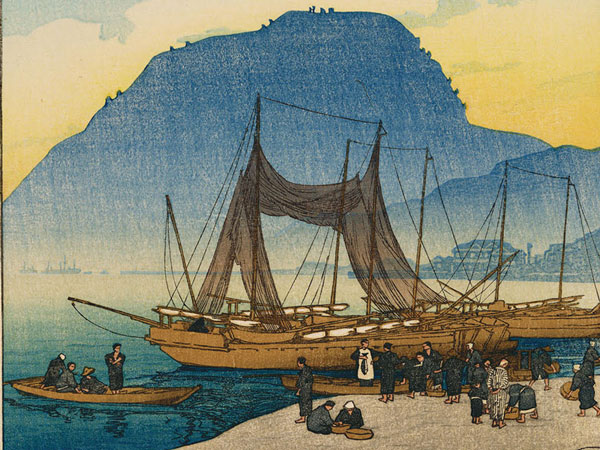
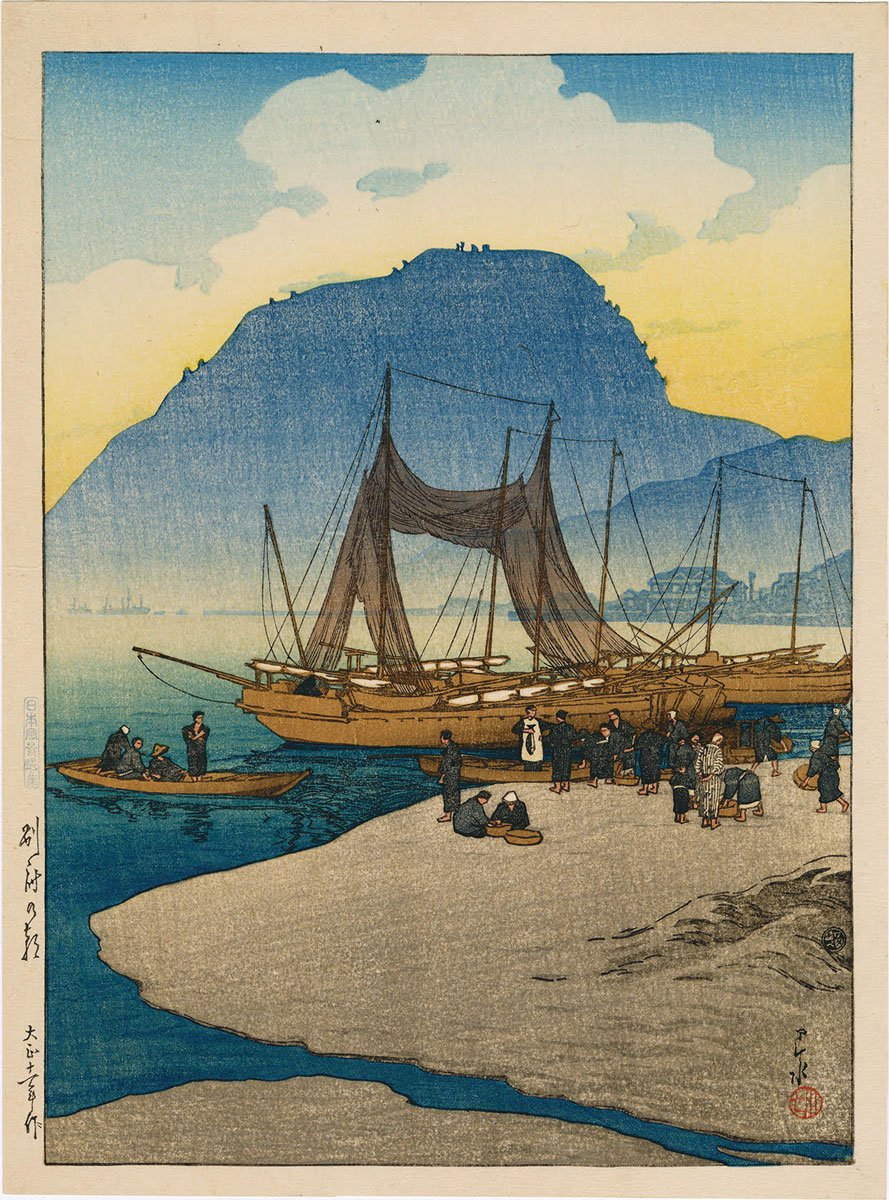
Morning In Beppu 別府の朝
Series: 日本風景選集 Nihon fukei senshu
Date: 1922
An unusually scarce, pre-earthquake design from the series “Selection of Scenes of Japan”. An informal fish market seems to be taking place, with a man in an apron holding up what looks to be a tuna. Other villagers gather on the beach, probably inspecting wares that were freshly delivered by the nearby fishing vessels. The small boat at left may be a ferry vessel. The morning sun is still a bright yellow, glowing behind the mountains. As Narazaki wrote: “Villagers and boat passengers gather along a coastal dune. This is the first work by Hasui that deals with a group of people, whose small forms in this composition are beautifully portrayed. A few fishing boats compose the middle ground, the spa town of Beppu and the faraway mountains are silhouetted in a purplish blue”. Beppu is one of Japan’s most famous hot spring resorts, home to more than two thousand onsen. This view seems to be from Mochigahama Beach; although the view from the sand looks much the same, urban sprawl seems to have completely covered most of the flat lands between the mountains and the sea, and this rural view that could be from hundreds of years ago has captured a charmingly pre-industrial scene that has largely disappeared. From a limited edition, verso, numbered “nine” from an edition of 300 prints.
Condition: Excellent impression, color and condition. With perfect color. One tiny pigment accretion in sky, from the time of printing. Dimensions: aiban 30.6 x 22.7 cm
Publisher: Watanabe Shôzaburô
Literature: H#89 Signature: Hasui with his seal
Price: $28,000
SKU: HAC089R
Contact Gallery
Gallery Website

Egenolf Gallery Japanese Prints
Kawase Hasui 巴水
(1883-1957)
Hakozaki, Chikuzen 筑前筥崎
Series: Selection of Scenes of Japan 日本風景選集 Nihon fûkei senshû)
Date: 1922
Nihon fûkei senshû, Chikuzen Hakozaki. A tall stone lantern shades a woman and young girl as they stroll along the coast. This lies within the precints of Hachiman shrine near Hakata Bay in present-day Fukuoka Prefecture. Pre-earthquake design with a limited edition seal, 57/300, verso.
Provenance: Formerly in the collection of the late Hasui scholar Hisao Shimizu. This is the exact print shown in the catalog “The Works of Kawase Hasui”, published by Tokyo Bijutsu in 2013 and written by Hisao Shimizu, number 32, page 38. This is the exact print that is shown full page in the catalog “Kawase Hasui Print Collection Art Works”, published by Tokyo Bijutsu Co., Ltd in 2019, page 53.
Condition: Excellent impression, color and condition.
Dimensions: aiban 30.8 x 22.8 cm
Publisher: Watanabe Shôzaburô
Literature: Kendall H. Brown, Kawase Hasui: The Complete Woodblock Prints, 2008, p. 332, no. 102; Kendall Brown, Water and Shadow: Kawase Hasui and Japanese Landscape Prints, Virginia Museum of Fine Arts, 2014, p. 158, cat. IV.101. “The Works of Kawase Hasui”, published by Tokyo Bijutsu in 2013 and written by Hisao Shimizu, number 32, page 38. This is the exact print that is shown full page in the catalog “Kawase Hasui Print Collection Art Works”, published by Tokyo Bijutsu Co., Ltd in 2019, page 53.
Signature: Hasui with his red artist’s seal
Price: $13,000
SKU: HAC102R
Contact Gallery
Gallery Website

Egenolf Gallery Japanese Prints
Koson 小原古邨
(1877-1945)
Japanese Bush Warbler and Peony in Snow
Date: ca. 1930
Dramatic design of a brightly colored green and yellow Japanese bush warbler perching against a deep black winter sky. Although this bird is identified as a Siberian Bluechat by Newland/Perrée/Schaap, the bluechat has a deep blue coloration above that this one lacks. In the 1936 Watanabe catalog (number O34), it is identified as a Japanese Nightingale, today called a Japanese bush warbler. The Japanese bush warbler (Horornis diphone) is olive brown above and may have a soft yellow below. Its head and leg coloration do look closer those seen on this Koson design. With thanks to Nick Hamatake, who kindly offered his expert birding eye to confirm that this is most likely a Japanese bush warbler due to a number of identifying features, including even the shape of the bird’s bill and the season of winter/early spring. He also noted a centuries-old poetic association as this bird as an early harbinger of spring.
In any case, this print features a lovely bird peering down from its perch on a snow-covered twig on a protective tentlike shelter that has been erected for an enormous red peony that is blooming despite the elements. The white snow contrasts dramatically with the jet black background, and the deep color of the flower beckons as invitingly as a warm spring morning. This is sourced from a collection of works that were assembled in Japan before WWII and were never framed. With the Watanabe “Wa-ta-na-be” personal seal, lower right, often referred to as a “gift” seal. From the paper and the printing, this dealer would judge this to be a prewar printing. There are also no postwar Watanabe seals on the work. A very scarce design that almost never appears on the market. Due to its rarity and lack of postwar reprints, it is probable that the blocks for this design were destroyed during the war.
Condition: Excellent impression and color; very good condition. With remnants of an original circular sticker, upper left and minor issues at upper margin.
Dimensions: 38.6 x 26 cm Publisher: Watanabe Shôzaburô
Seal: artist’s seal Signature: Shoson
References: Newland, Perrée, & Schaap, Crows, Cranes & Camellias (2001), checklist no. S26.1; Watanabe 1936 Catalog number O34, page 99.
Price: $3,500
SKU: KOC034R
Contact Gallery
Gallery Website

Egenolf Gallery Japanese Prints
Utagawa Kuniyoshi
(1797-1861)
Zen Priest Bukan, from Sixteen Female Sennin Charming Creatures, ca. 1847
Contact Gallery
Gallery Website

Egenolf Gallery Japanese Prints
Utagawa Kuniyoshi
(1798-1861)
Ouch! That hurts! (Oo, itai おお,いたい)
Series: Sankai medetai zue 山海目出度図絵 (Celebrated Treasures of Mountains and Seas)
1852
35.4 x 24 cm
Contact Gallery
Gallery Website

Egenolf Gallery Japanese Prints
Toyohara Kunichika
(1835-1900)
Beauty Sewing at Eight pm, From Scenes of the Twenty-four Hours, A Pictorial Comparison, 1866
Contact Gallery
Gallery Website
Egenolf Gallery Japanese Prints
Utagawa Hiroshige 広重
(1797-1858)
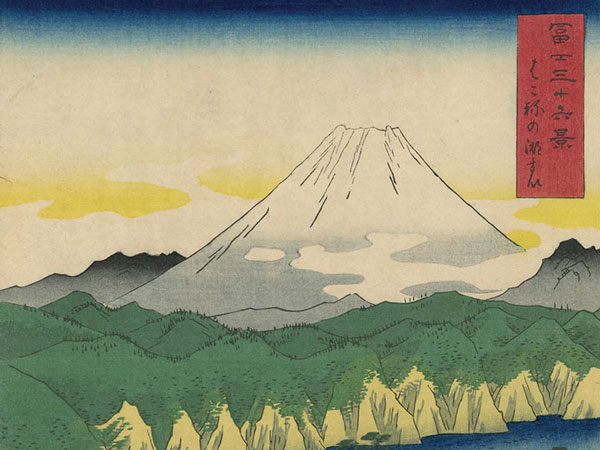
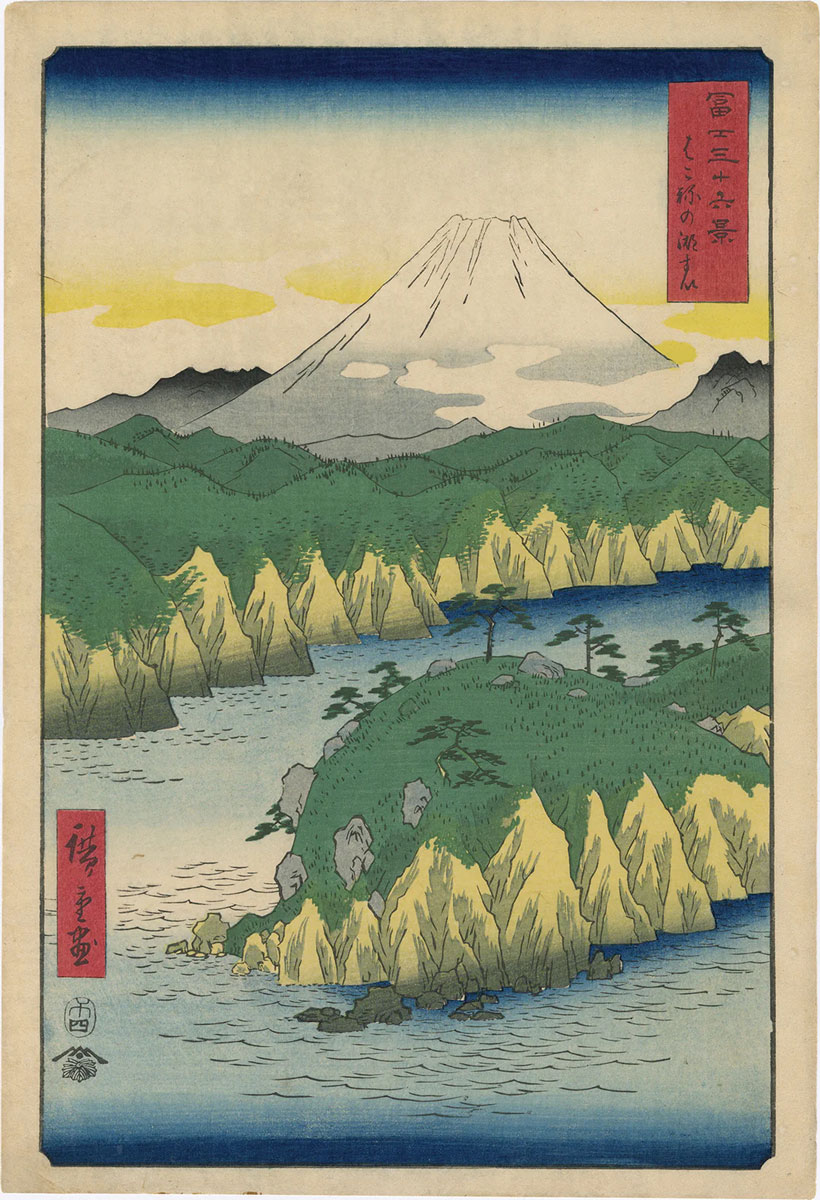
Lake at Hakone はこねの湖すい (Hakone no kosui)
Series: Thirty-six Views of Mt Fuji 富士三十六景 (Fuji sanju rokkei)
Date: 4/1858
The unmistakable and symmetric cone of Mount Fuji rises clear and strong above the mists as seen from Lake Ashinoko (also known as Hakone Lake) in the resort area of Hakone. Not a soul is in evidence, nor signs of human habitation, as our view features green hills atop gentle yellow cliffs. This scene is probably almost the same today, as the area remains very lightly developed. Bright yellow clouds lie just beyond Mount Fuji, so this may likely be a morning view.
Condition: Excellent impression, color and condition. Fresh and clean. Minor repaired binding holes in right margin
Dimensions: ôban (36.2 x 24.8 cm)
Publisher: Tsuta-ya Kichizô
Signature: Hiroshige ga
SKU: HIR563
Contact Gallery
Gallery Website

Egenolf Gallery Japanese Prints
Takahashi Hiroaki (Shotei)
(1871-1945)
Mount Fuji from Mizukubo 水久保
Date: 1936 (this version postwar)
Mount Fuji is seen from Mizukubo, the sky a dramatic purple-pink. The prewar versions have a much more subtle coloration, but this version is more dramatic. This view is from Fuji’s less perfect southeast side, where the Hoei crater and peak were formed due to a huge eruption in 1707. We see a few thatch-roofed buildings that crouch in the dusk beside a stream, their windows aglow with soft yellow. Most extant impressions of this work are postwar, as here; they also often bear no publisher’s mark.
Condition: Excellent impression and color; very good condition. With numerous areas of tape remnants, verso.
Dimensions: 26.2 x 39.6 cm Publisher: Watanabe Shôzaburô Signed: Hiroaki
SKU: HIA047
Contact Gallery
Gallery Website

Egenolf Gallery Japanese Prints
Kawase Hasui 巴水
(1883-1957)
The Kasuga Shrine in Nara in rain 奈良春日大社
Date: 4/1933
Series: Collected Views of Japan II, Kansai Edition 日本風景集 II 関西篇
We are treated to the view of the glowing vermilion Kasuga Shrine, along with two women in kimono who approach it beneath a shared umbrella. Rain falls in fine silver threads, and the wet surface in the foreground includes skillfully created shimmering reflections. Kasuga Taisha Shrine was founded by Emperor Shotoku in 768, and the Kasuga Festival on March 13th has been held for more than 1200 years. This shinto shrine has been revered by emperors and rulers since ancient times, and its treasure hall contains thousands of items donated by the aristocracy over the centuries. Today the shrine grounds and surrounding area has been designated a World Heritage Site. With the Watanabe seal that was in use 1930-1942, this may be considered a “first” edition.
Condition: Excellent impression and condition. Very good/near excellent color. Dimensions: ôban (39 x 25.8 cm)
Publisher: Watanabe Shozaburo; Seal “C”
Literature: Narazaki # 222, Hotei/Brown #317. See MFA Boston
Signature: Hasui Seal: Kawase
SKU: HAC317H
Contact Gallery
Gallery Website

Egenolf Gallery Japanese Prints
Yōshū Chikanobu
(1838-1912)
Fukujuso (Pheasant’s Eye, or Adonis Plant) 福寿草
Series: Fuku Zukushi. “Customs of the East: A Collection of Fuku Words”
東風俗福つくし Date: 1889
Fukujuso is also known as an adonis flower, and its name also means fortune-longevity-plant; its deep yellow hue also suggests the wealth of gold. Here we see two women visiting a night market in winter, shopping for their New Year’s decorations. They are at the stand of a plant seller, and the woman at right is pointing towards the potted adonis flower that the vendor is holding in his left hand. This plant is traditionally considered auspicious to display in the New Year, so we see a number of the flowers in a variety of pots on display. To the right we see what look like miniature plum trees for sale. The woman at right wears a fringed shawl over her kimono, and we see an oil lamp burning at each stand. This series features many interesting details of life in the Meiji era, including the changes in dress and decor.
This amusing series elaborates on words containing the sound “Fuku”; here we also see “Huku Giusoii{u}” in Romaji. Fuku (huku) also means blessings, or good fortune.
Chikanobu is one of the few ukiyo-e artists to be the eldest son of a samurai family. He was a retainer of the Sakakibara clan of the Takada Domain. He studied first with Kuniyoshi, and then with Kunisada, and then with Kunichika. In 1868 Chikanobu actually participated in the Battle of Ueno during the Boshin War as a samurai of his domain. He resumed his career as an ukiyo-e artist around 1875.
Condition: Very good impression and condition. Excellent color. Dimensions: ôban (35.5 x 24 cm)
Publisher: Takegawa Unokichi
Signature: Yôshû Chikanobu-hitsu with his toshidama seal in red
SKU: CHK078
Contact Gallery
Gallery Website
RECENT AUTUMN ASIA WEEK NEW YORK ONLINE EXHIBITION
New and Creative: Japanese Prints from the 20th Century
September 11–18, 2026
Online Exhibition
Our September online exhibition features woodblock prints by the shin-hanga “new prints” giants Kawase Hasui (1883-1957) and Ohara Koson (1877-1945) as well as a selection of works from the “creative prints” (sosaku hanga) movement. Featured are a number of pre-1923 earthquake designs by Hasui, including the blazing orange version of Kamino Bridge, Fukagawa, from 1920. Nine sosaku hanga designs are featured from the “100 Views of New Japan” series, published between 1938-1941 and whose artists include Onchi Koshiro (1891-1955), innovative leader of this “self-printed” movement.
We invite you to discover these remarkable works online here!
Latest Acquisitions
We are pleased to share their newest acquisitions!
New treasures are added every other day, so visit often and discover something inspiring each time.
To view our latest prints, click here.
About the Gallery
Established in 1975, Egenolf Gallery specializes in fine Japanese woodblock prints and drawings, including works by the earliest 17th century pioneers of ukiyo-e to the shin hanga masters of the 20th century. We are pleased to offer a highly curated selection of designs in exceptional condition over a broad range of prices. Our focus is providing value to our clients. Clients include museums, private collectors and dealers in the US, Europe, and Japan. First-time buyers as well as established collectors are able to buy from us with confidence, knowing that all prints and drawings are guaranteed authentic and as described.
Herbert Egenolf began dealing in Japanese prints in 1975 in Duesseldorf, Germany, following an eleven-year residency in Japan. In 1992 he invited Veronica Miller to join him in the business. After working together with Mr. Egenolf for ten years, she became the director of Egenolf Gallery following the untimely passing of Mr. Egenolf in 2002, and now is based near Los Angeles, California. In addition to our schedule of Print Fairs, viewings of prints can be arranged by appointment – contact us by phone or email.
We belong to both the International Fine Print Dealers Association (IFPDA) and the Ukiyo-e Dealers Association of Japan. Every March we participate in Asia Week, New York as well as regional Print Fairs on the West Coast.


