



RECENT AUTUMN ASIA WEEK NEW YORK EXHIBITION
Hijo Nam: Between Time and Being
September 4–27, 2026
Opening Reception: Friday, Sept 4, 2026, 5-7pm
Closing Reception: Thursday, Sept 24, 5-7pm
Presented as part of Autumn AWNY 2026, we are pleased to present Between Time and Being, a solo exhibition by New York–based Korean artist Hijo Nam, on view September 4 through 27, 2026. Bringing together fabric assemblages, lacquer sculpture, painting, and mixed media, the exhibition considers how time, memory, and relationships participate in the formation of human existence.
For Nam, time is not simply a linear progression from past to present. It accumulates. Fabric retains traces of cutting, layering, joining, and handling; lacquer gains depth through repeated application, drying, and waiting; wood preserves the irregularities of weathering and use. Rather than concealing these marks, Nam allows them to remain active within the work. Material becomes a record of duration, carrying what has passed into what continues to exist.
This understanding of time is inseparable from Nam’s sustained interest in relationship. In fabric assemblages including Moments of Journey 2503, Moments of Journey 2, and Moments of Journey 2501, Nam layers, joins, and adheres fragments of fabric to construct pictorial fields while allowing differences in color, texture, density, and scale to remain visible. Irregular seams, exposed edges, overlapping surfaces, and shifting fields of color make the act of connection visible.
For Nam, these fragments parallel the way a life is formed through encounters, memories, loss, care, and relationships with others. Connection does not erase difference; instead, distinct parts acquire new meaning through their coexistence. In Nam’s work, relationship is not simply represented—it is built. Being therefore appears not as a fixed and self-contained state, but as something continually formed through accumulated time and connection.
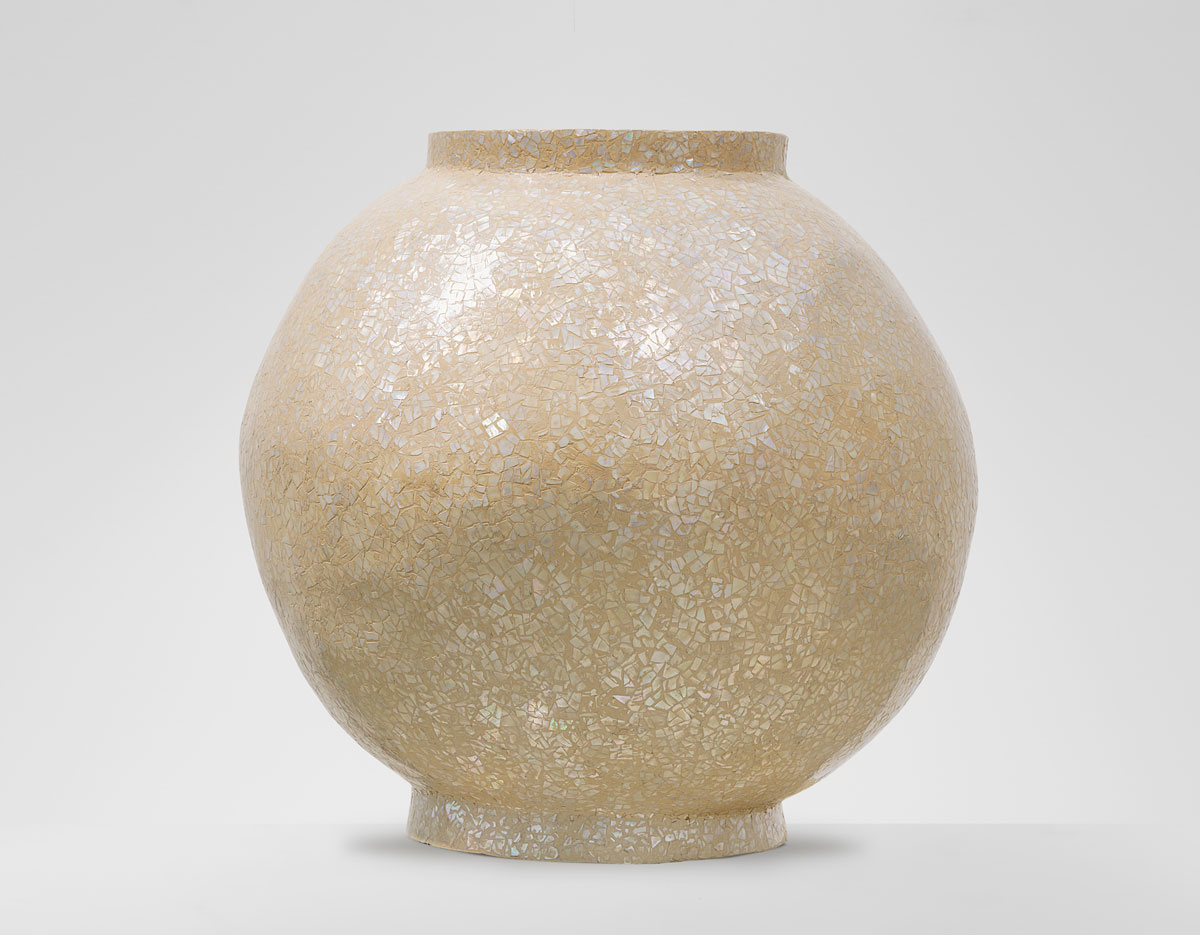
The exhibition extends these concerns across markedly different materials and forms. In Liberal Ashanti 3 and Liberal Ashanti 5, dark, vessel-like forms emerge through the slow process of dry lacquer, their layered surfaces bearing the history of repeated making. Full Moon turns a related rounded form toward luminosity through lacquer and mother-of-pearl. In Cycle of Nature 1, a weathered wagon wheel surrounds a circular painted image, allowing the physical history of an existing object to coexist with another register of time—one associated with landscape, memory, and natural recurrence. Works such as Rhythm 1 and Cycle of Life 7 further expand Nam’s material vocabulary through wood, metal, hanji, hemp, and linen.
Across these works, joining, layering, repetition, and circularity recur as both physical processes and ways of thinking. Time leaves traces; relationships gather those traces into changing structures. Natural cycles of growth, disappearance, and renewal intersect with the more intimate rhythms of individual experience. The space “between time and being” is therefore not an empty interval. It is the space in which memory persists, relationships are formed, and existence continues to change.
Nam’s material practice gives these ideas particular resonance within Autumn Asia Week New York. Fabric, lacquer, hemp, hanji, and labor-intensive hand processes recur throughout her work as materials and methods capable of transformation. While some of these materials and techniques carry deep histories within Korean artistic traditions, Nam does not treat tradition as a fixed image of the past. Instead, inherited processes enter into dialogue with contemporary abstraction, allowing material history to remain active while taking on new forms in the present.
The New York exhibition is presented in dialogue with Nam’s concurrent exhibition at SPACE776 Seoul. Both presentations share the title Between Time and Being and a common conceptual foundation, while bringing together different selections of work. Rather than reproducing a single exhibition across two cities, the project allows the same questions to take different material forms in each location. As the work moves between Seoul and New York, it encounters new spaces and audiences, accumulating another layer of the very conditions Nam explores: time, memory, and relationship.
To learn more, click here.
About the Gallery
Space 776 Gallery was founded in 2015 with the aim of supporting a diverse group of artists, both local and international, spanning multiple generations and working across various media. Since its inception, the gallery has become a significant platform for showcasing emerging artistic talents and fostering connections with institutions.
The gallery first opened its doors on Central Avenue in Bushwick in 2015. In 2020, we relocated to our present address at 37-39 Clinton Street in Manhattan’s Lower East Side. Furthering our commitment to global engagement, we expanded our presence in 2024 with the opening of a new location in Seoul.
Our vision is to continually foster an environment where the narratives of established and emerging artists converge, inspiring new creative dialogues. Our history reflects this commitment. During our time in Bushwick, our long-standing open studio initiative provided crucial support to local artists, many of whom have since achieved greater recognition. Space 776 has successfully introduced and placed the work of our notable new artists in prestigious collections, including the JP Morgan ART collection and the Ukrainian National Art Museum, as well as with significant private collectors. Our support extends beyond the gallery space, as demonstrated by our involvement with the documentary film, Liz N Val. In 2019, we also participated in collaborative exhibitions, such as “Plan B” at David Zwirner. Additionally, we regularly present curated exhibitions at the gallery and have participated in over 60 international art fairs.
Looking ahead to 2025, Space 776 Gallery will continue its mission to support artists throughout their careers, introduce innovative perspectives, and further expand its international network.