Eight Views of Omi: The Floating Pavilion at Katada
(Omi hakkei no uchi: Katada Ukimido)
Title date and signature at upper right: Omi hakkei no uchi Katada ukimido Taisho nananen gogatsu Shinsui (Eight Views of Omi, Ukimido at Katada, Taisho 7 [1918], May, Shinsui), with limited edition publisher’s seal on verso, Ito Shinsui ga, Omi hakkei Katada, shusatsu nihyaku mai kagiri no uchi dai gojuyon ban (picture by Ito Shinsui, Eight Views of Omi, Katada, limited edition of 200, no. 54), with publisher’s seals, hanmoto (publisher), and Watanabe, 1918
aiban tate-e 12 3/4 by 8 3/4 in., 32.3 by 22.3 cm
In 1917 Watanabe and Shinsui embarked on a print series rooted in tradition, the landscape theme of Eight Views of Omi (Omi Hakkei), which was adapted from a classical Chinese landscape grouping, Eight Views of the Hsiao and Hsiang. The Japanese version is a collection of eight famous views of the scenic area around Lake Biwa, paired with eight poetic references: Clear Breeze at Awazu, Evening Glow at Seta, Evening Snow at Mount Hira, Night Rain at Karasaki, Autumn Moon at Ishiyama, Returning Sails at Yabase, Evening Bell at Miidera, and this one, Wild Geese Descending at Katada. The ‘Eight Views’ grouping was a popular subject for numerous print series in the Edo Period (1600-1858); the annals of ukiyo-e are replete with variations, puns and parodies referencing the general framework provided by the poetic theme. In this composition Shinsui dispenses with the traditional ‘Wild Geese Descending’ that are usually depicted in an expansive view over Lake Biwa under a clear sky, and instead illustrates the hexagonal Ukimido Pavilion, ‘floating’ on the lake while enveloped by falling snow.
This classic series was perhaps Shinsui and Watanabe’s most creative, experimental and important collaboration. While adhering to the traditional subject, artist, carver, printer and publisher explored the possibilities of the woodblock print medium.
References:
Kato Junzo, comp., Kindai Nihon hanga taikei, 1975-76, Vol. 1, pl. 169
Tadasu Watanabe, Ito Shinsui: All the Woodblock Prints, 1992, p. 33, pl. 12
Reigle Stephens, Amy, gen. ed., The New Wave: Twentieth-Century Japanese prints from the Robert O. Muller Collection, 1993, p. 183, no. 234
Lawrence Smith, Modern Japanese Prints, 1912-1989, 1994, cat. 34, pl. 35 Nihon no hanga II 1911-1920, Chiba City Museum of Art, 2000, p. 113, pl. 223-2
Reigle Newland, Amy, gen. ed., Printed to Perfection: Twentieth-century Japanese Prints from the Robert O. Muller Collection, 2004, p. 107, no. 94
Koyama Shuko, Beautiful Shin Hanga- Revitalization of Ukiyo-e, Tokyo Metropolitan Edo-Tokyo Museum, 2009, p. 070, no. 2-36
Andreas Marks, Seven Masters: 20th Century Japanese Woodblock Prints from the Wells Collection, 2015, p. 109 cat. no. 55 Ukiyo-e modern: Shinsui no bijin, Hasui no fukei, soshite…), Machida City Museum of Graphic Arts, 2018, p. 61, no. 94
Signed Hasui with artist’s seal Kawase, the title on the left margin, Shiba Zojoji, followed by the date, Taisho juyonen saku (made in Taisho 14 [1925]), the publisher’s (Hotei ‘D,’ see comments below) seal on the lower right margin, Hanken shoyu Watanabe Shozaburo (Copyright ownership Watanabe Shozaburo), 1925
oban tate-e 15 1/4 by 10 3/8 in., 38.6 by 26.5 cm
In recent years this print has vaulted from Hasui’s most popular print, to the most famous shin-hanga landscape, and most recently, possibly one of the most recognizable Japanese woodblock prints of all, achieving its status as an icon of the genre in just under a century. This steady climb to fame began at its inception, it was a great success when Watanabe released it in 1925 and subsequently included it in the Twenty Views of Tokyo series which was completed in 1930.
As is the case with most Hasui prints published by Watanabe, the popularity of any given design is evident in the progression of different publisher seals found on various impressions. From a perspective of connoisseurship, a comparison of examples found in reference works (and often the cover illustrations) reveals remarkably few differences in impressions, a testament to the extraordinary skill of the carvers and printers working with Watanabe.
For this series Watanabe opted to have the series title cartouche, Tokyo Nijukkei, stamped on the print rather than carved into the keyblock, and that seal is often missing, as is the case with this example. Curiously, most impressions of this print (and other prints from this series) were issued without the series title cartouche (even the impressions in the Narazaki Muneshige book and the 2003 catalogue raisonné by Kendall Brown are missing the series title). While it was generally believed that the presence of the series cartouche indicates an early impression, Shimizu suggests (rather convincingly) that the prints were not initially produced as an intended series, but then Watanabe later to decided group them as such, hence the inconsistent presence of the stamped series title (Hisao Shimizu, Kawase Hasui, 2013). According to Narazaki, due to the immediate success of the design, additional batches were ordered, including a final run in 1933, but thereafter Watanabe decided to stop producing it even though the blocks were available and they could have sold many, many more.
In his 1986 book on shin-hanga, Irwin Patcher categorized Watanabe’s rectangular or oblong publisher copyright seals according to their approximate date range with the letters A-H (estimating the rectangular A seal was introduced in 1924), ending with the round seals I (6mm) and J (7mm). This arrangement was somewhat misleading as Watanabe used a version of the round seal from the beginning of his publishing business established in 1909, and the firm continued to used variations of the round seal with occasional changes to the size. In 2003, Kendall Brown’s catalogue raisonné from Hotei Publishing addressed this by beginning with the round seal as A and thereby bumping all seals up by one letter- a designation which we have followed at this gallery since its publication. However, because the old lettering system was entrenched in the minds of collectors, we always refer to the ‘Hotei seal’ in our cataloging. Recent exhaustive research by the printmaker Michael Peters on his website mokuhanga1.com reverts to the original letter designations and labels the round seal number 1, while adjusting some of the circa dates and introducing additional insight on a variety of nuances including the diamond-shaped paper labels sometimes found on the back of prints. For example: the publisher seal on the front of this print (Hotei D) is commonly known as the ‘sausage seal’- due to the tassel-shaped flourishes at the top and bottom on the cartouche. While Pachter indicated circa use dates between 1929 and 1942, Peters identifies two versions of the same seal, C1 (ca. January 1931-March 1933) and C2 (July 1932-1942), of which this is the earlier version.
References:
Dorothy Blair, Modern Japanese Prints, The Toledo Museum of Art, 1930, no. 81
Kato, Junzo, comp., Kindai Nihon hanga taikei, 1975-76, Vol. III, pl. 14
Narazaki Muneshige, Kawase Hasui mokuhanga shu, 1979, p. 56, no. 147
Irwin J. Pachter, Kawase Hasui and His Contemporaries, 1986, p. 55, no. 42 (‘edition 1925’); no. 43 (‘edition 1933’) Tokyo in Transition: The Changing City as Depicted in Modern Woodblock Prints, Edo-Tokyo Museum, 1996, p. 77
Kendall H. Brown, Kawase Hasui: The Complete Woodblock Prints, 2003, p. 356, no. 147
Kendall H. Brown, Visions of Japan: Kawase Hasui’s Masterpieces, 2004, p. 55, no. 19 (also cover)
Amy Reigle Newland, gen. ed., Printed to Perfection: Twentieth-Century Japanese Prints from the Robert O. Muller Collection, 2004, p. 13, fig. 5
Shimada City Museum, Kawase Hasui, The landscape woodblock prints of the Taisho and Showa periods, 2005, p. 60, no. 91
Folk Museum of Ota City, Hasui Kawase, 2007, p. 31, no. 17
Abe Publishing, Kawase Hasui Woodblock Prints, 2009, p. 68, no. 94
Chiba City Museum of Art, Kawase Hasui, 2013, p. 87, no. 81
Folk Museum of Ota City, Hasui Kawase, 2013, p. 58-59, nos. 56 and 57
Carolyn M. Putney, Fresh Impressions: Early Modern Japanese Prints, Toledo Museum of Art, 2013, pp. 140-141, cat. no. 85
Kendall Brown, Water and Shadow: Kawase Hasui and Japanese Landscape Prints, Virginia Museum of Fine Arts, 2014, p. 41, no. III.9
Amy Reigle Newland, ed., Waves of Renewal: Modern Japanese Prints, 1900-1960, Selection from the Nihon no hanga Collection, 2016, p. 34, fig. 3
Ukiyo-e Modern, Machida City Museum of Graphic Arts, 2018, p. 88, no.137
Museum of Fine Arts, Boston, accession no. 35.1890 (round publisher seal; purchased from Mrs. Wilmot R. Evans, Boston, Dec. 5, 1935)
Chazen Museum of Art, John H. Van Vleck Collection, accession no. 1980.749 (round publisher seal)
The Art Institute of Chicago, Oliver Statler Collection, reference no. 1961.1026a; and reference no. 1990.607.469
Michael Peters, mokuhanga1.com, States of Hasui’s Zojoji Temple in Shiba, 2023 (for detailed analysis of progression of printings); and How to date Watanabe Publisher seals, 2024
Europe Series: A Canal in Venice
(Oushu: Venisu no unga)
With brush signature in sumi ink at lower right, Yoshida, and red artist’s seal Hiroshi, large brown jizuri (‘self-printed’) seal on left margin, and titled below, Venisu no unga, blocks carved by Maeda Yujiro under the auspices of Watanabe Shozaburo; self-published by the artist, 1925
dai oban tate-e 16 by 10 7/8 in., 40.5 by 27.7 cm
This print is from an untitled series commonly known as the Europe Series. It bears the requisite ‘jizuri’ (‘self-printed’) seal (which does not actually mean that Yoshida carved or printed the blocks himself but that he oversaw the production) expected on almost all Hiroshi Yoshida woodblock prints. According to Dorothy Blair in the catalogue for the 1930 exhibition of shin hanga at the Toledo Museum of Art, the publisher Watanabe Shozaburo (1885-1962) managed the cutting of the blocks for this design which was initially produced in an edition (or batch) of only sixty impressions. In 1987 Ogura identified Maeda Yujiro (1889-1957), likely hired by Watanabe, as the carver for all but one (Moraine Lake) of the prints in this series.
An innovative publisher largely credited with being the driving force behind the development of a new form of Japanese printmaking that came to be known as shin-hanga (lit. ‘new prints’), Watanabe first collaborated with Yoshida when the artist was chosen to design a woodblock print, The Sacred Garden in Meiji Shrine, for the Meiji Shrine Support Association in 1920 to commemorate the grand opening. The commission connected the two, artist and publisher, both creative forces of nature, and together they produced seven additional works from 1921 to 1922 which Watanabe published and offered for sale in his print shop. At this point Yoshida was already a successful painter, and printmaking was not a primary focus. Then on September 1, 1923, a major earthquake with devastating fires in the aftermath destroyed Watanabe’s premises, including the unsold inventory and original woodblocks for the work of Yoshida and all the other print artists in Watanabe’s circle. Travel savvy Yoshida, having gone on two major journeys around the world in his younger days, quickly organized a trip to go to abroad with his wife Fujio (1887-1987), a talented painter herself, with a mission of raising funds for their artistic community. They departed for the United States in December 1923, bringing with them 62 paintings by fellow-members of their painting group, Taiheiyo gakai (Japan Pacific Painting Society), and 42 prints published by Watanabe that survived the conflagration. Both spoke excellent English, and they worked out an itinerary as they went along from city to city, utilizing their extensive contacts among collectors and curators across the country to arrange pop-up selling exhibitions at as many venues as possible. Local art critics often favorably reviewed the paintings, however, it was the woodblock prints that sold well. Hiroshi and Fujio also sketched and painted prodigiously, producing oil paintings, watercolors, drawings and sketches, amassing a quantity of source material to draw upon in the future. Over a year later in April 1925 they departed from the United States to the United Kingdom and then from there they continued their tour of Europe, visiting the Alps, Lugano, Venice and Greece.
Having appreciated first-hand the potential market for shin hanga type woodblock prints, upon his return to Japan in August 1925 Yoshida began exploring producing new woodblock prints. Certainly, the most logical course of action would have been to approach Watanabe with whom he had already collaborated. In 1987, Ogura recorded that Yoshida hired the master block carver Yamagisihi Kazue (1893-1966) for two prints (Fishes of Honolulu and El Capitan), and then Maeda Yujiro (1889-1957) for the rest of the United States and Europe series. However, in the catalogue for the 1930 exhibition of shin hanga at the Toledo Museum of Art, Blair confirms that while Yamagish carved the blocks for the first two prints, she clarifies that Murakami (dates unknown) carved the blocks for Moraine Lake, and the remainder from 1925 are credited to Watanabe- who likely hired Maeda Yujiro. It is not recorded who printed the blocks, presumably Watanabe initially provided production assistance with his printers as well.
A some point Yoshida must have decided that he wanted more control of the process and he decided to set up his own printing studio, which allowed him to experiment unchecked by the constraints of a publisher. A comparison of impressions of almost any of his early designs will reveal numerous tweaks and variations on how the color blocks were handled–the creative opportunities for a talented colorist such as Yoshida must have been liberating. From this point forward, final versions of almost all Hiroshi Yoshida prints produced in his lifetime have the jizuri.
References:
Dorothy Blair, A Special Exhibition of Modern Japanese Prints, Toledo Museum of Art, 1930, cat. no. 225
Ogura Tadao, Yoshida Hiroshi zenhangashu (The Complete Woodblock Prints of Hiroshi Yoshida), 1987, p. 46, no. 21 Yoshida Hiroshi: Woodblock Print Exhibition, Kushigata Shunsen Museum of Art, 1994, cat. no. 14
Ogura Tadao, Yoshida Hiroshi ten: shizen-e no manazashi, tokubetsuten, botosugo 50 shunen kinen (Yoshida Hiroshi Exhibition), MOA Museum of Art, 2000, p. 110, cat. no. 148
Carolyn M. Putney, et. al., Fresh Impressions: Early Modern Japanese Prints, Toledo Museum of Art, 2013, p. 250, cat. no. 232 Yoshida Hiroshi: A Retrospective, Chiba City Museum of Art, 2016, p. 149, cat. no. 4-33
Monika Hinkel, Yoshida: Three Generations of Printmaking, Dulwich Picture Gallery, 2024, p. 32, cat. no. 3
(inv. no. C-4675)
Europe Series: Sphinx – Night
(Oushu: Sufinkusu yoru)
Brush signed in sumi ink at lower right, Yoshida, with artist’s seal in the shape of an Egyptian djed column to the right and with red seal Hiroshi, small red-brown jizuri (‘self-printed’) in upper left margin, followed by the date, Taisho juyonen saku (made in Taisho 14 [1925]), the Japanese print title below, Sufinkusu yoru, blocks carved by Maeda Kentaro under the auspices of Watanabe Shozaburo; self-published by the artist, 1925
dai oban yoko-e 10 7/8 by 16 1/8 in., 27.5 by 41 cm
This print is from an untitled series commonly known as the Europe Series. It bears the requisite ‘jizuri’ (‘self-printed’) seal expected on almost all Hiroshi Yoshida woodblock prints published after the 1923 earthquake. The seal indicates that Yoshida oversaw the production himself, not that he actually carved the blocks or handled the printing (although sometimes he did get involved with both). According to Dorothy Blair in the catalogue for the 1930 exhibition of shin hanga at the Toledo Museum of Art, the publisher Watanabe Shozaburo (1885-1962) managed the cutting of the blocks for this design which was produced in an edition (or batch) of 95 impressions. In 1987 Ogura identified Maeda Yujiro (1889-1957), likely hired by Watanabe, as the carver for all but one (Moraine Lake) of the prints in this series.
References:
Dorothy Blair, A Special Exhibition of Modern Japanese Prints, Toledo Museum of Art, 1930, cat. no. 229
Ogura Tadao, Yoshida Hiroshi zenhangashu (The Complete Woodblock Prints of Hiroshi Yoshida), 1987, p. 48, no. 25 Yoshida Hiroshi: Woodblock Print Exhibition, Kushigata Shunsen Museum of Art, 1994, cat. no. 16 (and cover illustration) Hiroshi Yoshida Exhibition, A Master of Modern Landscape Painting, Fukuoka Art Museum, 1996, p. 131, cat. no. 113
Ogura Tadao, Yoshida Hiroshi ten: shizen-e no manazashi, tokubetsuten, botosugo 50 shunen kinen (Yoshida Hiroshi Exhibition), MOA Museum of Art, 2000, p. 112, cat. no. 152
Koyama Shuko, Beautiful Shin Hanga- Revitalization of Ukiyo-e, Tokyo Metropolitan Edo-Tokyo Museum, 2009, p. 087, no. 2-62
Carolyn M. Putney, et. al., Fresh Impressions: Early Modern Japanese Prints, Toledo Museum of Art, 2013, p. 253, cat. no. 236 Yoshida Hiroshi: A Retrospective, Chiba City Museum of Art, 2016, p. 151, cat. no. 4-37
Monika Hinkel, Yoshida: Three Generations of Printmaking, Dulwich Picture Gallery, 2024, p. 37, cat. no. 7
Brush-signed in sumi ink at lower left corner, Yoshida, with red artist’s seal Hiroshi, with rust red jizuri (‘self-printed) seal on upper left margin, dated below, Showa ninen saku (work of Showa 2 [1927]), and titled in Japanese below, Kisogawa, with English title in pencil on the bottom margin, Kiso River, and signed in pencil, Hiroshi Yoshida, self-published, 1927
oban yoko-e 11 by 16 1/8 in., 28 by 41 cm
According to Dorothy Blair in the catalogue for the 1930 exhibition of shin-hanga at the Toledo Museum of Art, the blocks for this print were carved by Maeda Yujiro (1889-1957) and at the time, issued in an edition (or batch) of 80 prints.
References:
Dorothy Blair, A Special Exhibition of Modern Japanese Prints, Toledo Museum of Art, 1930, cat. no. 284
Kato Junzo, comp., Kindai Nihon hanga taikei, 1975-76, Vol. III, pl. 8
Ogura Tadao, Yoshida Hiroshi zenhangashu (The Complete Woodblock Prints of Hiroshi Yoshida), 1987, p. 85, no. 85
Ogura Tadao, Yoshida Hiroshi ten: shizen-e no manazashi, tokubetsuten, botosugo 50 shunen kinen (Yoshida Hiroshi Exhibition), MOA Museum of Art, 2000, p. 72, cat. no. 92 (printed with a yellow sky)
Kendall H. Brown, et. al., A Japanese Legacy: Four Generations of Yoshida Family Artists, The Minneapolis Institute of Arts, 2002, p. 54, cat. no. 28
Amanda T. Zehnder, Modern Japanese Prints: The Twentieth Century, Carnegie Museum of Art, 2009, p. 186
Carolyn M. Putney, et. al., Fresh Impressions: Early Modern Japanese Prints, Toledo Museum of Art, 2013, p. 286, cat. no. 291
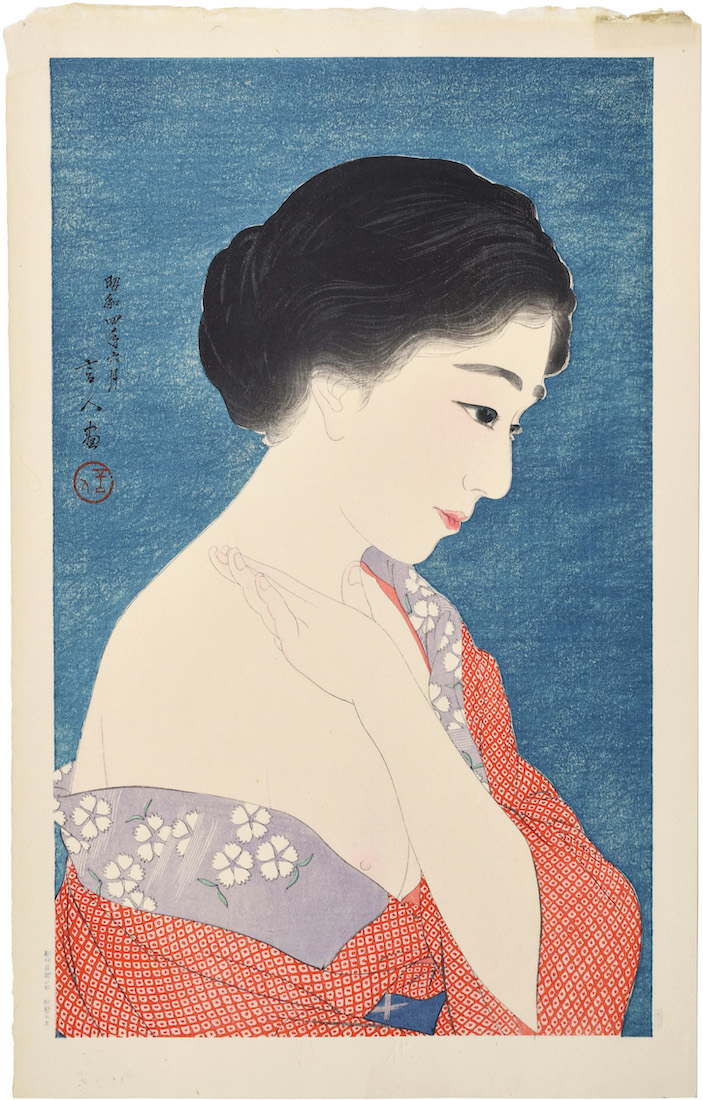
Dated and signed, Showa yonnen roku gatsu (Showa 4 [1929], June), Kotondo ga with artist’s seal Kotondo, the title, Kesho, embossed at the center of the bottom margin, the carver, printer and copyright seal in lower left margin, hori Ito, suri Komatsu, hanken shoyu (carved by Ito, printed by Komatsu, copyright), and publisher’s seal in lower right margin, Kawaguchi, 1929
dai oban tate-e 18 by 11 1/4 in., 45.7 by 28.6 cm
In 1929 Kotondo began producing prints with the publishers Sakai and Kawaguchi, and then the following year with Ikeda. Within five years he produced twenty-two bijinga prints, the majority of which remain among the finest of the shin-hanga genre. The six prints issued by Sakai and Kawaguchi were first issued in a limited edition of 200 and bear a paper label on the back for the export market. Later, some of those six were reissued by Kawaguchi alone in editions of 300 for the domestic market. This print is a variant of the first version of the design, which had a darker background, and was likely produced around the time of second group made for the domestic market, although it does not bear a limited edtion seal.
References:
Dorothy Blair, Modern Japanese Prints: Woodblock Prints by Ten Artists, the Work of the Past Five Years, Toledo Museum of Art, 1936, cat. no. 127 (titled Applying Powder)
Amy Reigle Stephens, gen. ed., The New Wave: Twentieth-Century Japanese Prints from the Robert O. Muller Collection, 1993, p. 198, no. 262
Kendall H. Brown and Hollis Goodall-Cristante, Shin-Hanga: New Prints in Modern Japan, Los Angeles County Museum of Art, 1996, p. 20, fig. 7, cat. 46
Amy Reigle Newland and Hamanaka Shinji, The Female Image: 20th Century Prints of Japanese Beauties, 2000, p. 125, no. 167 (and cover)
Koyama Shuko, Beautiful Shin Hanga- Revitalization of Ukiyo-e, Tokyo Metropolitan Edo-Tokyo Museum, 2009, p. 112, no. 3-16
Amanda T. Zehnder, Modern Japanese Prints: The Twentieth Century, Carnegie Museum of Art, 2009, p. 177
Allen Hockley, Women of Shin Hanga: The Judith and Joseph Barker Collection of Japanese Prints, Hood Museum of Art, Dartmouth College, 2013, pp. 206-207, no. 52
Andreas Marks, Seven Masters: 20th Century Japanese Woodblock Prints from the Wells Collection, Minneapolis Institute of Arts, 2015, pp. 185-189; p. 187, fig. 3
Amy Reigle Newland, gen. ed., Waves of Renewal: Modern Japanese Prints, 1900-1960, Selection from the Nihon no hanga Collection, 2016, p. 4, fig. 6; p. 277, no. 238
Marije Jansen, Japan: Modern, Japanese Prints from the Elise Wessels Collection, 2016, p. 82; p. 218, cat. no. 82 Ukiyo-e modern: Shinsui no bijin, Hasui no fukei, soshite…), Machida City Museum of Graphic Arts, 2018, p. 35, no. 43 Shin hanga: The New Prints of Japan, 1900-1960, 2022, p. 109, cat. 93 (and cover)
Abe Shuichi, Prints of Japanese Beauties in the 20th Century, 2022, p. 128, no. 193
Minneapolis Institute of Arts, accession nos, P.77.28.8, 2002.161.21
The First Collection of Modern Beauties: Mosquito Net
(Gendai bijin shu dai isshu: Kaya)
Dated and signed, Showa yonen gogatsu, Shinsui ga (Showa 4 [1929], 5th month, by Shinsui), with artist’s red square seal Shinsui; with hand-numbered limited edition seal on verso, Nihyakugoju mai zeppan, dai jusan ban (250 limited edition, number 13), followed by publisher’s rectangular seal, Watanabe, ca. 1929
dai oban tate-e 16 3/4 by 10 7/8 in., 42.6 by 27.6 cm
A half-length portrait of a beauty hanging a mosquito net. She wears a blue and white yukata, the light cotton kimono worn in the summertime. She leans back as she pulls the metal ring of the mosquito net up to a hook; the net casts an arching sweep of cloth across the foreground. Light falls on her face, highlighting strands of her hair against the grey bokashi background which darkens towards the lower right.
In 1929 Watanabe announced the production of this series, First Collection of Modern Beauties, to be issued in editions limited to only 250 impressions. Of each edition, he intended to distribute 200 impressions by subscription and the remaining 50 would be available individually. Although it consisted of only twelve designs, it took two years to complete.
References:
Dorothy Blair, A Special Exhibition of Modern Japanese Prints, Toledo Museum of Art, 1930, no. 23
Tadasu Watanabe, Ito Shinsui: All the Woodblock Prints, 1992, p. 85, pl. 51
Amy Reigle Newland and Hamanaka Shinji, The Female Image: 20th Century Prints of Japanese Beauties, 2000, p. 63, pl. 55
Laura J. Mueller, Strong Women, Beautiful Men: Japanese Portrait Prints from the Toledo Museum of Art, 2005, p. 89
Carolyn M. Putney, Fresh Impressions: Early Modern Japanese Prints, Toledo Museum of Art, 2013, p. 96, cat. no. 25
Katsuta Akiko and Khanh Trinh, Ito Shinsui, Reitberg Museum, Zurich, 2016, p. 84, cat. no. 43
Abe Shuichi, Prints of Japanese Beauties in the 20th Century, 2022, p. 66, no. 71
The First Collection of Modern Beauties: Rouge
(Gendai bijin shu dai isshu: Kuchibeni)
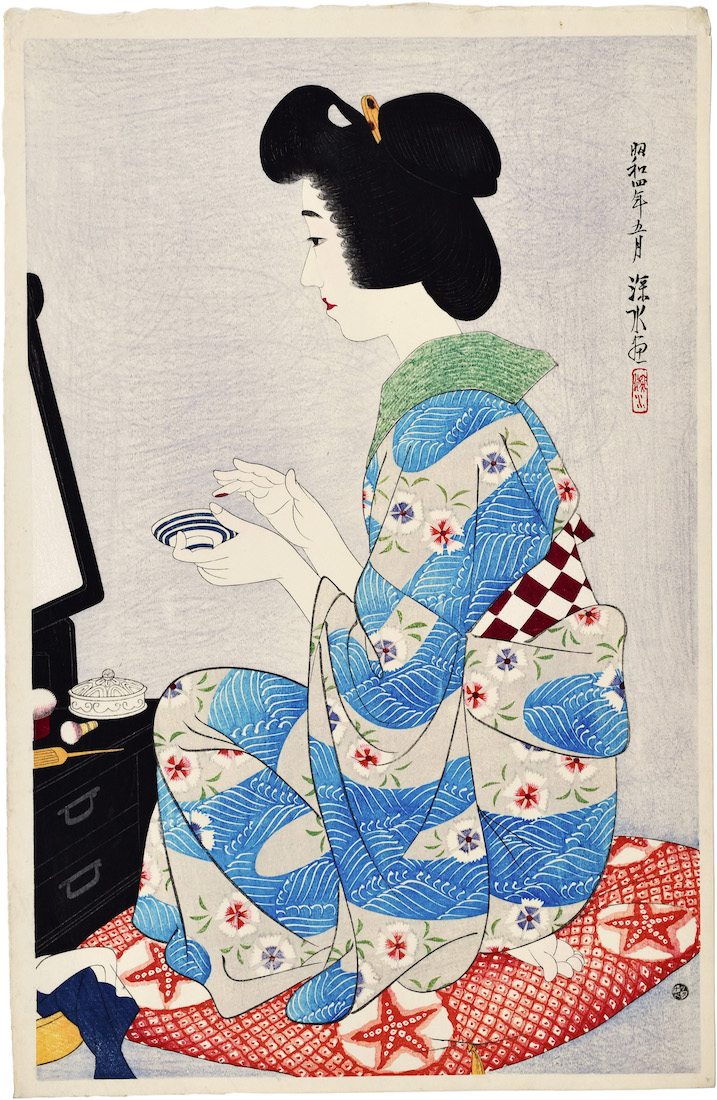
With mica highlights on her obi and the mirror; signed and dated at upper right corner, Showa yonnen gogatsu Shinsui ga (Showa 4 [1929], 5th month, by Shinsui), with artist’s seal Shinsui, with limited edition seal on verso, Nihyakugoju mai zeppan, dai hyaku kyujuroku zetsuban (250 limited edition, number 196), and publisher’s rectangular seal Watanabe, 1929
dai oban tate-e 16 3/4 by 11 in., 42.5 by 27.8 cm
A beauty seated before her kyodai daubs a bit of beni (red safflower used to stain the lips which is also used as a pigment for prints and paintings) on her finger from a small porcelain dish. She wears a kimono decorated with bands of stylized fringed carnations (nadeshiko) floating on a pale grey ground and bands of blue stylized waves, with a contrasting soft green creped collar and dramatically offset by a deep red and white checked obi. The reflective surface of her mirror and the white squares of her obi highlighted with white mica.
References:
Dorothy Blair, A Special Exhibition of Modern Japanese Prints, Toledo Museum of Art, 1930, p. 97, no. 26
Tadasu Watanabe, Ito Shinsui: All the Woodblock Prints, 1992, p. 80, no. 52
Amy Reigle Newland and Hamanaka Shinji, The Female Image, 2000, p. 63, no. 56
Laura J. Mueller, Strong Women, Beautiful Men: Japanese Portrait Prints from the Toledo Museum of Art, 2005, p. 89
Carolyn M. Putney, Fresh Impressions: Early Modern Japanese Prints, 2013, p. 97, cat. no. 26
The First Collection of Modern Beauties: Catching Fireflies
(Gendai bijin shu dai isshu: Hotaru-gari)
Dated and signed, Showa rokunen shichigatsu, Shinsui ga (Showa 6 [1931], 7th month, by Shinsui), with artist’s red rectangular seal Shinsui, publisher’s seal Watanabe in lower right corner; with hand-numbered limited edition seal on verso, Nihyakugoju mai zeppan, dai jukyu ban (250 limited edition, number 19), followed by publisher’s rectangular seal, Watanabe, 1931
dai oban tate-e 17 1/4 by 11 in., 43.8 by 28 cm
References:
Dorothy Blair, Modern Japanese Prints: Woodblock Prints by Ten Artists, the Work of the Past Five Years, Toledo Museum of Art, 1936, no. 153
Tadasu Watanabe, Ito Shinsui: All the Woodblock Prints, 1992, pp. 82-83, no. 61
Amy Reigle Newland, and Hamanaka Shinji, The Female Image: 20th Century Prints of Japanese Beauties, 2000, p. 67, no. 65
Andreas Marks, Seven Masters: 20th Century Japanese Woodblock Prints from the Wells Collection, 2015, p. 127, cat. no. 80
Katsuta Akiko and Khanh Trinh, Ito Shinsui, Reitberg Museum, Zurich, 2016, p. 94, cat. no. 53
Abe Shuichi, Prints of Japanese Beauties in the 20th Century, 2022, p. 69, no. 81
Minneapolis Institute of Art, accession no. 2002.161.165
Styles of Contemporary Make-up: no. 2, Make-up
(Kindaijisesho no uchi: ni, Kesho)
dated and signed at upper left, Showa gonen rokugatsu (Showa 5 [1930], 6th month) Kobayakawa Kiyoshi, with artist’s bird-shaped seal; the title Kindaijisesho no uchi ni- Kesho, along the lower margin, the limited edition seal on lower left margin, Hyaku mai kagiri zeppan, dai sanjuyon ban (100 limited edition, number 34), privately published, 1930
dai oban tate-e 20 7/8 by 11 3/4 in., 53 by 30 cm
According to Dorothy Blair in the catalogue for the 1936 exhibition of shin-hanga at the Toledo Museum of Art, the blocks for this print were carved by Takano (Takano Shichinosuke) and printed by Onotomi (Ono Tomisaburo), comprising 14 blocks which required 20 “superimposed printings” (pulls from the blocks).
References:
Dorothy Blair, Modern Japanese Prints: Woodblock Prints by Ten Artists, the Work of the Past Five Years, Toledo Museum of Art, 1936, cat. no. 116 (titled Powdering the Face)
Kato Junzo, comp., Kindai Nihon hanga taikei, 1975-76, Vol. III, pl. 70
Kendall H. Brown, Light in Darkness: Women in Japanese Prints of Early Showa, 1996, p. 59, cat. no. 66
Amy Reigle Newland and Hamanaka Shinji, The Female Image: 20th Century Prints of Japanese Beauties, 2000, p. 142, no. 190 Nihon no hanga III 1921-1930, Toshi to onna to hikari to kage to (Japanese Prints III, 1921-1930: Cities and Women, Lights and Shadows), Chiba City Museum of Art, 2001, p. 122, pl. 264-2
Abe Shuichi, Prints of Japanese Beauties in the 20th Century, 2022, p. 141, no. 216
Signed in sumi ink at lower right, Yoshida, with artist’s seal Hiroshi, titled Lahore in Urdu in lower left corner, jizuri (‘self-printed’) seal in upper left margin, followed by the date Showa shichinen saku (Showa 7 [1932]), and Japanese title below, Sharamaru Gaden, the English title printed on the bottom margin, Shalimar Garden, Lahore, and signed in pencil Hiroshi Yoshida; ‘MADE IN JAPAN’ stamped on verso, self-published, 1932
dai oban tate-e 15 7/8 by 10 3/4 in., 40.2 by 27.3 cm
According to Dorothy Blair in the catalogue for the 1936 exhibition of shin-hanga at the Toledo Museum of Art, the blocks for this print were carved by Maeda Yujiro (1889-1957), comprising 12-18 blocks which required 30-50 “superimposed printings” (pulls from the blocks), and issued in an edition (at the time) of 100 impressions.
References:
Dorothy Blair, Modern Japanese Prints: Woodblock Prints by Ten Artists, the Work of the Past Five Years, Toledo Museum of Art, 1936, cat. no. 260 (titled Shalimar Garden)
Ogura Tadao, Yoshida Hiroshi zenhangashu (The Complete Woodblock Prints of Hiroshi Yoshida), 1987, p. 126, no. 168
Amy Reigle Newland, ed., Waves of Renewal: Modern Japanese Prints, 1900-1960, Selection from the Nihon no hanga Collection, 2016, p. 108, cat. no. 20
Taj Mahal at Night, no. 6
(Taji Maharu no yoru, dai roku)
Signed in sumi ink at lower right, Yoshida, with artist’s seal Hiroshi, with jizuri (self-printed) seal at upper left margin, followed by the date, Showa shichinen saku (Showa 7 [1932]), and Japanese title, Taji Maharu no yoru, dai roku, English title printed on the bottom margin, Night in Taj Mahal no. 6, and signed in pencil, Hiroshi Yoshida, 1932
dai oban yoko-e 15 5/8 by 21 1/8 in., 39.8 by 53.5 cm
According to Dorothy Blair in the catalogue for the 1936 exhibition of shin-hanga at the Toledo Museum of Art, the blocks for this print were carved by Maeda Yujiro (1889-1957), comprising 12-18 blocks which required 30-50 “superimposed printings” (pulls from the blocks), and issued in an edition (at the time) of 100 impressions.
References:
Dorothy Blair, Modern Japanese Prints: Woodblock Prints by Ten Artists, the Work of the Past Five Years, Toledo Museum of Art, 1936, cat. no. 267
Ogura Tadao, Yoshida Hiroshi zenhangashu (The Complete Woodblock Prints of Hiroshi Yoshida), 1987, p. 129, no. 174 Yoshida Hiroshi: Woodblock Print Exhibition, Kushigata Shunsen Museum of Art, 1994, cat. no. 90
Ogura Tadao, Yoshida Hiroshi ten: shizen-e no manazashi, tokubetsuten, botosugo 50 shunen kinen (Yoshida Hiroshi Exhibition), MOA Museum of Art, 2000, p. 118, cat. no. 160
Kendall H. Brown, et. al., A Japanese Legacy: Four Generations of Yoshida Family Artists, The Minneapolis Institute of Arts, 2002, p. 62, cat. no. 37 Yoshida Hiroshi: A Retrospective, Chiba City Museum of Art, 2016, p. 207, cat. no. 5-23
Monika Hinkel, Yoshida: Three Generations of Printmaking, Dulwich Picture Gallery, 2024, p. 53, cat. no. 19
REDISCOVERED TREASURES: The León Chattah Collection of Modern Japanese Prints
September 10–18, 2026 Special Autumn AWNY Hours: Daily, 11am–5pm (appts appreciated); otherwise by appt through Oct 2
We are pleased to present Rediscovered Treasures: The León Chattah Collection of Modern Japanese Prints during this season of Asia Week New York Autumn 2026.
The exhibition includes a group of approximately sixty works by 20th century shin hanga masters from the ‘hidden’ collection of León Chattah (1934-2025). Recently rediscovered by his family, this significant collection had been tucked away in the back of a closet in a New York City apartment since the early 1980s.
The entire group was acquired (purportedly all at once) from Abraham & Rachel Bornstein, the proprietors of the Boston Book and Art Shop which had closed in 1971. Mr. Bornstein was an authority on print production and would host Japanese art graduate seminars from Boston University to view works from his personal collection of some 5,000 Japanese prints. It is likely that the shin-hanga in the Chattah collection may have been initially acquired for sale in the shop around the peak of the movement in the mid-1920s to 1930s, some of it directly from the artists and publishers at the time of production. The Chattah collection includes works by Yoshida Hiroshi (1876–1950), Hashiguchi Goyo (1880–1921), Ishii Hakutei (1882–1958), Kawase Hasui (1883–1957), Yamamura Koka (Toyonari, 1885–1942), Miki Suizan (1887–1957), Yoshikawa Kanpo (1894–1979), Ito Shinsui (1898–1972), Kasamatsu Shiro (1898–1991), Kobayakawa Kiyoshi (1899–1948), Torii Kotondo (1900–1976), and Kato Shinmei (1910–1988).
We look forward to welcoming soon!
To learn more about this extraordinary collection, click here.
RECENT ONLINE SUMMER EXHIBITION
A Private Collection of Shin-Hanga Kabuki Portraits – Part 2
Summer 2026
We are pleased to present Part 2 of our special Online Exhibition featuring thirty exceptional 20th-century kabuki actor prints from a distinguished private collection. Following the first installment, released in December 2025 and showcasing works from the 1920s through the early 1930s, this second exhibition highlights outstanding portraits from the 1930s through the 1950s by two of the genre’s leading artists, Natori Shunsen and Ota Gako (Masamitsu). Together, these remarkable woodblock prints represent some of the finest examples of shin-hanga portraits of kabuki actors, and we hope you enjoy exploring this exceptional collection.
To learn more and view the exhibition index, click here.
PRINT ADDITIONS
New Prints by Chizuko Yoshida
After visiting the Portland Art Museum in Oregon this past October to attend an insightful symposium related to YOSHIDA CHIZUKO, the first major retrospective exhibition devoted to the work of the pioneering artist Chizuko Yoshida (1924-2017), we were inspired to expand their offerings of her work at the gallery. It took some time to make the arrangements, but we’re delighted to share that a new shipment of works from the Yoshida Family Collection has arrived and is now available on our website.
Included in the new group are impressions of several prints that were seen on view in the Portland exhibition—with examples from various phases of the artist’s life and work. Several are quite large and lavishly embellished with glowing mica. Particularly significant is an impression of Baroque Yellow Wall in Szentendre from 1997 poignantly dedicated to her husband Hodaka Yoshida who had passed away unexpectedly in 1995, which references his affinity for images of highly-textured walls; and one impression of Rondo from 2005, Chizuko’s very last print.
To learn more and view these exceptional prints, click here.
ONLINE EXHIBITIONS
A Private Collection of Shin-Hanga Kabuki Portraits
December 2025 – Early 2026
We are delighted to present a special Online Exhibition of 20th century actor prints from a private collection. Carefully and patiently assembled over decades, the collection includes the finest shin-hanga portraits of kabuki actors produced by leading artists of the period. The selection offered here represents approximately half of the collection, focusing on early works by Yamamura Koka (Toyonari), Natori Shunsen, and Shin’ei. A second grouping will be offered later in the New Year.
To learn more and view these remarkable prints, click here.
Pride of Edo: Collaboration in the Capital City
November – December 2025
We are pleased to announce a special Online Exhibition presenting a selection of prints from the 1864 collaborative series celebrating the famous sights and culture of the historic city, Thirty-Six Scenes of the Pride of Edo (Edo jiman sanjurokkyo), featuring figures by Utagawa Toyokuni III (Kunisada, 1786-1865), set within landscapes designed by Utagawa Hiroshige II (1826-1869).
The Pride of Edo series combines several ukiyo-e tropes: images of bijin (beautiful people, mostly women), celebrating local specialties associated with meisho (famous or popular views) of the capital. Published in the twilight of the Edo Period (1600-1868), the era named after the metropolis itself, the series captures a glimpse of the city and its denizens shortly before the dramatic pivot to modernity on the not-too-distant horizon. But until then, the Edokko (residents of Edo) are depicted going about their daily lives, visiting their favorite haunts, and enjoying the familiar entertainments offered by their hometown. Most of the locations and subjects were readily recognizable to the audience at the time, featuring familiar landmarks with figures modeling up-to-date fashions whilst on their outings about town.
The series seems almost nostalgic, illustrating the traditional lifestyles of the residents of Edo, with very few visual acknowledgments of the encroaching foreigners and their influences which had been flooding through the nearby port of Yokohama for five years. Edo would be renamed Tokyo just four years hence following a violent revolution, with bloody battles fought within the city itself, and concluding with the fall of the Tokugawa shogunate. But until then, the Edokko present the best of their city, with pride.
To learn more and view the online exhibition, click here.
Past Exhibitions
Explore our past exhibitions online—each one a unique journey through exceptional art and craftsmanship. View them all here.
About the Gallery
Scholten Japanese Art is a private gallery specializing in Japanese woodblock prints and paintings. We offer ukiyo-e from the 18th to 20th centuries, including shin hanga, sosaku hanga, and Japanese-style woodblock prints produced by Western artists. Located in a spacious suite in the old Meurice Hotel, just steps from Central Park South, we enjoy meeting with visitors one on one in order to best learn about your interests and share the collection with you.
We opened its doors September 2000 in a renovated townhouse on New York’s Upper East Side. In May of 2003, Scholten moved to a private suite in the old Meurice Hotel located on 58th Street between Sixth and Seventh Avenues. We initially planned to stay in midtown temporarily, however, we were pleasantly surprised to find the central location in the heart of Manhattan offers advantages in accessibility for both local collectors (who frequently have business in the area) and proximity to numerous hotels for out-of-town visitors. In 2009 we decided to expand to a larger space in the same building which was renovated to provide more exhibition space as well as a separate ‘Print Room’ devoted to our library and large inventory of woodblock prints. We organize at least two public exhibitions every year during Asia Week (both March and September), but we always have a selection of prints and paintings on view throughout the year.