Beautifully decorated in Chinese style with land and seascapes on the front, bamboo around the sides of the back, and the underfoot with a stylized chilin medallion.
Diameter: 6¼ in. (16 cm)
Ex: Private New York Collection (acquired from John Sparks, London in the early 1980s)
Of impressive size and remarkable form, with overhangings, and highly contoured surface with numerous openings. The shape is abstract but may suggest a dragon in clouds. Of overall medium gray color.
Finely modelled in the full round, forming a true pair, right and left (male and female). The male is depicted with his front paw resting upon a brocaded ball; the female, with a cub clambering at her side. Their faces display smiling animated expressions, and their heads are finely detailed with multi-colored curls.
Height: 14 in. (35.5 cm)
Ex: French Private Collection
Two almost identical examples with similar colored curls are in the Gulbenkian Collection, Lisbon and the Lady Lever Art Gallery, England. Smaller versions with the holders are in the historic collection of Augustus the Strong and another is illustrated in La Porcelaine de Chine by Octave du Sartel, 1881.
The figure dressed in armor, and the horse wearing padded armor as well. Finely modeled in the full round. Retaining red polychrome and slip decoration. Of rare and fine form.
Height: 10 ¾ in. (27.3 cm)
Similar/ related figures were included in the noted exhibition: The Quest for Eternity, Los Angeles County Museum and PR China, 1987, No. 46; Victoria & Albert Museum, from the Eumorfopoulos Collection (Illustrated and described: Hobson, London, 1925-28, Vol. I, No. 118); and Royal Ontario Museum, Toronto
Decorated with scenes from The Romance of the Western Chamber, with a reserve of the loving couple on one side, and warlords on the other. All finely painted in underglaze blue or varying tone. Of elegant form quality.
Thinly potted and of elegant form with lobed sides and foliated lip. Glazed overall in a beautiful and even ivory tone, with characteristic “tears” along the inner rim.
Height: 3 ¾ in. (9.5 cm)
Diameter: 6 ¾ in. (17 cm)
Decorated with Immortals likely situated in the Daoist Paradise. These include the Eight Immortals, and Xiwangmu Queen Mother of the West, and others playing weiqi, all set against a rare honeycomb patterned ground.
Height: 17 in.(43 cm)
Ex: Private New York Collection (acquired in the early to mid-1900s)
An almost identical example is the in the Anthony de Rothschild Collection, now at the Ascot Estate, UK, illustrated by Kraahl, The Anthony de Rothschild Collection of Chinese Ceramics, 1996: Vol. 1, No. 87. Another was formerly in the collection of JT Tai (sold at Sotheby’s, New York, March 22, 2011, Lot 96). A small Fahua tile in the British Museum is similarly decorated with deities, identified as the Three Official Great Primordial Rulers (San Guan Da Di), popular Daoist stellar deities also known as the controllers of Heaven, Earth and Water, see Jessica Harrison-Hall, Ming Ceramics in the British Museum, London, 2001, pp. 426-427, pl. 13.35.
SHUNZHI/ KANGXI PERIOD, CA: MIDDLE/ LATE 17TH CENTURY
Decorated inside and out with horses galloping over swirling waves amidst rocky promontories, flowerheads, and Precious Things. All finely painted in varying colors against a deep green ground.
Height: 3 ½ in.(8.8 cm)
Diameter: 7 ⅝ in. (19.3 cm)
Ex: Private American Collection
Prior: with Parish Watson (prominent early 20th century New York dealers)
Porcelains with this decoration in varying forms may be found in important private and museum collections including the Butler Collection, the J.P Morgan Collection, the Taft Museum, and the Victoria & Albert Museum.
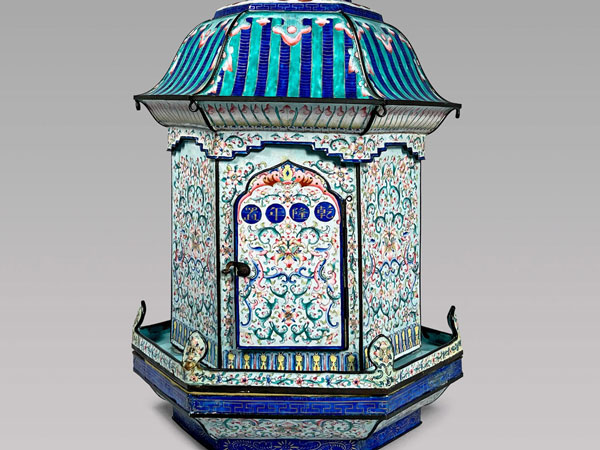
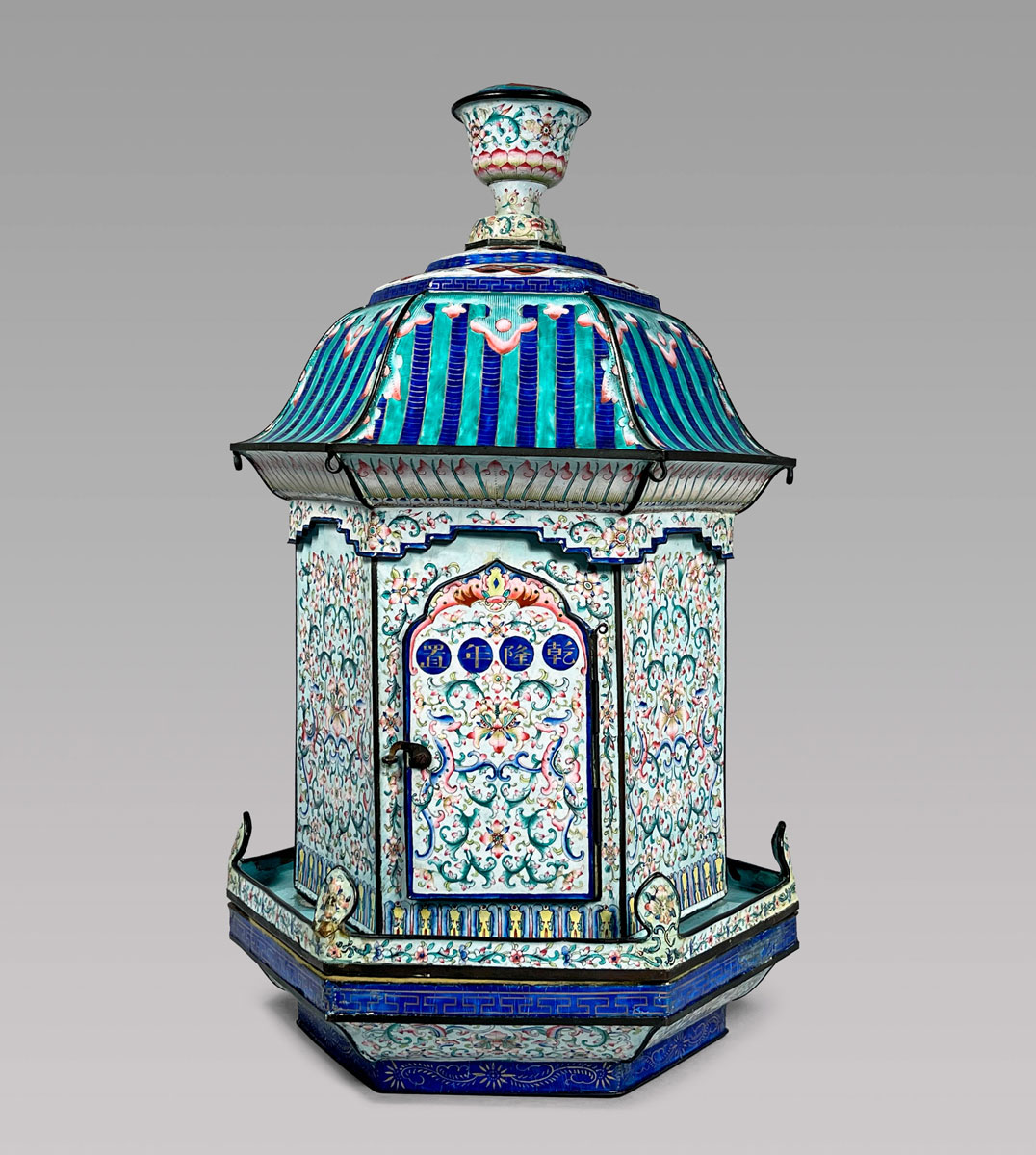
Rare Chinese Imperial Enamel on Copper Lantern Pagoda
Qianlong four-character Mark and period, ca: mid-18th century
Of unusual and interesting architectural form, the pagoda structure with hinged door revealing a candleholder in the interior. Finely decorated with flower and tendril designs; the roof with straited colored designs imitating the beams. All finely decorated in bright colors.
Exhibition of Chinese Porcelains and Works of Art in both Chinese and Western Taste
September 10–18, 2026 Special AWNY Hours from Sept 10–18: 10am-6pm, with limited hours on Sept 11 and closed Sept 12–13
We are delighted to present Exhibition of Chinese Porcelains and Works of Art in Both Chinese and Western Taste as part of this autumn’s Asia Week New York. Bringing together exceptional works, many from distinguished American private collections, the exhibition offers a fascinating look at the dialogue between Chinese artistic traditions and Western taste.
Highlights include a rare pair of Kangxi-period (1662–1722) blue-and-white phoenix-tail vases, as well as an exceptionally rare pair of 18th-century Chinese export porcelain figures of a gentleman and lady. Beautifully painted in famille rose enamels and dressed in distinctly Chinese-inspired attire, the figures offer a captivating glimpse into the cultural exchange that shaped Chinese export art.
We invite you to browse through our deeply researched collection of catalogues, showcasing a stunning array of fine antique Chinese porcelain and works of art. You may find one or more to match an occasion or simply add enjoyment into your own collection! If you have any questions or would like further information, please don’t hesitate to contact us by phone or email.
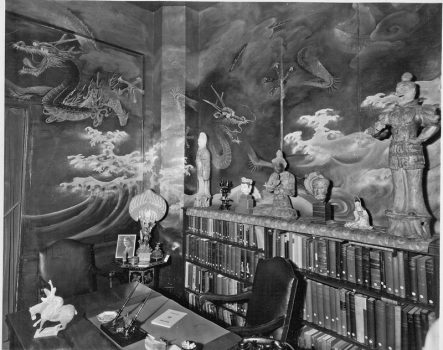
2025 marks an extraordinary milestone since our founding in 1910! Above are some vintage photographs of our founder along with his famous office with its dragon mural wall in a previous gallery location from the 1930s.
We look forward to marking this remarkable period of time with an active year of exhibitions of fine porcelains and works of art!
About the Gallery
The Ralph M. Chait Galleries, established in 1910, holds the distinction of being the oldest specialist gallery in the United States focusing on fine antique Chinese porcelain and works of art. Founded by Ralph M. Chait, a self-taught connoisseur with an impeccable eye for quality, the gallery quickly gained prominence. Chait’s expertise and taste attracted notable collectors of his time, including John D. Rockefeller, Jr., and President Herbert Hoover, as well as an array of influential political figures, scholars, and artists. Today, the gallery continues to serve a distinguished global clientele, maintaining its legacy of excellence.
The gallery’s storied history is reflected in its enduring traditions and the prominent individuals who have frequented it. A central table, present since the early days, has served as a gathering point for collectors from varied backgrounds to examine and discuss pieces. Over the decades, the gallery has sold significant works to many major museums, such as the Metropolitan Museum of Art and the Art Institute of Chicago. Additionally, it has collaborated with renowned architects and designers like Frank Lloyd Wright and Sister Parish, cementing its role as a trusted authority in the field of antique Chinese art.
A third-generation family business, now led by Steven and Andrew Chait, the gallery has not only survived but thrived through diverse historical and economic challenges. Its involvement in prestigious antique fairs and organizations, such as the National Antiques and Art Dealers Association of America, underscores its commitment to the art community. With over a century of history, the Ralph M. Chait Galleries continues to honor its rich heritage while looking forward to a promising future in the world of fine Chinese antiques.