Central Tibet
15 th century
Gilt-copper alloy with inlaid stones
Height: 15 in. (38.1 cm)
Provenance:
Swiss Private Collection
The Le Cong Tang Collection
Han Hai, “The Merciful Buddha,” Hong Kong, 2015, no. 58
Zhiguan Museum of Fine Art
Published:
The Light of Buddha – Buddhist Sculptures of the Palace Museum and the Zhiguan Museum of Fine Art, exhibition catalogue, Beijing, 2018, pp. 232-243
Jeff Watt, Himalayan Art Resources, item no. 8074
Southern Tibet or Bhutan
First quarter of the 18th century
Distemper on cloth
27½ by 16¾ in. (69.9 by 42.5 cm)
Provenance:
Richard R. & Magdalena Ernst Collection
Sotheby’s, New York, March 22, 2018, no. 960
Published:
Elena Pakhoutova, “Art Treasures Picturing Padmasambhava,” Orientations, Vol. 49, No. 3, May/June 2018, pp. 44-51, fig. 9
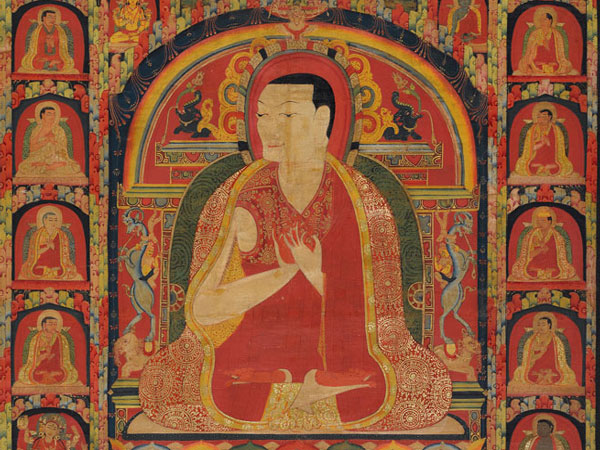
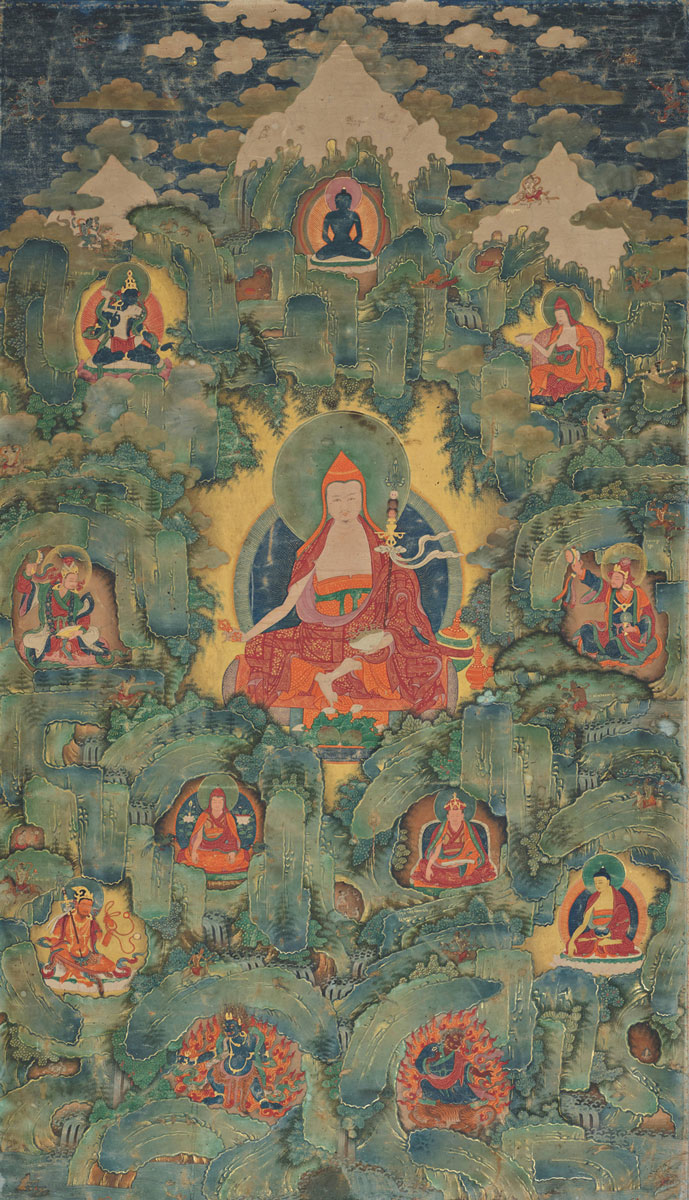
Padmasambhava sits at the center of the painting within a luminous golden grotto, wearing a scholar’s cap and monk’s robes while holding a vajra and kapala (skull cup). A khatvanga rests against his shoulder, and a basket of sacred texts, a ritual water vessel, and offerings of bilva fruit reinforce his role as a tantric master and teacher. Rather than isolating the guru against a plain background, the artist places him within a mountain landscape that unfolds in every direction.
The surrounding grottoes contain Padmasambhava’s Eight Manifestations, each representing a different aspect of his spiritual activity. Above sits the primordial Buddha Samantabhadra, while two important Nyingma masters appear below the central figure. Together they place Padmasambhava within the lineage through which his teachings were transmitted.
The mountain landscape is animated by scenes of meditation, travel, ritual practice, and animal life. Monks move between meditation retreats, a tantric adept receives visitors, another monk meditates in solitude, and a siddha ferries a pandita across the water. Elsewhere, snow leopards shelter in rocky caves, birds nest among the cliffs, deer roam the slopes, and the Twelve Tanma goddesses pass through the landscape. These episodes invite the eye to move from one grotto to the next, revealing new details throughout the composition.
A dedicatory inscription on the reverse establishes that the painting was completed before 1723 and links it to the Pema Lingpa tradition, one of Bhutan’s most influential religious lineages. Whether painted in southern Tibet or Bhutan, the work reflects artistic exchanges between the two regions during the early eighteenth century. The distinctive blue-green mountain forms draw upon earlier Chinese painting traditions while being reinterpreted within a Himalayan setting, giving the landscape its distinctive visual character.
Northeastern India, Bihar
Pala Dynasty, 11th/12th century
Sedimentary stone
Height: 7 1/8 in. (18.2 cm)
Provenance:
European Private Collection, acquired in 1993
This miniature stele belongs to a rare group of Buddhist shrines produced during the Pala Dynasty for pilgrims visiting Bodh Gaya. Many were carried to monasteries throughout Asia, and surviving examples have been found as far away as Tibet and Myanmar, reflecting the importance of Bodh Gaya as the spiritual center of the Buddhist world. Once thought to have been made in Myanmar, these portable shrines are now firmly recognized as products of eastern India.
At the center, Sakyamuni Buddha sits beneath the Bodhi Tree at the moment of his enlightenment. His right hand reaches toward the earth in bhumisparsa mudra, recalling his victory over Mara at the vajrasana, or Diamond Throne, where he attained enlightenment. Surrounding the central image are scenes illustrating the Eight Great Events of the Buddha’s life, including his birth, the First Sermon, the Miracle at Shravasti, the descent from the Trayastrimsha Heaven, and the offering of honey by the monkey at Vaishali. Above the Bodhi Tree appears the Buddha’s mahaparinirvana. Together these scenes transform the shrine into a compact visual biography intended for devotion and pilgrimage.
One of the sculpture’s most distinctive features is the Buddha’s unusually short neck. Scholars have associated this characteristic with the now-lost principal Buddha image of the Mahabodhi Temple, suggesting that it served as the model for many of the portable shrines produced for pilgrims. Although the original monument was destroyed centuries ago, sculptures such as this preserve valuable evidence of its appearance and enduring influence.
These portable shrines also carried the artistic traditions of eastern India far beyond Bodh Gaya. As pilgrims returned home, they brought with them devotional images that helped spread the sculptural style of the Pala Dynasty throughout Tibet, Myanmar, Nepal, and other parts of Asia. At the same time, they preserved the memory of one of Buddhism’s most revered pilgrimage sites in a form that could be carried, installed, and venerated far from its place of origin.
Durga’s Warning given to Kamsa, Page from the ‘Large’ Bhagavata Purana Series
Attributed to Fattu, son of Manaku
Guler or Basohli, 1760-1765
Opaque pigments with gold on paper
Image: 9 1/8 by 13 3/8 in. (23.2 by 34 cm), within a black margin and a red border with white rules; folio: 11 5/8 by 15 7/8 in. (29.5 by 40.3 cm)
Inscribed on the verso in Devanagari with the Sanskrit text of Bhagavata Purana
Book X, canto 16, vv. 1-12
Provenance:
Mrs. F. K. Smith
Sotheby’s, London, February 3, 1960, no. 2
Collection of Anthony Hobson
Christie’s, London, June 10, 2015, no. 54
Despite the wicked Kamsa, king of Mathura, vowing to kill all the children born to his imprisoned sister Devaki since it had been foretold that one would kill him, the baby Krishna has already been born to her and was unharmed. Through divine intervention casting a profound sleep over everyone, her husband, Vasudeva, had already taken the child to a foster mother, Yashoda, across the River Jumna in Gokul and exchanged him for the child who had been born to her. This was in fact not an ordinary baby but the goddess Yogamaya, ‘Illusion,’ whom he placed beside his sleeping wife and then replaced his own shackles.
Alerted by the watchmen that his sister Devaki had given birth again, Kamsa hastens to her side to wrest the child from her and to destroy it. We see the watchmen waking the king on the left, alerting him to the birth, and then Kamsa wresting the child from the imprisoned Devaki’s arms while her husband, Vasudeva, looks on. Devaki’s protective gesture for her daughter is most moving, as Kamsa roughly grasps the baby’s arm. Vasudeva is clearly perplexed as to what to tell his wife. Once outside, however, as Kamsa tries to dash the child’s head against a large rock she slips from his hands and assumes a form in the sky as the goddess Durga in the center of a fiery conflagration. Complete with her eight arms and all her accoutrements, and with an admiring cast of heavenly divinities, she warns him that the child who would destroy him has already been born.
This large series, generally called the ‘Large’ Guler-Basohli Bhagavata Purana, shows an early vigorous Pahari style succumbing to the charms of a softer, Mughal-influenced type of painting style from Guler. Both Archer (Indian paintings from the Punjab Hills, London, 1973, vol. I, pp. 49-51) and Goswamy and Fischer (Pahari Masters: Court Painters of Northern India, Zurich, 1992, p. 314) speculate that the basic idiom of the Bhagavata Purana is that of a pupil of Manaku, perhaps his son Fattu. The influence of Manaku’s younger brother Nainsukh is also apparent. Given the close links between Guler and Basohli it could have been prepared in either court studio. After the death of his great patron Balwant Singh in Guler in 1763, Nainsukh took service with Raja Amrit Pal of Basohli and seems to have remained there for the rest of his life. Fattu was charged with taking Nainsukh’s ashes to the Ganges at Kuruksetra in 1778, presumably because he lived at Basohli also and worked with his uncle.
Clearly several different hands were involved in this extensive series. Some of the paintings are bordered in red, others blue. The grouping and the naturalistic interaction of the figures are impossible to conceive of without the influence of Nainsukh. We note the bearded watchman’s concern, Kamsa’s grasping of the child’s arm to wrest her from her mother, and Devaki’s sorrowful countenance as she hugs her daughter close, the child’s calm gaze at her would-be murderer, and Vasudeva’s inner turmoil as Kamsa gazes at him, perhaps surprised by his inaction—all this suggests Nainsukh’s influence on the next generation of artists at Guler and Basohli. Nainsukh was influenced directly by the Mughal style of the Muhammad Shah period and softened the jagged outlines and harsh colors of the earlier Pahari styles towards a softer and more naturalistic style reflective of this Mughal influence. This is felt in this series in the naturalistic groupings of the figures and their interaction, although the artists have not yet learned how to unify their compositions across large pages such as these but instead still compartmentalize the different groups.
This dispersed series of the Bhagavata Purana is one of the most important achievements of Pahari artists and the most influential in determining the development of Pahari painting at Guler, Basohli, and Kangra in the illustration of poetical Vaishnava texts. The series is widely dispersed among many public and private collections, including the Victoria and Albert Museum, Museum Rietberg, The British Museum, The British Library, the Chester Beatty Library, The Metropolitan Museum of Art, the Philadelphia Museum of Art, the Museum of Fine Arts, Boston, the San Diego Museum of Art, and the National Museum, New Delhi.
Tibet
18th century
Gilt-copper alloy with pigment
Height: 13 3/8 in. (34 cm)
Provenance:
Clarice Goldstone Collection
Rossi & Rossi
New York Private Collection
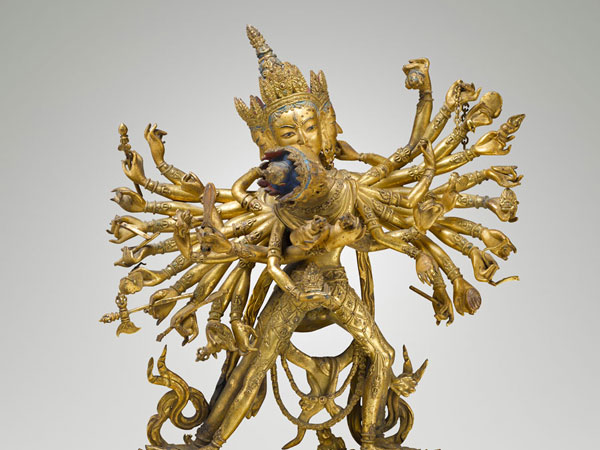
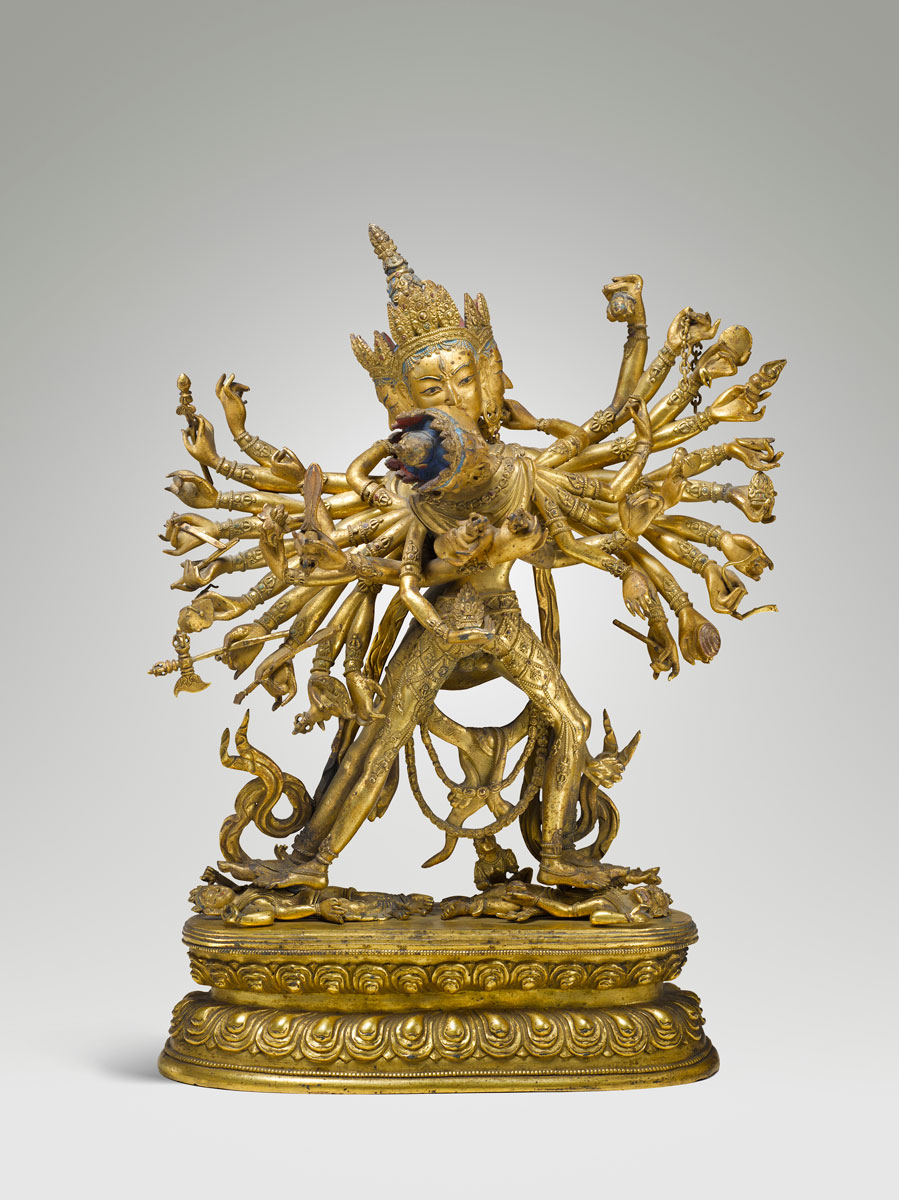
The subject of this splendid gilt-copper alloy image is Kalacakra, The Wheel of Time. Kalacakra is one of the principal deities of the Anuttarayoga tantras, the final phase of Esoteric Buddhist literature that arose in north India during the medieval period. The highly-complex literature associated with the practice of Kalacakra dates to around the end of the tenth century and was first translated into Tibetan in the early eleventh century.
Tibet
Late 14th century
Distemper and gold highlights on cotton canvas
33 1/8 by 29 1/8 in. (84.2 by 74 cm)
Provenance:
Rossi & Rossi, London
European Private Collection, acquired in 1993
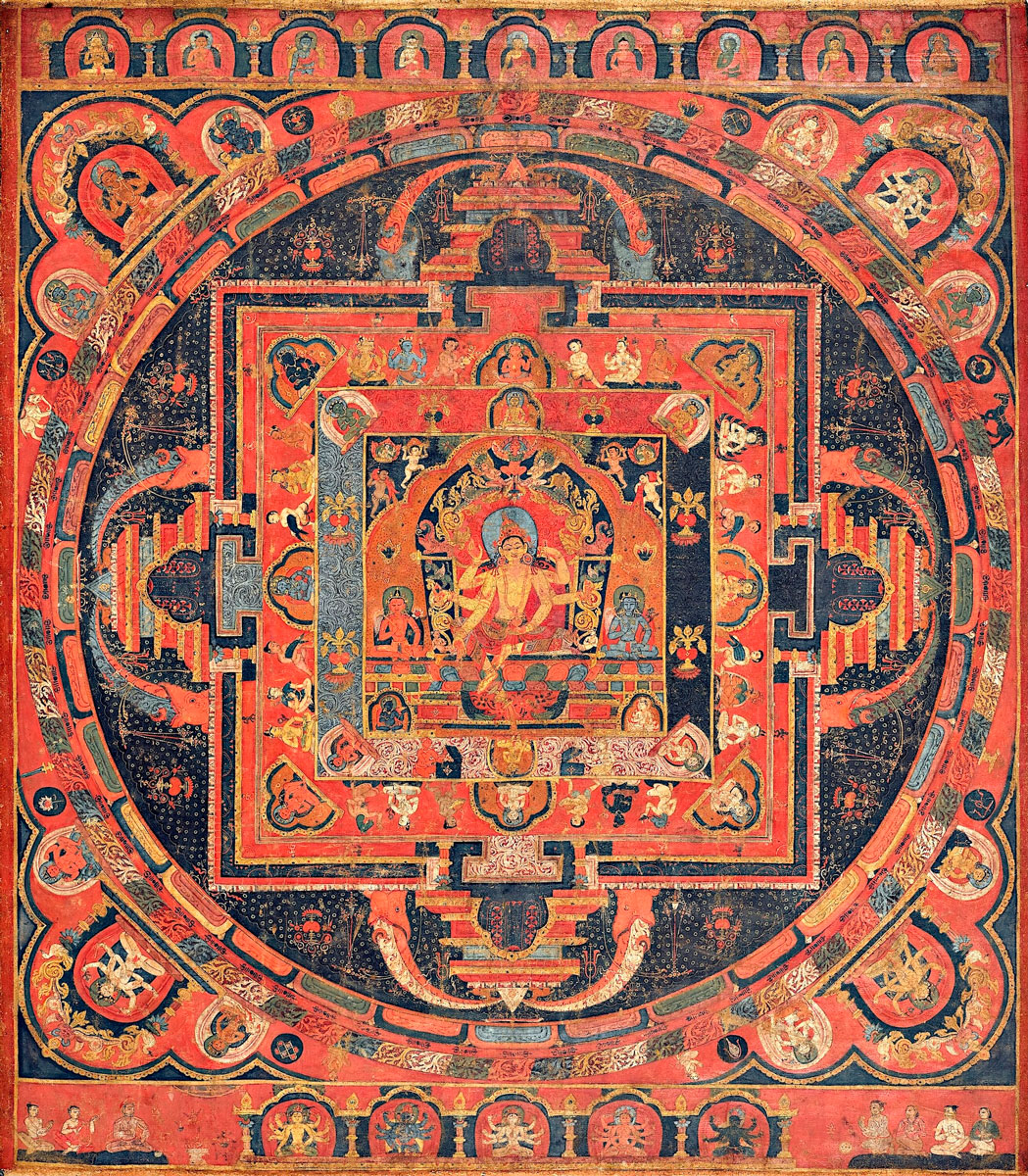
This painting depicts the mandala of Shakyamuni Buddha in the form of Shakya Simha, as described in the Vajravali (Adamantine Garland) treatise by Abhayakaragupta (d. 1125), in which the Indian pandit compiled the mandala practice of esoteric Buddhist deities in extensive iconographic detail.[1]
The painting is one of numerous mandalas known from the same series that remains amongst the finest and most important Tibetan works of art from the second half of the fourteenth century. Paintings from the series were first published and recognized as masterpieces by Robert Burawoy in his seminal 1978 Paris exhibition “Peintures du monastère de Nor,” which featured four of the mandalas.[2] At that time the paintings were thought to be from Ngor monastery, but current scholarship suggests a provenance of Shalu is likely. Paintings from the set are preserved in museum and private collections worldwide, and their historical importance has been documented by scholars including Pratapaditya Pal,[3] Steven M. Kossak and Jane Casey Singer,[4] Amy Heller,[5] John C. Huntington and Dina Bangdel,[6] Jane Casey,[7] Steven Kossak,[8] and Jeff Watt.[9] Each of the mandalas depict Lama Dampa Sonam Gyaltsen (1312-1375) at the center of the upper register, suggesting that the cycle of mandalas is dedicated to him. Lama Dampa was a student and patron of the celebrated scholar Buton Rinchen Drup (1290-1364), the eleventh abbot of Shalu monastery. Watt suggests the paintings may have been dedicated to Lama Dampa by his devoted student Chen-nga Chenpo (1310-1370).
The series is the most extensive of all Tibetan Vajravali mandala sets from the fourteenth century. Each example is designed and painted with the same vibrant palette and exquisite attention to detail. While the overall format and dimension of the paintings is the same throughout the series, the iconography of the deity represented dictates the final composition of each work. Here, Shakya Simha is seated on his crouching white snow-lion surrounded by an entourage of deities within the mandala palace. Unlike many in the series there are no charnel grounds depicted. In their place a ring of fabulous Vedic planetary deities encircles the palace. Buddhas within scrolling vine appear in the quadrants outside the palace. A Sakya lineage is depicted in the upper register, and deities and wealth gods in the lower register accompany the donor monk seated next to an offering table. This highly-important Tibetan painting retains its original blue silk fishtail-shaped mounts and resist-dyed silk veils.
1 See Jeff Watt, https://www.himalayanart.org/search/set.cfm?setID=1556
2 Robert Burawoy, Peintures du monastère de Nor, Paris, 1978
3 Pratapaditya Pal, Tibetan Paintings: A Study of Tibetan Thangkas, Eleventh to Nineteenth Centuries, Basel, 1984, and Tibet: Tradition and Change, Albuquerque, 1997, pp. 146-147
4 Steven M. Kossak and Jane Casey Singer, Sacred Visions: Early Paintings from Central Tibet, New York, 1998, pp. 163-164
5 “The Vajravali Mandala of Shalu and Sakya: The Legacy of Buton (1290-1364)” in Orientations, Hong Kong, May 2003, pp. 69-73
6 John C. Huntington and Dina Bangdel, The Circle of Bliss: Buddhist Meditational Art, Serindia, 2003, pp. 308-312
7 Jane Casey in Divine Presence, Barcelona, 2003, p. 148
8 Steven M. Kossak, Painted Images of Enlightenment: Early Tibetan Thangkas, 1050-1450, Mumbai, 2010, pp. 107-109
9 Jeff Watt, https://www.himalayanart.org/search/set.cfm?setID=2083
10 Ibid.
Pakistan, ancient region of Gandhara
Circa 3rd century
Schist
9 by 15 in. (22 by 38 cm.)
Provenance:
Sotheby’s, London, June 5, 1989, no. 133, cover illus.
Bumper Development Corporation Collection, Canada, 1989-2017
Bonhams, New York, March 16, 2021, no. 322
New York Private Collection
Exhibited:
On loan to the Glenbow Museum, Calgary, 1989-2015
This finely carved relief panel depicts Maitreya (“The Benevolent One”), the future Buddha, shown enthroned in Tushita Heaven as a bodhisattva awaiting the moment of his final rebirth. Seated beneath an elaborately-rendered baldachin, Maitreya occupies the compositional and symbolic center of the scene, his monumental presence emphasized by symmetrical framing elements and hierarchical scale. His calm, idealized features, carefully-articulated drapery, and poised bearing reflect the Gandharan synthesis of Indic religious iconography with Hellenistic sculptural naturalism.
Flanking him are two attendant bodhisattvas, one seated on a distinctive wicker stool—an iconographic motif common in Gandharan art that signals both status and ascetic refinement—while others stand in attitudes of reverence. Above, winged putti fan the central figure, standing on the capitals of columns that rise behind a pair of lions, whose vigilant presence reinforces the protective and regal character of Maitreya’s throne.
The architectural setting is rendered with remarkable narrative richness and spatial complexity. Thatched and leaf-covered balconies, supported by beams intricately carved on their undersides, frame the upper register of the relief, evoking a celestial palace environment. These balconies are populated by figures identified as fortunate beings reborn in Tushita Heaven, who observe and participate in the scene. Their varied postures and gestures introduce a lively sense of movement and human engagement, enhancing the dramatic immediacy of the composition. In the upper right corner, a woman prepares to scatter flowers from an arched balcony, a ritual gesture of devotion that underscores the sacred status of Maitreya and the atmosphere of celestial celebration. The careful integration of architectural motifs and narrative detail reflects Gandharan sculptors’ sophisticated command of spatial illusion and compositional balance, informed by Greco-Roman traditions of relief carving.
Within the broader context of Gandharan art, this panel exemplifies the region’s distinctive approach to Buddhist narrative and devotional imagery. Gandhara, situated at the crossroads of South Asia, Central Asia, and the Mediterranean world, developed a highly-syncretic visual language during the early centuries of the 1st millennium, blending Hellenistic naturalism with Buddhist symbolic and doctrinal concerns. The use of classical architectural elements, putti, and perspectival structuring reveals a deep engagement with Greco-Roman models, while the iconography of Maitreya in Tushita Heaven reflects Mahayana doctrinal developments and devotional practices centered on hope for future salvation. Such narrative reliefs likely adorned stupas and monastic complexes, serving both didactic and contemplative functions. As such, this panel not only demonstrates the technical and artistic sophistication of Gandharan workshops but also offers valuable insight into the evolving religious imagination and intercultural exchanges that shaped early Buddhist art.
Nepal
12th/13th century
Gilt-copper alloy
Height: 6½ in. (16.5 cm)
Provenance:
Zimmerman Family Collection
Published:
Pratapaditya Pal, “The Zimmerman Collection of Nepali Art,” Arts of Asia, September-October 1974
Pratapaditya Pal, Art of the Himalayas: Treasures from Nepal and Tibet, American Federation of Arts exhibition catalogue, 1991, no. 12
This luminous gilt-copper alloy image of Vasudhara, the Buddhist goddess of wealth, fertility, and spiritual abundance, embodies the refined elegance and devotional intimacy characteristic of medieval Nepalese sculpture. Seated in relaxed lalitasana on a lotus base, the goddess radiates serene benevolence, her supple body animated by sensuous modeling and rhythmic compositional balance. Her multiple arms, delicately poised in symbolic gestures, hold attributes associated with prosperity, generosity, and fecundity, while her gently-smiling countenance conveys an inward stillness that invites contemplation. The softly-burnished gilding, combined with precise chasing and subtle gemstone inlays, enhances the sculpture’s visual warmth, evoking both material splendor and transcendent grace.
The figure exemplifies the extraordinary achievements of Newar metalworkers during the Licchavi and early Malla periods, when Nepal emerged as a major artistic center of the Himalayan world. Drawing upon Indian Pala prototypes while cultivating a distinctive local aesthetic, Newar artists developed a sculptural idiom marked by supple naturalism, elaborate ornamentation, and technical virtuosity in lost-wax casting. The present image reflects this synthesis through its elegant proportions, fluid contours, and meticulous surface detail. The restrained dynamism of the pose, together with the luminous gilded finish, suggests a work created not merely for visual admiration, but for sustained ritual engagement, in which divine presence and material form converge.
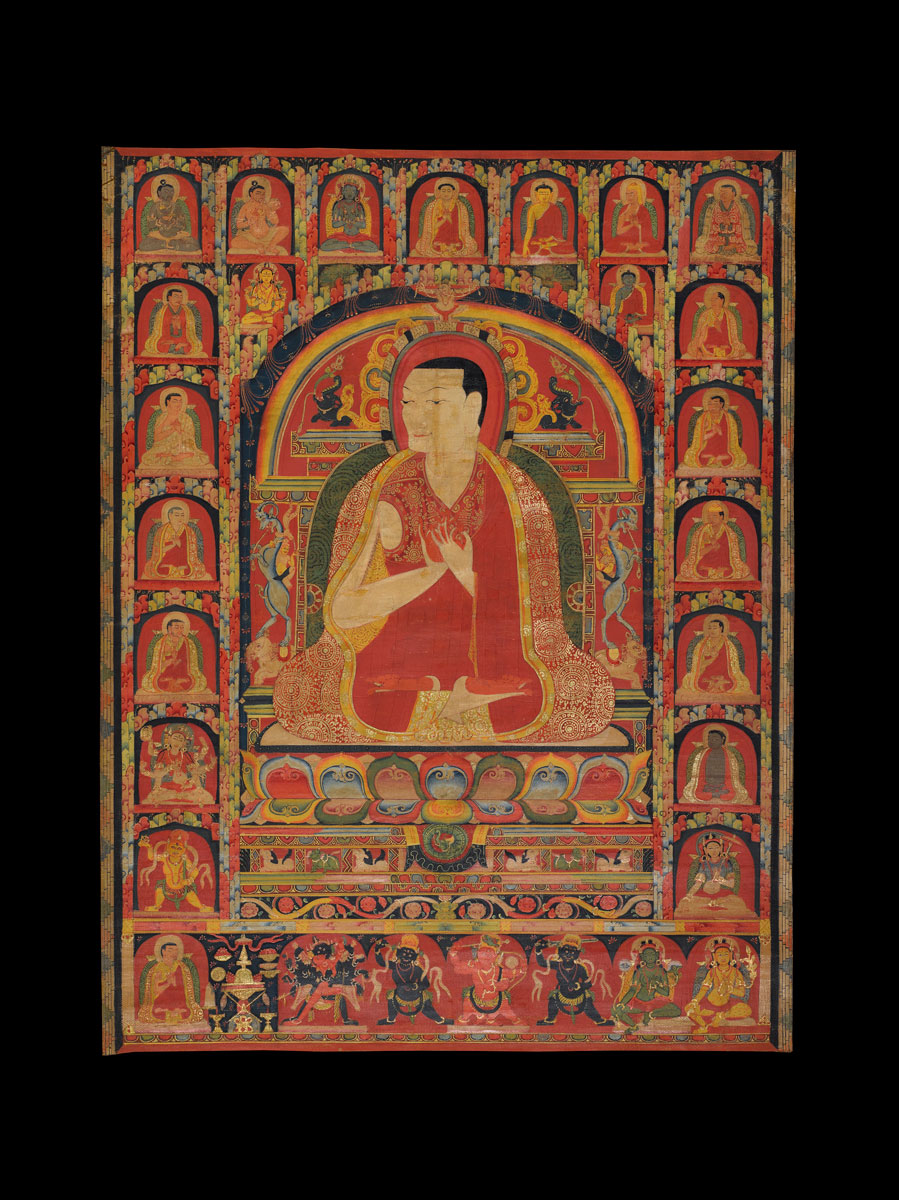
Tibet
Mid-13th century
Distemper on cloth
20½ x 15 in. (52 by 38 cm)
Provenance:
American Private Collection
Published:
Jane Casey Singer, “Early Thangkas: Eleventh-Thirteenth Centuries,” in Pratapaditya Pal ed., On The Path to Void: Buddhist Art of the Tibetan Realm, Mumbai, 1996, p. 194, pl. 12
David P. Jackson, Mirror of the Buddha, Early Portraits from Tibet, Rubin Museum exhibition catalogue, New York, 2011, fig. 4.16
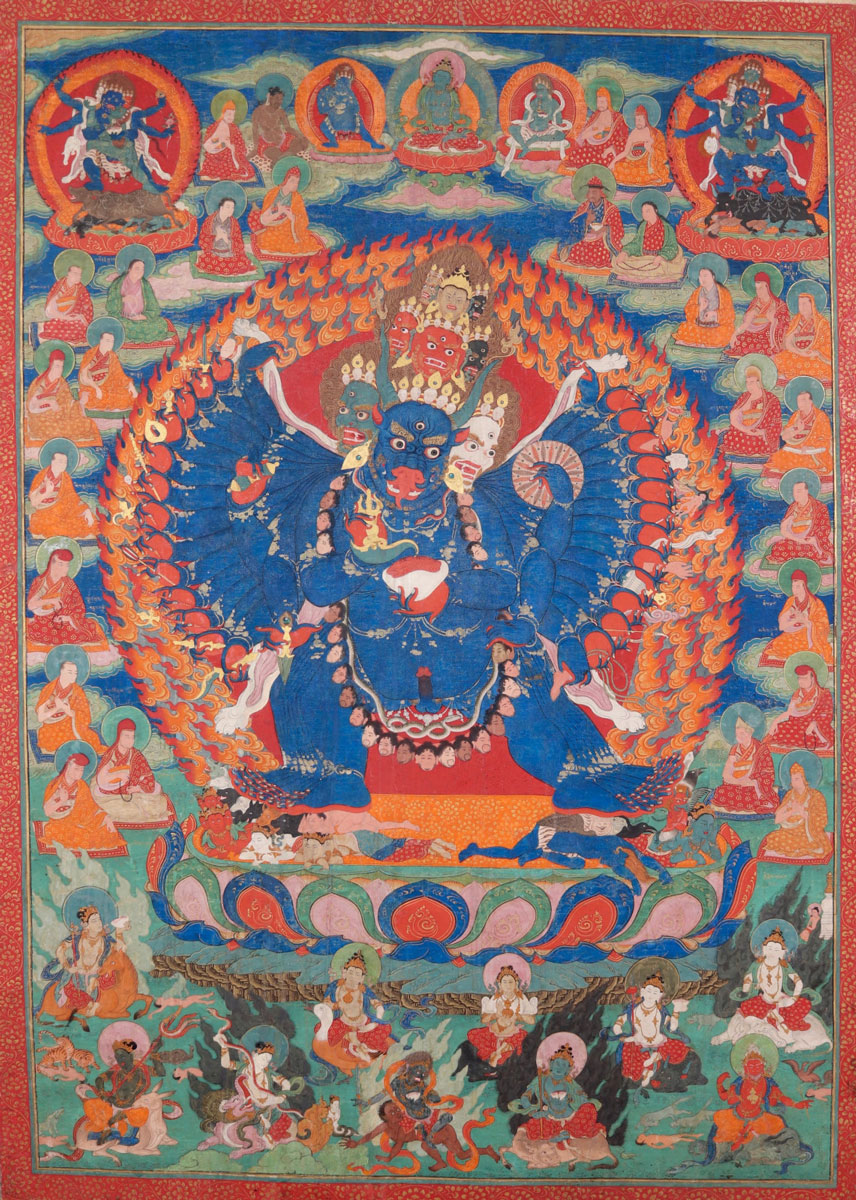
Tibet
Early 17th century
Distemper on cloth
42½ by 30¼ in. (108 x 77 cm)
Provenance:
Collection of Richard R. and Magdalena Ernst
Published:
David Jackson, A History of Tibetan Painting, Wien, 1996, p. 187, pl. 27
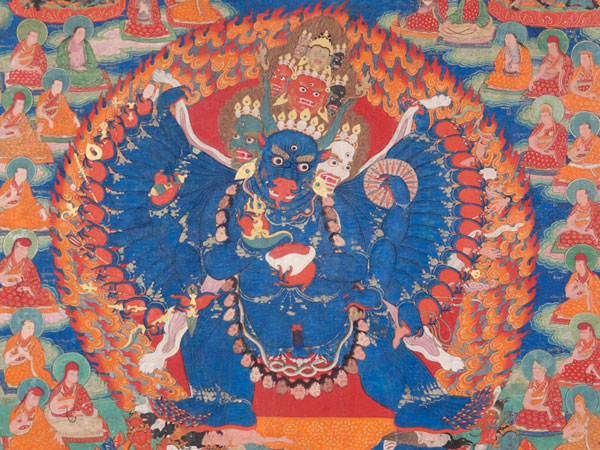
The blue, buffalo-headed Yamantaka is ithyphallic and without consort in his Ekavira Vajrabhairava manifestation, with nine faces, sixteen legs, and thirty-four arms, and holding a flayed elephant skin cape at his back and a panoply of ritual implements.
He is adorned with human skulls and bone jewelry, snakes, and a garland of severed heads, and he stands in pratyalidha trampling naked humans, fierce animals, and angry birds, with Brahmanical deities lying prone on a lotus pedestal resting on mountainous landscape and an aureole of flames behind representing pristine awareness.
Ekavira Vajrabhairava – Tibet – Artworks-Items – Carlton Rochell
Vajradhara above is flanked by Yama and Nairatmya, multi-armed forms of Krishna Yamari astride buffalo, and a lineage of Indian adepts and Tibetan Sakya-order hierarchs. Mounted Brahmanical dikpala guardians appear below, including Indra on his elephant to the right, four-armed Agni on a ram beneath, Ishana on a black bull, blue Yama holding a skull staff and riding a buffalo, Bhudevi on her black sow, blue Nirrti on a naked dark-skinned zombie, Brahma on a goose, Varuna holding the serpent, Vayu on a gazelle, and Yaksha on a horse.
David Jackson has identified the final teacher depicted in the Sakya lineage surrounding Vajrabhairava as the 13th abbot of Ngor monastery, Drangti Panchen Namkha Pelzang (1535—1602),[1] thus suggesting a Ngor-monastery provenance for the painting and a date of around 1600. The red-painted border with gold floral design is typical of Sakya-order thangkas from this period, such as a circa-1600 Kurukulla in the Museum of Fine Arts, Boston.[2]
[1] Jackson, op. cit.
[2] Pratapaditya Pal, Himalayas: An Aesthetic Adventure, Chicago, 2003, p. 259, pl. 171
October 14–18, 2026
Booth B-8 Regent’s Park | London, UK
We are pleased to once again be exhibiting at Frieze Masters from October 14-18, presenting a selection of sculpture and painting spanning more than two thousand years of Asian art. Bringing together works from India, Nepal, Tibet, China, and Southeast Asia, the presentation reflects the breadth of the gallery’s interests and the variety of forms, materials, and traditions that characterize the art of these regions.
Sacred Stories: Narrative in the Arts of India and the Himalayas
Through September 7, 2026 Online exhibition
Stories have long been among the most powerful ways to convey religious teachings, preserve history, and inspire devotion. Across India and the Himalayan world, artists transformed sacred texts, legendary biographies, and epic events into vivid works of sculpture and painting that invited viewers to contemplate both the visible image and the deeper meaning it conveyed.
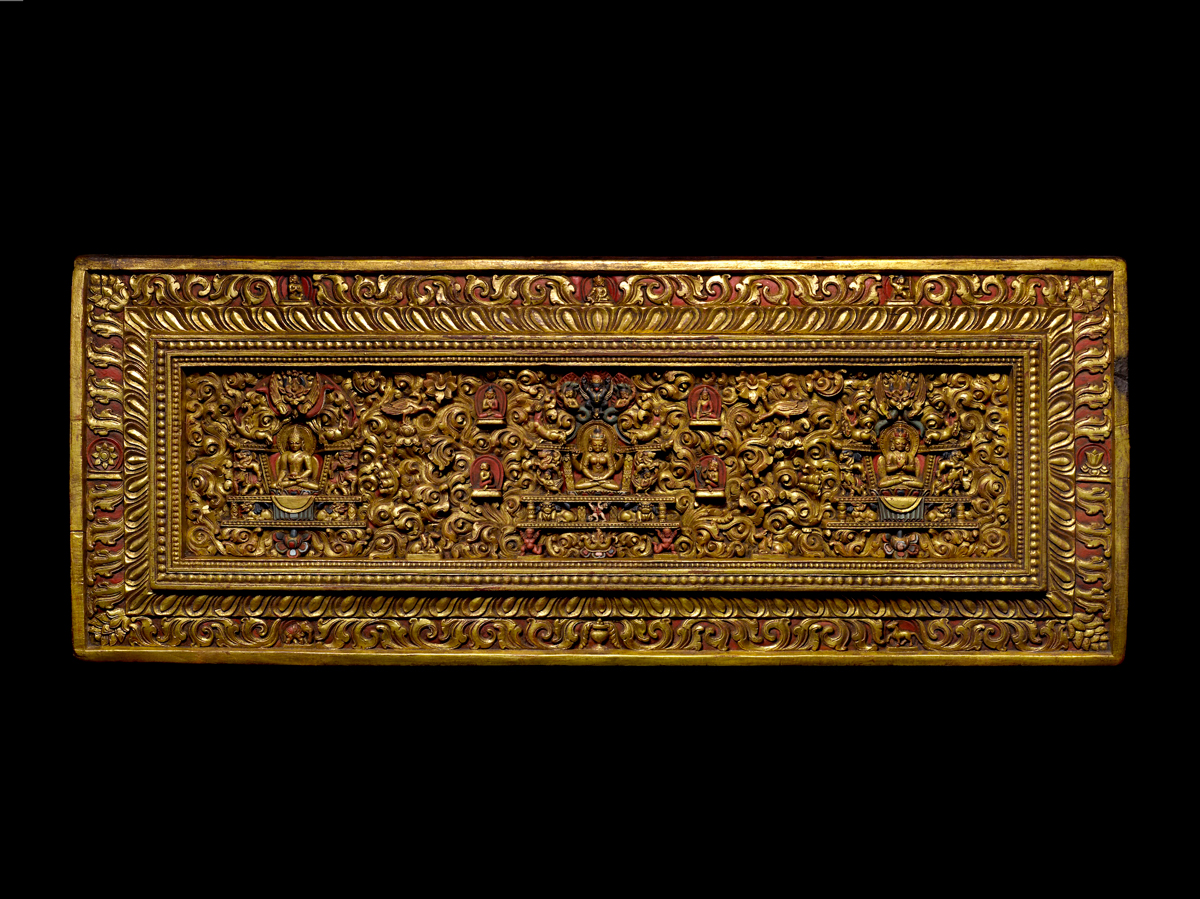
These six works illustrate that tradition through narratives spanning more than a millennium. The Buddha’s previous lives unfold in a Tibetan Jataka Tales painting, while a Pala stone stele presents scenes from his final earthly life. Hindu mythology comes to life in a dramatic page from the Bhagavata Purana, where the goddess Durga confronts the tyrant Kamsa, and the life of Padmasambhava is celebrated through a richly-illustrated visual biography. The life of the Tibetan king Tri Ralpachen reflects the vital role of royal patronage in establishing and strengthening Buddhism in Tibet, and a cover from a Prajnaparamita manuscript reminds us that these stories were not only depicted in works of art but also preserved in the sacred texts that carried Buddhist teachings across generations.
Together, they reveal the richness of narrative in the arts of India and the Himalayas, where stories were not merely told—they were carved, painted, and preserved.
Carlton Rochell established his gallery in New York in 2002 after a distinguished career at Sotheby’s. He has remained focused on the art of India, the Himalayas, and Southeast Asia and has staged many important exhibitions since opening his gallery. Holland Cotter of the New York Times in his review of the inaugural exhibition in 2002 wrote: “The arrival of a new, open-to-the public gallery devoted to Indian and Southeast Asian art is an event for the city; such showcases are few and far between.”
Carlton Rochell established the first full-time auctions in North America devoted to Indian and Southeast Asian in 1985, and he has handled many important objects from distinguished collections including: the Pan-Asian Collection, the Heeramaneck Collection, Carter Burden, Laurance Rockefeller, William S. Paley, the Ehrenfeld Collection, the Estate of William H. Wolff, the Estate of Richard B. Gump, and many others.
Since the establishment of Carlton Rochell Asian Art, the gallery has placed works of art privately with many important private collectors in the United States, Europe, Asia, and the Middle East, as well as to institutions such as: The Metropolitan Museum of Art, Museum of Fine Arts, Houston, Dallas Museum of Art, Los Angeles County Museum of Art, The Rubin Museum of Art, Ackland Art Museum, Virginia Museum of Fine Arts, Nelson-Atkins Museum of Art, Ashmolean Museum, Oxford, Museum Rietberg, Zurich, The David Collection, Copenhagen, and the Zhiguan Museum of Fine Art, Beijing.
Carlton Rochell has also exhibited in international art fairs such as Asia Week New York, Frieze Masters in London, Fine Art Asia in Hong Kong, The Winter Show in New York, and TEFAF Maastricht.
The gallery purchases art as well as accepting works on consignment and is pleased to offer advisory services to collectors. We also provide appraisal services for Fair Market, Insurance, and Charitable Gift purposes.