AUTUMN ASIA WEEK NEW YORK EXHIBITION

Tchah Sup Kim: The Key to a New World
September 17 – October 24, 2026
Tchah Sup Kim (1940–2022) was an artist whose lifelong practice explored fundamental questions of civilization, the universe, existence, and humanity. Moving beyond formal experimentation, his work sought new ways of seeing and understanding the world—often by challenging established boundaries between East and West, the individual and the cosmos, and the finite and the infinite.
Kim moved to New York in 1974 and studied printmaking at Pratt Institute, where he began developing a distinctive visual language. His landmark etching Triangle Between Infinites (1976), now in the collection of The Museum of Modern Art, New York, introduced the triangle as a central motif in his practice. Rather than treating it as a closed geometric form, Kim opened its vertex, transforming the triangle into a structure of openness, circulation, and connection.
Throughout the 1980s, his work reflected his experiences of migration, otherness, and diasporic identity in New York. After returning to Korea in 1990, his inquiry expanded toward broader questions of civilization, history, and the origins of humanity.
New York played a pivotal role in this artistic and intellectual journey. It was here that Kim encountered the center of Western modernism while also beginning to question its prevailing systems of thought. Presenting his work again in New York, The Key to a New World revisits that formative relationship and considers his practice through a contemporary lens. The exhibition title comes from a phrase found in one of Kim’s own notes. For him, a “new world” was not simply a vision of the future, but the possibility of thinking and seeing beyond existing frameworks.
Tchah Sup Kim received his BFA from Seoul National University in 1963. With a grant from John D. Rockefeller 3rd Fund Fellowship, he completed his MFA at the Pratt Institute in New York in 1977. Working primarily in paint and mixed media, Kim explores the principles of cosmos through nature and its phenomena. He raises questions regarding the universal truth that human beings have sought in and out of history. His artistic journey can be divided into three major periods: from 1965 to 1982, during his early years in Korea and New York, his work is characterized by a focus on geometry; from 1983 to 1993, during his New York period, he turns toward geopolitical and historical themes; and from 1993 to 2022, after leaving New York for the rural village of Naepyung-ri in Korea, and later alternating between the two locations, he focuses his work on geography and nature. Tchah Sup Kim’s artwork is currently housed in the collections of many renowned institutions, including the Museum of Modern Art (NY), the Metropolitan Museum of Art (NY), and the National Museum of Contemporary Art (Gwachun, Korea).
To learn more, click here.
ONGOING INSTALLATION
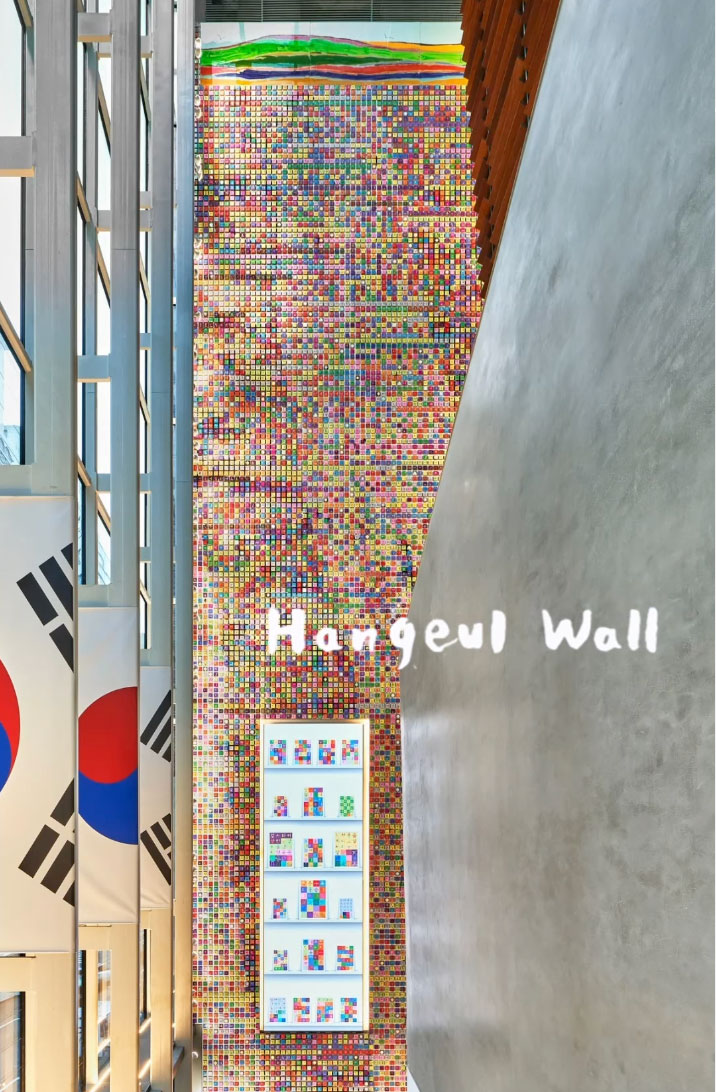
Ik-Joong Kang, Hangeul Wall: Things I Love to Talk About, 2024, 20,000 Hangeul tiles (mixed media on wood: 3×3 inches each), approximately 26 x 72 ft (8 x 22 meters)
Hangeul Wall: Things I Love to Talk About
Atrium
The Hangeul Wall, measuring 26 x 72 feet (8 x 22 meters) and composed of 20,000 Hangeul tiles, connects the wisdom and experiences of global citizens. Developed in collaboration with LG CNS, KCCNY launched a website in May 2024, enabling people worldwide to create their own artworks using the site’s translation and coloring functions under the theme “Things I Love to Talk About.” The website attracted over 8.2 million visits from more than 50 countries and received 7,000 artwork submissions within two months. From these, 1,000 pieces were selected through public online voting and artist review, culminating in this monumental installation.
The Hangeul Wall stands as a symbol of the rich cultural heritage of Hangeul and the universal freedom of expression, serving as a testament to our shared human narratives. Traditionally, walls are seen as barriers that divide and separate; however, the Hangeul Wall represents a different kind of structure—a wall of peace and unity. It transcends the conventional notion of separation to become a canvas of connection and harmony.
To learn more, click here.